


⏲️ Estimated reading time: 6 min
Table of Contents
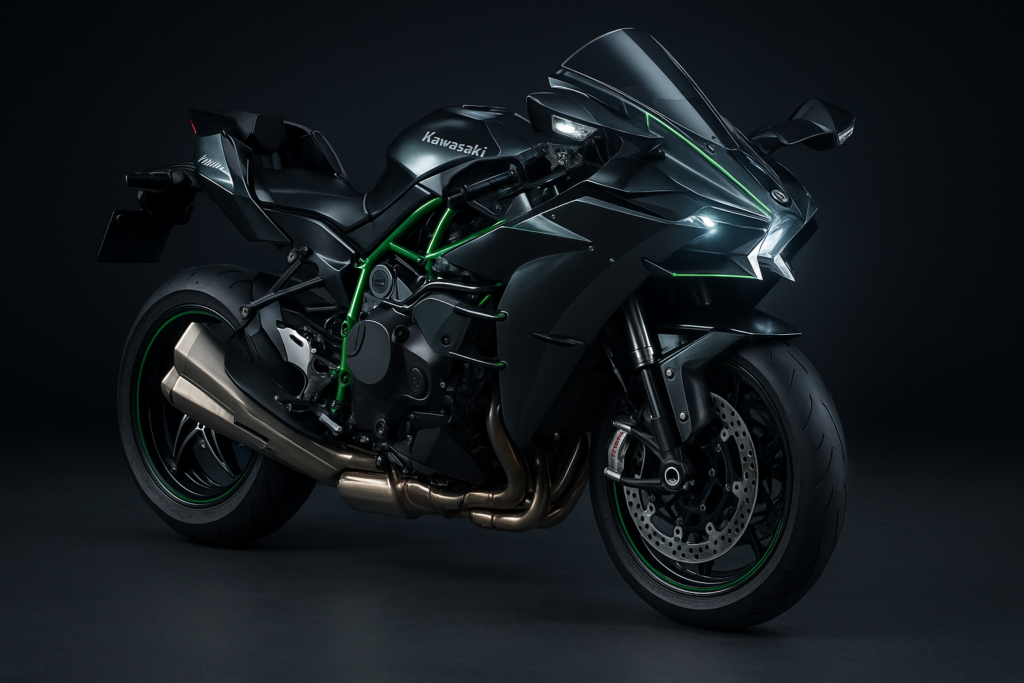
Kawasaki Ninja H2 Specs – The Supercharged Beast Explained. The Kawasaki Ninja H2 is not just another superbike it’s a revolution in motorcycle engineering. With a factory-fitted supercharger, breathtaking performance, and futuristic design, it redefines what a street-legal motorcycle can do. Let’s explore every detail of this legendary machine.
Why the Kawasaki Ninja H2 Stands Out
Read also: Michigan Family Tragedy: What Happened and What We Know So
The world of superbikes has always been about speed, innovation, and the pursuit of perfection. Yet, very few motorcycles have achieved the legendary status of the Kawasaki Ninja H2. Unlike most superbikes that rely on natural aspiration or turbo conversions, the Ninja H2 is the only production motorcycle equipped with a factory-built supercharger.
This makes it unique, powerful, and a technological masterpiece. Designed for riders who crave adrenaline, but also precision engineering, the Ninja H2 bridges the gap between racetrack DNA and road-going practicality.
But what makes the Kawasaki Ninja H2 so extraordinary? Let’s dive into its specs, features, and the reasons why it is regarded as one of the most powerful and fascinating motorcycles ever created.
Engine & Performance – Heart of the Beast
At the core of the Ninja H2 lies a 998 cc, inline-four, supercharged engine. This isn’t just an ordinary powerplant it’s the product of Kawasaki Heavy Industries’ aerospace division, utilizing advanced aerodynamics and turbine technology.
Technical Engine Specs
- Displacement: 998 cc
- Configuration: 4-stroke, inline-4, DOHC, 16-valve
- Supercharger: Centrifugal, planetary gear-driven
- Bore × Stroke: 76 × 55 mm
- Compression Ratio: 8.5:1
- Max Power: ~228 hp @ 11,500 rpm (with RAM air ~240 hp)
- Max Torque: ~141.7 Nm @ 11,000 rpm
- Fuel System: Digital Fuel Injection (DFI) with dual injectors per cylinder
- Transmission: 6-speed, dog-ring gearbox (inspired by MotoGP)
- Final Drive: Chain
What Makes the Engine Unique?
- Supercharger Technology – Unlike turbochargers, which depend on exhaust gases, the Ninja H2’s supercharger uses a planetary gear system to spin at up to 130,000 rpm, delivering instant power.
- Power Delivery – Smooth at low revs, explosive after 8,000 rpm.
- Dog-Ring Transmission – Provides lightning-fast gear shifts with minimal loss of power.
In practice, this means the Ninja H2 accelerates like no other street bike 0 to 100 km/h in just over 2.5 seconds.
Chassis & Suspension – Built for Precision
To handle its monstrous power, the Ninja H2 is built on a trellis frame, offering balance between strength and flexibility.
Chassis Breakdown
- Frame: Steel trellis with swingarm mounting plate
- Front Suspension: 43 mm KYB AOS-II fork, fully adjustable
- Rear Suspension: Öhlins TTX36 gas-charged shock, fully adjustable
- Front Brakes: Dual 330 mm Brembo semi-floating discs, Brembo Stylema calipers
- Rear Brake: Single 250 mm disc
- ABS: Kawasaki Intelligent Braking System (KIBS)
This combination ensures that despite its massive horsepower, the bike remains stable at high speeds and nimble in tight corners.
Dimensions & Ergonomics
The Ninja H2 is not a featherweight racer it’s designed for road dominance.
- Overall Length: 2,085 mm
- Width: 770 mm
- Height: 1,125 mm
- Seat Height: 825 mm
- Wheelbase: 1,450 mm
- Curb Weight: ~238 kg
Rider Experience
Unlike pure track machines, the H2 provides a relatively upright position compared to supersport models. It’s aggressive but not punishing, making it manageable for longer rides.
Electronics & Rider Aids
Kawasaki has equipped the Ninja H2 with a full suite of modern electronics to tame its power.
Key Features
- KTRC (Traction Control): Multiple levels of intervention for different riding styles.
- KLCM (Launch Control): For blistering starts without wheelspin.
- KQS (Quick Shifter): Smooth clutchless upshifts and downshifts.
- KCMF (Cornering Management): Assists stability when braking or accelerating in corners.
- KIBS (ABS): Intelligent anti-lock braking system.
- TFT Display: Full-color digital screen with Bluetooth smartphone connectivity.
- LED Lighting: Modern illumination with aerodynamic styling.
These technologies make the Ninja H2 surprisingly user-friendly despite its intimidating numbers.
Design & Aerodynamics
One of the first things you notice is its futuristic, angular design. Every line serves a purpose, from cooling ducts to aerodynamic stability.
- Mirror-finish paint: Self-healing top coat that repairs minor scratches.
- Winglets: Built into the fairing for downforce at high speeds.
- Aggressive stance: Unique among superbikes, making it instantly recognizable.
The Ninja H2 isn’t just a motorcycle it’s a work of art that looks like it came from the future.
Kawasaki Ninja H2 vs Ninja H2R – The Track Monster
While the Ninja H2 is street-legal, the Ninja H2R is an unrestricted track-only variant.
Key Differences
- Ninja H2 (Street Legal): ~228–240 hp, 238 kg, top speed ~337 km/h.
- Ninja H2R (Track Only): 326 hp (over 350 hp with RAM air), carbon fiber wings, lighter weight, top speed 400+ km/h.
The H2R is so extreme that it cannot be registered for public roads it’s a track-exclusive beast.
Ninja H2 vs Other Superbikes
When compared to rivals like the Suzuki Hayabusa or Ducati Panigale V4, the Ninja H2 doesn’t just compete it dominates in unique ways:
- Hayabusa: Known for top speed, but lacks forced induction.
- Panigale V4: Superb handling, but less raw acceleration.
- BMW S1000RR: Track weapon, but still underpowered compared to the H2.
The Ninja H2 is in a league of its own.
Real-World Riding Experience
Riding a Ninja H2 isn’t just about speed it’s about control, thrill, and prestige. Owners often describe:
- Addictive acceleration that pins you to the seat.
- Surprising comfort for a superbike.
- Attention everywhere – it turns heads like no other bike.
However, it’s not for beginners. The H2 demands respect, skill, and experience.
Ownership & Costs
The Ninja H2 is a premium motorcycle with premium costs.
- Price Range: ~$31,000–$35,000 (varies by country)
- Insurance: High due to power and rarity.
- Maintenance: Regular servicing + supercharger-specific checks.
- Fuel Efficiency: ~15–18 km/l, but most owners don’t care it’s about performance.
Owning one is less about practicality and more about passion.
The Legacy of the Kawasaki Ninja H2
Introduced in 2015, the Ninja H2 revived Kawasaki’s dominance in the hyperbike world. It represents:
- Cutting-edge aerospace engineering applied to motorcycles.
- A machine that pushes the boundaries of what’s possible on two wheels.
- A future-proof design that remains iconic a decade later.
Final Thoughts
The Kawasaki Ninja H2 is more than just a motorcycle it’s an engineering marvel, a rider’s dream, and a living legend. Its combination of raw power, futuristic design, and advanced technology ensures it will always be remembered as a game-changer in motorcycle history.
If you’re looking for the ultimate superbike experience and want to own a piece of engineering history, the Ninja H2 is unmatched.
🔔 For more tutorials like this, consider subscribing to our blog.
📩 Do you have questions or suggestions? Leave a comment or contact us!
🏷️ Tags: Kawasaki Ninja H2, Ninja H2R, Kawasaki superbike, supercharged motorcycle, fastest motorcycles, hyperbike, motorcycle specs, superbike comparison, Ninja H2 review, Kawasaki technology
📢 Hashtags: #KawasakiNinjaH2, #NinjaH2, #Superbike, #MotorcycleSpecs, #FastestBikes, #Hyperbike, #MotorcycleLife, #BikerCommunity, #Supercharged, #Kawasaki
