


⏲️ Estimated reading time: 7 min
Table of Contents
In 1959, Jacques Plante changed hockey forever. After a facial injury, he became the first NHL goalie to wear a mask in a regular-season game a revolutionary moment that redefined safety and the image of goaltending forever.
You may also be interested in: Taylor Swift Teases ‘Patient Zero’ Ahead of MTV VMAs
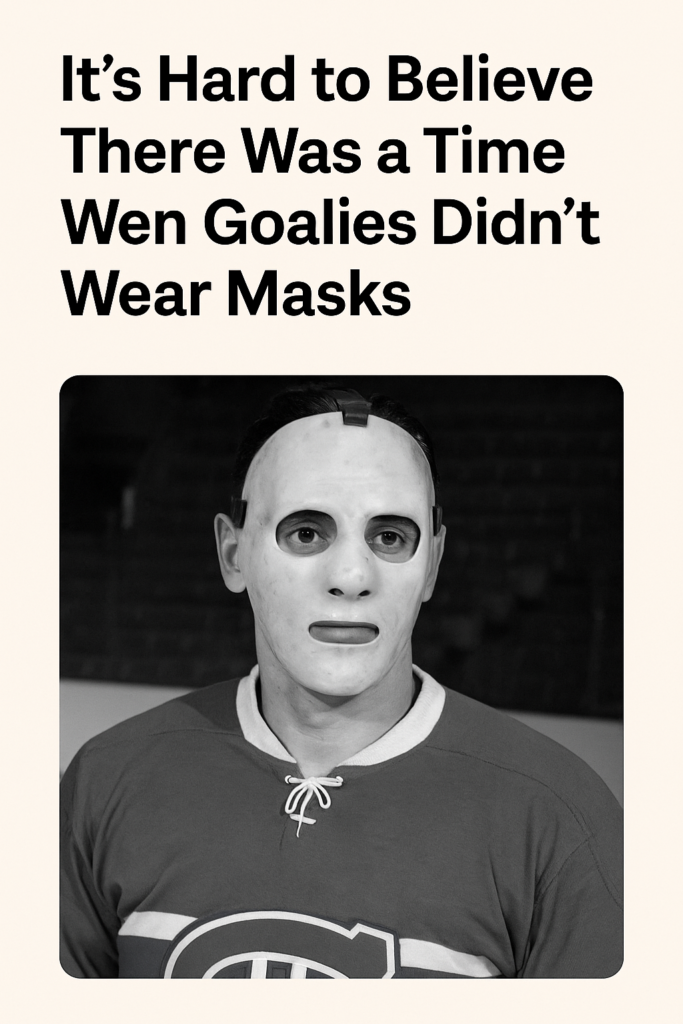
It’s Hard to Believe There Was a Time When Goalies Didn’t Wear Masks
In today’s fast-paced, high-intensity hockey, a goaltender without a mask seems unthinkable. The speed of the puck, the force of slapshots, and the chaos in front of the net make head protection an absolute necessity. Yet, not so long ago, NHL goalies faced blistering shots with nothing but courage and bare skin to protect them.
That all changed on November 1, 1959, when Jacques Plante, the brilliant goaltender of the Montreal Canadiens, made a decision that would transform the game forever.
The Moment That Changed Hockey Forever
It happened during a regular-season game against the New York Rangers. Early in the match, Plante took a hard shot directly to his face. The puck smashed into his nose, leaving him bleeding and shaken.
At that time, masks were frowned upon seen as a sign of weakness or a distraction. But Plante had already been using a homemade fiberglass mask during practice sessions. As he left the ice for stitches, he told coach Toe Blake that he would only return if he could wear it during play.
Blake reluctantly agreed. When Plante skated back onto the ice with the mask strapped on, fans gasped. It was a moment that would mark the dawn of a new era.
A Revolution in Goaltending
The Canadiens went on to win that game and several more in a row. The mask, once considered strange or unnecessary, quickly became Plante’s trademark.
Soon after, other goalies began experimenting with their own designs. Within a few years, masks became a common sight in the NHL.
Jacques Plante didn’t just protect his face that night he protected generations of goalies to come. His courage to break tradition and prioritize safety over convention changed the entire sport.
Before the Mask: The Dangers of the Position
Before Plante’s innovation, goaltenders regularly endured broken noses, shattered teeth, deep cuts, and concussions. Photos of legendary goalies from the 1940s and 1950s show faces crisscrossed with scars badges of honor in an era when toughness was everything.
Players like Terry Sawchuk famously bore the physical toll of years spent in the crease without protection. Sawchuk’s face, permanently marked by hundreds of stitches, symbolized both bravery and the brutal cost of tradition.
Plante’s decision marked the end of that dangerous chapter in hockey history.
The Evolution of the Goalie Mask
From Plante’s handmade fiberglass design to today’s carbon-fiber marvels, goalie masks have evolved into both essential safety gear and artistic canvases.
Modern goaltenders personalize their masks with custom graphics, team colors, and symbolic art turning protection into self-expression. But at their core, each mask still pays tribute to the man who started it all.
Legacy of Jacques Plante
Jacques Plante wasn’t just a pioneer in safety equipment; he was a technical innovator. He revolutionized the way goaltenders approached positioning, angles, and game awareness.
He introduced techniques that emphasized standing tall and anticipating shots rather than simply reacting. His analytical approach inspired future generations of goalies to think strategically, not just athletically.
Plante went on to win six Stanley Cups with Montreal and earned seven Vezina Trophies. His legacy extends far beyond his statistics he changed the very image of the goaltender, from fearless gladiator to intelligent, tactical athlete.
Breaking Stigma and Redefining Courage
When Jacques Plante first donned his mask, critics called him “soft.” Fans mocked him. Coaches worried it would block his vision.
But Plante proved that bravery isn’t about ignoring danger it’s about facing it wisely. His mask was not a sign of fear, but of intelligence and evolution.
By standing firm, he shattered one of the sport’s most dangerous traditions and paved the way for every goaltender after him to play another day.
How Hockey Changed Forever
Today, goaltending equipment is a science. Masks are tested for impact resistance, designed for comfort, and customized for performance. Players at every level from peewee to professional owe their safety to that single moment in 1959.
Every time a puck clangs off a mask or a goalie walks away uninjured from a slapshot, that’s Jacques Plante’s legacy in motion.
The Mask as a Symbol
Over time, the goalie mask became more than protection it became an identity. Each design tells a story: a fierce animal, a personal tribute, or a team emblem.
The mask has come to represent individuality, creativity, and the spirit of resilience. From Ken Dryden’s simplicity to Patrick Roy’s fierce artwork, every mask traces its lineage back to Plante’s bold move.
From Controversy to Standard
By the mid-1970s, every NHL goaltender wore a mask. The evolution continued with the introduction of the cage-mask hybrid and full fiberglass molds.
What began as an act of rebellion became an essential rule. Today, it’s impossible to imagine hockey without it and that’s exactly how Plante would have wanted it.
Remembering November 1, 1959
That date stands as one of hockey’s most important milestones. Not a record-breaking goal or a championship victory but a moment of quiet defiance that redefined safety and courage in sport.
When Jacques Plante stepped back onto the ice wearing that white fiberglass mask, he wasn’t just changing his own future he was changing the entire game.
Interesting Facts About Jacques Plante
- He personally designed and improved his masks throughout his career.
- Plante was known for teaching younger goalies and writing about his techniques.
- He was inducted into the Hockey Hall of Fame in 1978.
- His innovative mind also led him to experiment with defensive systems and training routines decades ahead of their time.
- The famous Plante mask is now displayed in museums and hockey halls worldwide.
Why Plante’s Courage Still Matters Today
Every sport evolves because someone dares to challenge the norm. Jacques Plante’s act wasn’t about rebellion it was about progress.
In a world where safety and innovation often meet resistance, his story remains a timeless reminder that one person’s bold decision can change history.
The next time you see a goalie’s mask decorated, polished, and iconic remember that it all began with one man refusing to let a broken nose end his game.
The Mask That Changed Everything
In an era when toughness was defined by scars, Jacques Plante redefined courage. His mask wasn’t just a piece of equipment it was a declaration of progress, intelligence, and resilience.
Hockey has never been the same since that November night in 1959.
The face of goaltending quite literally changed forever.
Frequently Asked Questions
1. Who was the first NHL goalie to wear a mask?
Jacques Plante of the Montreal Canadiens was the first to wear a mask during a regular-season game on November 1, 1959.
2. Why did Jacques Plante start wearing a mask?
After taking a puck to the face, Plante insisted on wearing his practice mask to protect himself from future injuries.
3. How did other players react at the time?
Many mocked or doubted him initially, but after Montreal’s winning streak, opinions quickly changed.
4. When did all NHL goalies start using masks?
By the mid-1970s, every NHL goalie wore a mask, making it a mandatory part of goaltending equipment.
5. What was Jacques Plante’s legacy?
Beyond the mask, Plante was a tactical innovator who revolutionized goaltending technique and safety in hockey.
🔔 For more tutorials like this, consider subscribing to our blog.
📩 Do you have questions or suggestions? Leave a comment or contact us!
🏷️ Tags: Jacques Plante, NHL history, goalie mask, hockey innovation, Montreal Canadiens, sports safety, 1959 hockey, ice hockey history, famous goalies, hockey evolution
📢 Hashtags: #JacquesPlante, #HockeyHistory, #NHL, #GoalieMask, #SportsSafety, #MontrealCanadiens, #IceHockey, #HockeyLegends, #SportsInnovation, #1959
