


⏲️ Estimated reading time: 8 min
Table of Contents
Phoenix A harbors the largest black hole ever discovered an ultramassive cosmic monster weighing about 100 billion times the mass of our Sun. Nicknamed the “Galaxy Eater,” this black hole is so immense that it could devour entire galaxies, reshaping our understanding of cosmic evolution. In this article, we will explore what makes Phoenix A unique, how astronomers discovered it, why ultramassive black holes are so rare, and what role they play in the grand architecture of the universe. From comparing Phoenix A with famous black holes like Sagittarius A* and M87*, to analyzing its influence on galaxy clusters, we’ll take you deep into the mysteries of the largest known abyss in space.
The Birth of a Cosmic Monster
Black holes have fascinated scientists, philosophers, and dreamers for decades. They represent both the destructive and creative aspects of the cosmos: regions where gravity crushes matter to an infinite density, yet where the very laws of physics help galaxies form, evolve, and shine.
Traditionally, astronomers classify black holes into three categories:
- Stellar-mass black holes – formed from collapsing stars, weighing up to tens of solar masses.
- Intermediate-mass black holes – rare, ranging from hundreds to thousands of solar masses.
- Supermassive black holes – sitting at the centers of galaxies, weighing millions to billions of Suns.
For many years, supermassive black holes were thought to be the limit of cosmic monsters. Then came evidence of something even larger ultramassive black holes, tipping the scales at tens to hundreds of billions of solar masses.
The largest known resides in the Phoenix A cluster, a sprawling collection of galaxies nearly 5.7 billion light-years away. At its center lies an abyss so immense, so unfathomably heavy, that astronomers nicknamed it the Galaxy Eater.
With a mass of about 100 billion Suns, it dwarfs every black hole ever discovered. If placed at the heart of our Solar System, its event horizon would extend well beyond Neptune’s orbit, engulfing every planet, asteroid, and comet with ease.
The discovery of Phoenix A’s central black hole challenges not only our sense of scale but also our understanding of cosmic evolution.
What is Phoenix A?
Phoenix A is not a single galaxy it is a galaxy cluster, one of the largest structures in the known universe. Galaxy clusters are gravitationally bound families of hundreds or even thousands of galaxies, embedded in vast reservoirs of dark matter and hot intergalactic gas.
At the heart of Phoenix A lies its Brightest Cluster Galaxy (BCG) the central giant around which the cluster is organized. It is inside this luminous behemoth that astronomers discovered signs of an ultramassive black hole.
The cluster itself is remarkable. Phoenix A shines brightly in X-rays, emitting more radiation than nearly any other known cluster. Its hot plasma glows at temperatures of tens of millions of degrees, revealing complex interactions between gravity, gas, and cosmic feedback.
But the true jewel of Phoenix A is its black hole so large that it redefines our very vocabulary of astrophysics.
How Does Phoenix A Compare to Other Famous Black Holes?
To appreciate Phoenix A’s uniqueness, let’s compare it to other well-known black holes:
- Sagittarius A* (Milky Way’s black hole): ~4.3 million solar masses.
- M87* (in galaxy Messier 87, imaged by the Event Horizon Telescope): ~6.5 billion solar masses.
- TON 618 (a quasar black hole): ~66 billion solar masses.
- Phoenix A Black Hole: ~100 billion solar masses.
The scale is staggering. Phoenix A outweighs Sagittarius A* by more than 20,000 times and surpasses TON 618, once thought to be the heaviest known, by a wide margin.
If we attempted to imagine Phoenix A consuming galaxies, the Milky Way itself would look like a snack compared to its appetite.
Why Is It Called the “Galaxy Eater”?
The nickname isn’t just poetic it reflects its true destructive potential. Phoenix A earns the title Galaxy Eater for three reasons:
- Sheer Mass – At 100 billion solar masses, it could tear apart entire galaxies through tidal forces.
- Feeding Power – Black holes grow by pulling in matter from their surroundings. At this scale, Phoenix A can siphon gas, stars, and even dwarf galaxies from tens of thousands of light-years away.
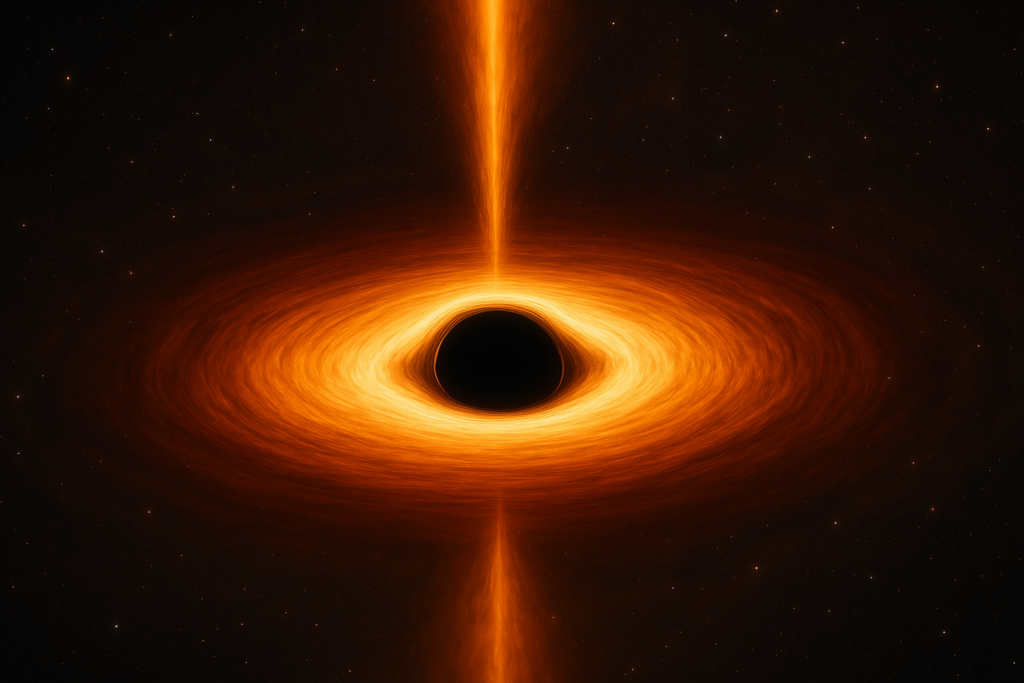
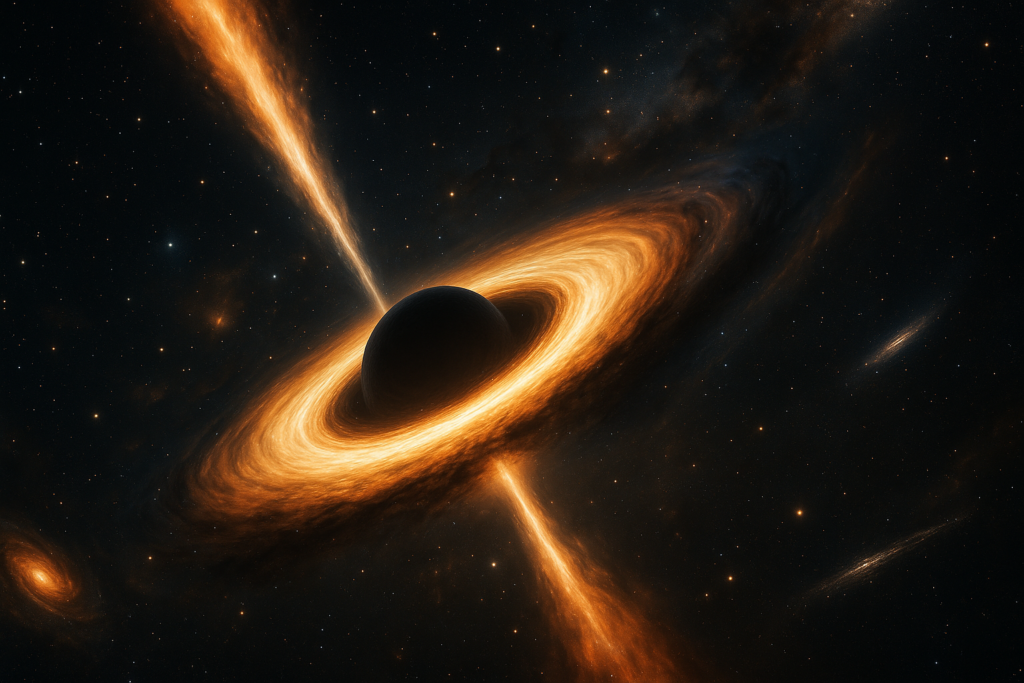
- Feedback Energy – When matter spirals into the black hole’s accretion disk, it releases enormous energy, producing jets and radiation powerful enough to strip galaxies of their ability to form new stars.
For any unlucky galaxy wandering too close, Phoenix A is nothing less than a cosmic predator.
How Was Phoenix A Discovered?
Phoenix A’s ultramassive black hole was uncovered through the combined efforts of multi-wavelength astronomy:
- X-ray Observations – NASA’s Chandra X-ray Observatory revealed extraordinary emissions from the cluster’s core, hinting at extreme gravitational processes.
- Radio Telescopes – Instruments detected giant jets blasting away from the central black hole, carving enormous cavities into surrounding plasma.
- Optical Telescopes – Measurements of stellar motion confirmed an invisible mass so immense that only a black hole could explain it.
In 2023, refined data confirmed what astronomers suspected: Phoenix A hosts a black hole weighing about 100 billion Suns the heaviest ever detected.
The Role of Ultramassive Black Holes in Cosmic Evolution
Black holes are not passive monsters; they shape the very structure of the universe. Phoenix A’s black hole is a perfect case study in cosmic feedback.
Read also: Steve Jobs – 71 Years Since the Birth of a Visionary
- Regulating Star Formation – The black hole’s energy output prevents intergalactic gas from cooling, suppressing the birth of new stars.
- Heating the Cluster Medium – By injecting energy into the plasma, it ensures the cluster doesn’t collapse under its own weight.
- Driving Galaxy Evolution – Nearby galaxies experience turbulence, shocks, and stripped gas due to its influence.
Without such feedback, galaxy clusters might evolve into chaotic, unstable environments. Phoenix A demonstrates that black holes are not just destroyers they are also cosmic architects.
Could a Black Hole Like Phoenix A Threaten the Universe?
At first glance, the term “Galaxy Eater” sounds like an existential threat. But black holes don’t move around hunting prey; they influence only the matter within their gravitational reach.
Phoenix A is 5.7 billion light-years away. At that distance, it poses absolutely no danger to Earth or our galaxy.
However, hypothetically, if such a black hole existed inside the Milky Way, the long-term result would be catastrophic. Over billions of years, it would consume much of our galaxy, erasing everything familiar.
Fortunately, ultramassive black holes are extremely rare, and Phoenix A’s safe distance means we can admire it without fear.
Scientific Mysteries and Future Research
Phoenix A opens the door to profound questions:
- How do black holes grow to such colossal sizes?
- Did Phoenix A form through the merger of multiple smaller black holes, or was it born ultramassive?
- Is there a maximum possible black hole mass, or could there be giants even larger?
Future instruments will help. The James Webb Space Telescope is already studying distant galaxies and quasars, while upcoming observatories like the Extremely Large Telescope (ELT) and Square Kilometre Array (SKA) promise insights into black hole formation.
Phoenix A might be the key to understanding the limits of cosmic growth.
Philosophical Reflections: Humanity and the Galaxy Eater
Black holes like Phoenix A inspire awe and humility. They remind us how small and fragile our existence truly is. A single cosmic object can outweigh billions of stars, dwarfing human history into insignificance.
Yet, the fact that we can discover, measure, and understand such a phenomenon is proof of humanity’s resilience and brilliance.
In many ways, the Galaxy Eater is a mirror: it shows us the darkness and power of the cosmos, but also reflects our unyielding quest for knowledge.
Standing under the night sky, knowing that such a monster exists, we are both terrified and inspired.
Phoenix A – Galaxy Eater
Phoenix A is more than a record-breaking discovery it’s a cosmic revelation.
At 100 billion solar masses, it challenges our models of black hole formation and forces scientists to rethink the limits of the universe. It shapes galaxies, regulates star formation, and embodies the delicate balance between destruction and creation.
Nicknamed the Galaxy Eater, Phoenix A is not just the largest black hole we know of it is a symbol of the universe’s grandeur and humanity’s endless curiosity.
And while it lies billions of light-years away, its discovery lights a fire in our imagination, urging us to look further, dream bigger, and embrace the mysteries of the cosmos.
🔔 For more tutorials like this, consider subscribing to our blog.
📩 Do you have questions or suggestions? Leave a comment or contact us!
🏷️ Tags: Phoenix A, ultramassive black hole, galaxy eater, astronomy, astrophysics, universe mysteries, galaxy clusters, largest black hole, space science, cosmic evolution
📢 Hashtags: #BlackHole, #PhoenixA, #GalaxyEater, #SpaceMysteries, #Astronomy, #Astrophysics, #Cosmos, #Universe, #GalaxyClusters, #SpaceExploration
