

⏲️ Estimated reading time: 11 min
Table of Contents
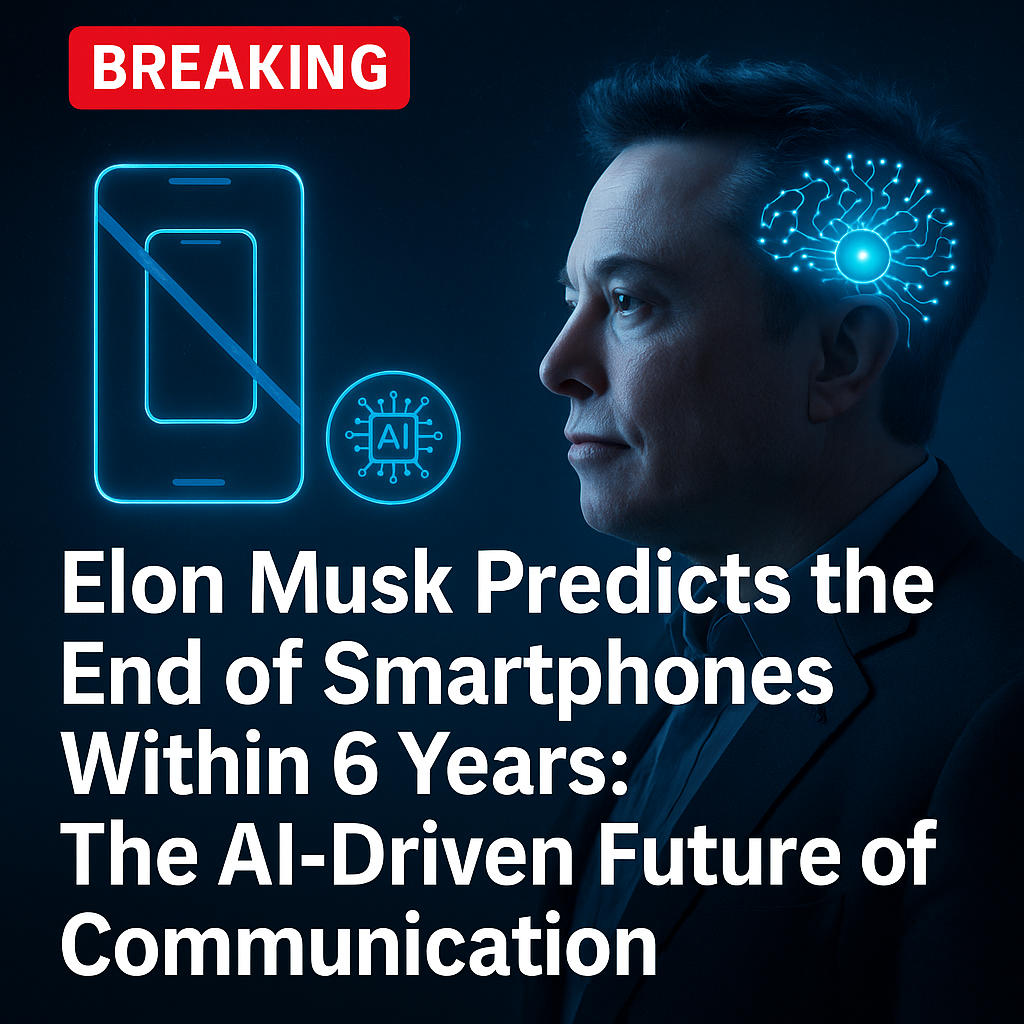
Elon Musk Predicts the End of Smartphones Within 6 Years: The AI-Driven Future of Communication
Elon Musk believes traditional smartphones and apps will soon vanish, replaced by brain-computer technology and AI-generated content. This bold prediction hints at a revolutionary shift in how humans communicate, consume information, and interact with technology by 2030.
The Future According to Elon Musk
Elon Musk, the billionaire innovator behind Tesla, SpaceX, and Neuralink, has once again made headlines with a bold prediction about the future of communication and technology.
According to Musk, within the next five to six years, the devices we now rely on smartphones, apps, and operating systems may no longer exist in their current form.
While this may sound futuristic, Musk’s vision aligns with the rapid progress being made in brain–computer interfaces and artificial intelligence. His company Neuralink is already testing technology that connects the human brain directly to computers, bypassing traditional screens and touch interfaces.
Let’s explore what this prediction could mean for our future and whether it’s as close as Musk believes.
From Smartphones to Neuralink: A Radical Shift
The smartphone has been humanity’s most transformative invention of the 21st century. It replaced dozens of tools camera, GPS, calculator, map, radio, and even personal computers.
Yet, Musk believes this era is nearing its end.
In several interviews and social-media posts, Musk has hinted that brain–computer interfaces (BCIs) will soon replace physical devices. His famous statement, “In the future, there will be no phones, just Neuralinks,” summarizes his belief that people will communicate and access digital information directly through thought.
This statement wasn’t just a metaphor it reflects a growing scientific trend. Neuralink’s prototype devices already allow users to control a cursor or robotic arm using only brain signals.
Imagine a world where you no longer need to pick up your phone, type, or even speak to send a message. You would simply think it.
How Neuralink Works: The Basics
Neuralink’s brain chip is a tiny device implanted in the skull, equipped with electrodes thinner than a strand of hair. These electrodes read brain signals and translate them into digital commands.
This allows direct interaction between the brain and external devices, bypassing the need for a keyboard, touchscreen, or mouse. In essence, it’s the ultimate wireless connection your brain as the controller.
Musk’s long-term goal is not just to restore lost motor or sensory functions for people with disabilities but to augment human intelligence. By linking human minds with AI, Neuralink aims to create a symbiotic relationship where humans and machines evolve together.
The Decline of Conventional Devices
If Neuralink and similar technologies become widely available by the 2030s, traditional smartphones may become obsolete.
Musk suggests that in such a world, people would no longer depend on apps or operating systems as we know them. Instead, the interface would exist in the mind.
Imagine thinking “open maps,” and instantly seeing your route in your mind’s eye. Or listening to a song without earbuds just mental playback from your memory, powered by AI data streams.
While this may sound like science fiction, similar leaps once did too. Twenty years ago, few believed everyone would carry pocket computers capable of instant global video calls.
If Neuralink succeeds, the next revolution could be mental rather than mechanical.
AI’s Role in the New Era
Musk also warned that most of the content people consume will soon be AI-generated.
This doesn’t mean humans will stop creating, but AI will handle much of the production from news articles and marketing to videos, music, and even digital relationships.
We already see this shift:
- AI models write code and compose music.
- Tools like ChatGPT and Midjourney generate human-like content in seconds.
- Social media feeds are increasingly curated and generated by algorithms.
By 2030, the majority of online interactions could be between humans and AI agents, not humans with other humans. Neuralink’s system would merge these realities allowing direct mental interaction with digital entities.
Challenges Ahead
Despite the excitement, there are significant challenges technical, ethical, and psychological.
- Safety: Implanting devices in the human brain carries health risks. Even minor infections could have severe consequences.
- Privacy: If a device can read your thoughts, who owns that data? Protecting mental privacy could become the most crucial human right of the future.
- Inequality: Initially, such technology will be expensive. It could create a divide between “enhanced” and “non-enhanced” humans.
- Dependence: Just as we became addicted to smartphones, mental integration with AI could lead to loss of autonomy.
Still, history shows that every great innovation from electricity to the internet faced skepticism before transforming society.
How Realistic Is Musk’s Timeline?
The claim of “5–6 years” is ambitious. Experts in neuroscience and computer engineering argue that mass adoption of brain–computer interfaces will take longer, possibly decades.
However, Musk has a history of pushing timelines aggressively and sometimes, reality catches up faster than expected.
Tesla was once doubted for its electric-car goals; today, it dominates global EV markets.
SpaceX was ridiculed for its Mars ambitions; now it’s a NASA partner.
So while six years might sound short, the trajectory of innovation could make Neuralink prototypes functional for early adopters by 2030.
Could This Be the End of Apps and Operating Systems?
If Neuralink allows direct brain-to-AI communication, the concept of “apps” might dissolve. Instead of downloading an app, users could think of a task and let the AI perform it.
The AI would become the universal operating system contextual, adaptive, and omnipresent.
There would be no “iOS” or “Android,” just your mind interacting seamlessly with the cloud.
This transition could also redefine the tech industry. Companies that depend on app stores or hardware sales would face extinction or complete reinvention. Developers might design neuro-programs instead of apps mental interfaces that interact with thought rather than touch.
The AI-Generated Content Revolution
Already, AI is transforming how we produce and consume media. By 2030, it could dominate every form of content.
Imagine reading an article written in your personal style, or watching a movie that changes its ending based on your emotions.
AI-driven personalization could blur the line between creator and consumer.
This shift will raise questions about authenticity, creativity, and copyright but it will also unleash new forms of entertainment and learning.
Musk’s prediction of AI-generated content dominating the web aligns with the direction in which technology is heading regardless of whether Neuralink achieves full integration by 2030.
What Happens to Social Media?
Social media could evolve into neural media a digital layer that integrates directly into human perception. Instead of scrolling, you might visualize memories, experiences, or virtual conversations in your mind.
Platforms like X (formerly Twitter), which Musk owns, might become early adopters of brain–based communication. Users could send thoughts, emotions, or even sensations instantly to others.
However, this level of connectivity would redefine privacy, consent, and information overload.
Society would need new ethical frameworks to handle such unprecedented intimacy.
The Psychological Impact
Humanity’s relationship with technology has always been double-edged. We gain convenience but lose patience; we gain connection but lose attention.
If Neuralink succeeds, the challenge will be preserving humanity in the digital age.
Instant mental communication may weaken face-to-face empathy, while full AI immersion could distort reality perception. The brain might struggle to distinguish between genuine memory and simulated experience.
Experts suggest gradual adaptation starting with medical applications, then communication tools, before full-scale integration.
Economic Implications
If physical devices disappear, trillion-dollar industries will collapse or transform:
- Smartphone manufacturers could pivot to neural hardware.
- App developers might become cognitive interface designers.
- Telecom companies would evolve into neural network providers.
- Ad industries would target your thoughts instead of clicks.
Meanwhile, AI-generated content would redefine creative professions, blurring lines between artist, writer, and machine.
New careers could emerge: “neuro-narrative designer,” “thought security specialist,” and “digital ethics consultant.”
Elon Musk’s Vision Beyond Smartphones
For Musk, Neuralink is not just about convenience it’s about survival.
He warns that artificial intelligence could surpass human intelligence and render humans obsolete. Neuralink, in his view, could serve as humanity’s “digital lifeline,” merging biological and machine intelligence to stay relevant.
By integrating with AI, humans wouldn’t compete with machines; they’d evolve alongside them.
This philosophy echoes Musk’s larger mission across his companies: making humanity multi-planetary (SpaceX), sustainable (Tesla), and now, mentally integrated (Neuralink).
Critics and Skeptics
Not everyone shares Musk’s optimism. Neuroscientists caution that human cognition is too complex for such seamless fusion.
Ethicists warn that once big tech companies can access brain data, manipulation could reach dystopian levels.
Others simply doubt the timeline. Neural prosthetics are still experimental, and mainstream adoption could take decades.
Still, Musk’s track record forces even skeptics to pay attention. His predictions often accelerate innovation even when they sound impossible at first.
Is This the Dawn of Post-Smartphone Civilization?
If Musk is right, the 2030s may mark the beginning of a post-device civilization.
Humans could interact with data, memories, and one another directly through thought.
Physical screens, keyboards, and icons might become as obsolete as floppy disks.
AI would act as an invisible companion reading, predicting, and fulfilling our mental commands before we articulate them.
This would redefine education, work, and creativity. A student could learn quantum physics by instantly downloading knowledge into memory. An artist could paint using imagination alone. A scientist could share live sensory experiences with a colleague across the globe.
The Ethical Horizon
As Neuralink and AI merge, the world will face unprecedented moral questions:
- Should thoughts be private property?
- Can governments regulate brain data?
- What happens if AI accesses emotions or memories?
- Could “mind hacking” become the next cybercrime?
Society will need new digital-rights laws to protect mental autonomy. Just as the 2010s focused on data privacy, the 2030s may focus on thought privacy.
A Balanced Perspective
Elon Musk’s prediction captures humanity’s relentless drive for innovation but also our anxiety about losing control to machines.
Whether or not Neuralink replaces smartphones in six years, one thing is certain: the line between human and machine is fading fast.
The future will not belong to those who resist technology, but to those who understand and guide it responsibly.
FAQ Section
See also: Playmate Desireé Reveals How a Man Can Win Her Heart
Q1: Did Elon Musk really say there will be no phones in the future?
Yes. Musk posted that “In the future, there will be no phones, just Neuralinks,” referring to his brain-computer interface project.
Q2: Is the 5–6 year timeline accurate?
Not exactly. That timeframe appears to be speculative; Musk hasn’t provided an official deadline for phone obsolescence.
Q3: What is Neuralink’s goal?
Neuralink aims to connect the human brain directly to computers, enabling thought-based control and potentially merging humans with AI.
Q4: Will apps and operating systems really disappear?
If brain interfaces become standard, traditional apps may be replaced by direct AI functions though complete elimination is uncertain.
Q5: Is this technology safe?
Neural implants come with surgical and ethical risks, including infection, data privacy issues, and potential misuse.
The End of Phones as We Know Them
Elon Musk’s vision of a world without smartphones might sound radical, but so did the internet thirty years ago.
If Neuralink achieves what he imagines, communication will shift from physical to mental, from typing to thinking, from screens to pure imagination.
The next revolution may not be in your hand it might be in your head.
🟦 Disclaimer and Source Hygiene
Disclaimer:
This article offers general information based on currently available data, expert analysis, and public statements. It should not be considered financial advice, scientific guidance, health instruction, or a guaranteed prediction. All opinions, interpretations, and projections are speculative and may evolve as technology, research, and empirical evidence progress.
The content is created for educational and informational purposes. Readers should use independent judgment and consult qualified professionals when making decisions related to health, technology adoption, financial choices, or ethical considerations.
Source Hygiene:
To ensure accuracy and integrity, this article uses only credible, publicly accessible sources such as:
- Official company announcements (e.g., Neuralink, Tesla, SpaceX)
- Verified interviews and statements from Elon Musk
- Reputable news outlets and investigative journalists
- Peer-reviewed scientific publications and research findings
- Governmental or institutional data when relevant
- Industry-standard analytics and technological reports
All material is reviewed for consistency and factual alignment. When conflicting information exists, the most authoritative and transparent source is prioritized. Readers are encouraged to consult primary sources directly, as ongoing scientific and technological developments may update or improve the information presented here.
🔔 For more tutorials like this, consider subscribing to our blog.
📩 Do you have questions or suggestions? Leave a comment or contact us!
🏷️ Tags: Elon Musk, Neuralink, AI future, smartphone evolution, brain interface, artificial intelligence, technology trends, post-smartphone era, human-AI merge, digital ethics
📢 Hashtags: #ElonMusk, #Neuralink, #AI, #Technology, #FutureTech, #Smartphones, #ArtificialIntelligence, #Innovation, #BrainInterface, #DigitalFuture
