


⏲️ Estimated reading time: 11 min
Table of Contents
🧿 Demodex Mites: The Tiny Creatures Living on Your Skin Explained. Demodex mites are microscopic creatures that naturally live on human skin, especially around hair follicles. Discover what they are, how they affect your health, when they cause problems, and what you can do to keep your skin balanced and healthy.
Read also: João Ferreira da Silva: The Controversial Case That Ended
Demodex Mites: The Tiny Creatures Living on Your Skin Explained
Most people are shocked to discover that their skin is home to countless microscopic creatures.
Among the most fascinating and sometimes unsettling are Demodex mites.
These mites live inside your hair follicles and sebaceous glands, quietly feeding on oils and dead skin cells.
While the idea might make you cringe, don’t panic.
Demodex mites are a natural part of the human microbiome the ecosystem of microscopic organisms that coexist with us.
In this comprehensive guide, you’ll learn what Demodex mites are, how they live, when they become a problem, and how to manage them safely.
Let’s zoom in (literally) to meet your smallest roommates.
The Hidden World on Your Skin
Your skin isn’t just a protective barrier it’s a living ecosystem.
Thousands of species of bacteria, fungi, and microscopic animals inhabit its surface.
Among these organisms, Demodex mites stand out because they’re not single-celled like bacteria they’re tiny arachnids, related to spiders and ticks.
There are two main species that inhabit human skin:
- Demodex folliculorum – Found primarily in hair follicles, especially on the face (nose, cheeks, forehead, and chin).
- Demodex brevis – Lives deeper, inside sebaceous glands that produce skin oils.
Each species has adapted perfectly to its microenvironment, forming a unique relationship with your skin.
The Anatomy of a Microscopic Parasite
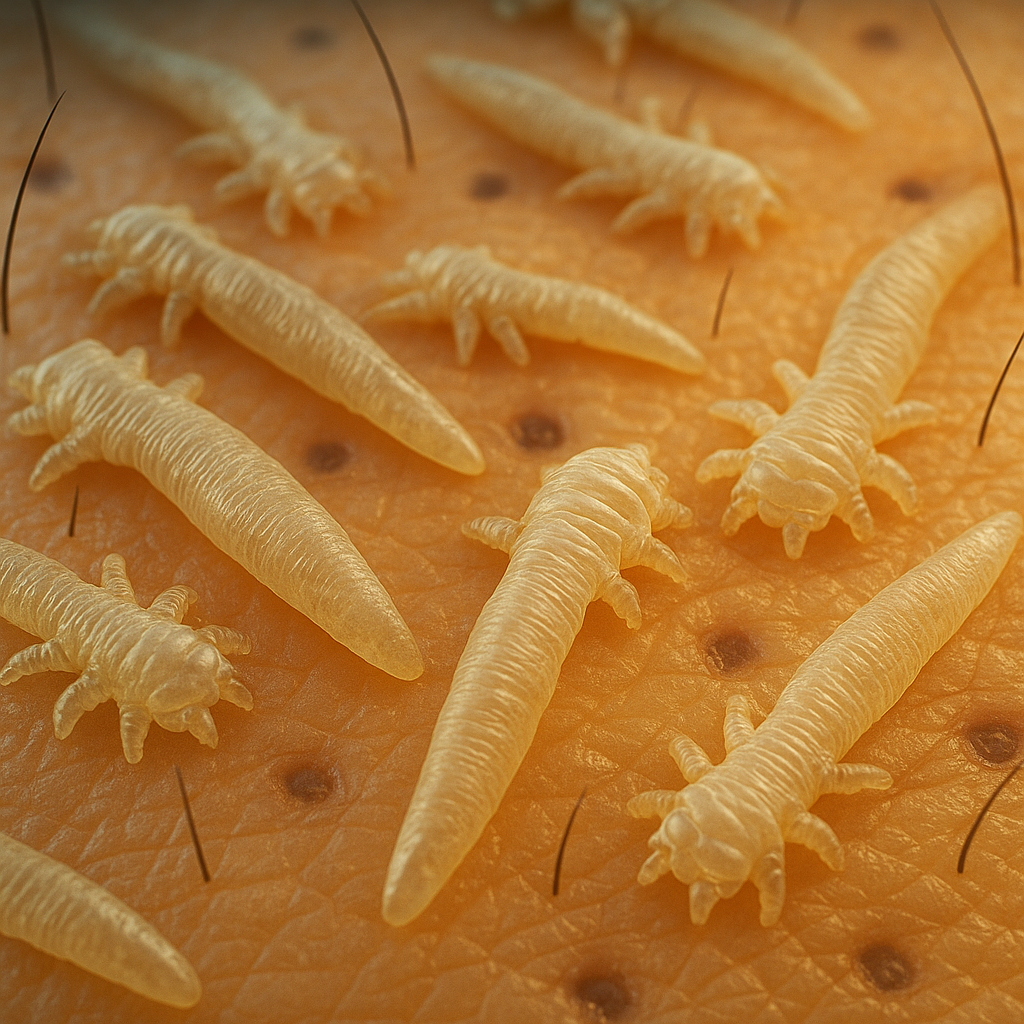
Under a microscope, Demodex mites look like transparent worms with stubby legs.
They measure about 0.3 to 0.4 millimeters, making them invisible to the naked eye.
Their bodies have three parts:
- A mouthpart that helps them consume sebum (oil) and dead skin cells.
- A thorax with eight tiny legs used to crawl around your skin at night.
- A long abdomen, where they store food and, eventually, eggs.
Despite their alien-like appearance, Demodex mites have no anus meaning waste builds up inside them until they die.
When their bodies decompose, the stored waste releases onto your skin’s surface.
It sounds gross, but in normal amounts, it doesn’t cause harm.
Where Do Demodex Mites Live?
You’ll mostly find Demodex mites in oily areas the face, scalp, chest, and sometimes ears.
They prefer warm, moist environments and hide deep in hair follicles or oil glands during the day.
At night, these mites crawl out to mate on the surface of your skin.
Their slow movements go unnoticed by us, but under a microscope, it looks like a nighttime parade.
After mating, the female returns to the follicle to lay eggs, and within a few days, the cycle continues.
In short: they live, feed, reproduce, and die all without us ever noticing.
How Many Do You Have?
Nearly every adult human hosts Demodex mites.
Research shows that by age 60, 100% of people carry them in some quantity.
Newborns are mite-free at birth, but they often acquire them soon after through skin-to-skin contact usually from their mothers.
The typical person may have a few dozen mites per square centimeter, while others especially those with oily skin or weakened immune systems may carry hundreds or thousands.
The Role of Demodex in Healthy Skin
Surprisingly, Demodex mites aren’t purely harmful.
They play a small but important role in your skin’s ecosystem.
Here’s how:
- They clean up dead skin cells, preventing pore blockages.
- They consume excess oil, helping balance sebum production.
- They may compete with harmful bacteria, reducing infection risk.
So, in moderate numbers, they can actually help maintain skin homeostasis.
The problem arises when their population explodes beyond control.
When Demodex Mites Cause Problems
Too many mites in one area can trigger inflammation and irritation.
This condition is known as demodicosis.
Common Symptoms:
- Persistent redness or irritation
- Burning or itching, especially around the eyes or face
- Scaly, rough patches of skin
- Small bumps resembling acne
- Hair loss (in severe cases, like eyelash or eyebrow loss)
Commonly Affected Areas:
- Eyelids and eyelashes (Demodex blepharitis)
- Cheeks, nose, and forehead (Demodex rosacea)
- Scalp and hairline
An overgrowth may be mistaken for acne, eczema, or rosacea, leading to incorrect treatments.
Therefore, identifying the cause is crucial.
The Connection Between Demodex and Rosacea
Researchers have found that people with rosacea often have a higher density of Demodex mites on their skin.
While mites don’t directly cause rosacea, they may worsen inflammation.
Here’s the suspected process:
- The mites overpopulate the skin.
- When they die, bacteria inside their bodies are released.
- The immune system reacts strongly to these bacteria.
- This leads to redness, swelling, and irritation typical of rosacea.
In other words, the mites act as triggers, not the root cause.
Controlling their numbers can help manage rosacea symptoms.
What Causes Demodex Overgrowth?
Demodex populations naturally fluctuate, but certain factors can tip the balance.
1. Oily Skin and Poor Hygiene
Sebum (skin oil) is their food. When there’s plenty available especially if skin isn’t regularly cleansed mites thrive.
2. Weakened Immune System
People with immune disorders, chronic illness, or high stress levels may be more prone to infestations.
3. Age and Hormones
Adults produce more sebum than children. That’s why Demodex overgrowth is rare in kids but common in adults, especially after puberty.
4. Skin Conditions or Medications
Corticosteroids and certain topical creams can weaken skin defenses, giving mites an opportunity to multiply.
5. Close Contact
Demodex mites can spread through direct skin contact or shared items like towels and bedding.
Diagnosis: How Doctors Identify Demodex Infestations
If you suspect you have too many mites, dermatologists can confirm it using several methods:
- Skin scraping – A small amount of skin is scraped and examined under a microscope.
- Eyelash sampling – In suspected eye infestations, a few lashes are plucked to check for mites.
- Adhesive tape test – Transparent tape is applied to skin, removed, and analyzed.
Finding several mites per follicle or gland usually confirms Demodex overpopulation.
Treatment Options: Getting Rid of Demodex Mites
Treating Demodex overgrowth involves reducing mite numbers and restoring healthy skin balance.
You can achieve this through a combination of professional treatments and at-home care.
1. Medical Treatments
Dermatologists often prescribe:
- Topical metronidazole or ivermectin (anti-parasitic creams)
- Sulfur-based cleansers
- Tea tree oil (low concentration) treatments
- Oral ivermectin (for severe infestations)
These medications kill mites and reduce inflammation.
Consistency is crucial because mites reproduce every 14–18 days.
2. Natural Remedies
Several natural substances may help control mite populations:
- Tea tree oil (diluted to 5%)
- Aloe vera gel
- Neem oil
- Apple cider vinegar (diluted)
- Green tea extract
Use them cautiously; some can irritate sensitive skin.
3. Hygiene and Lifestyle Changes
To prevent reinfestation:
- Wash your face twice daily with a gentle cleanser.
- Change pillowcases and sheets frequently.
- Avoid sharing towels or makeup.
- Disinfect makeup brushes regularly.
- Maintain a balanced diet to support skin immunity.
Are Demodex Mites Contagious?
Technically, yes but not in a dangerous way.
Demodex mites can transfer through direct contact, such as kissing or sharing personal items.
However, since they already live on almost everyone’s skin, “catching” Demodex from someone doesn’t usually cause problems.
Only when conditions favor rapid growth like oily skin, stress, or immune imbalance do they cause visible symptoms.
Demodex in Pets vs Humans
Dogs, cats, and other mammals have their own species of Demodex.
For example:
- Demodex canis affects dogs
- Demodex cati affects cats
These species are host-specific, meaning dog mites won’t survive long on human skin.
However, pets with mange (a severe Demodex infection) should still be treated and kept clean to avoid irritation or contamination.
The Nightlife of Demodex Mites
One of the strangest facts about these creatures is that they’re nocturnal.
They emerge from follicles at night to find mates and crawl across your skin at about 8–10 mm per hour.
Once mating is complete, females return to lay eggs inside follicles.
Each female lays up to 20 eggs, which hatch in 3–4 days.
Within a week, they reach adulthood, starting the cycle all over again.
Their lifespan is only two to three weeks, but the population remains stable because reproduction is constant.
Can You See Demodex Mites?
Not without a microscope.
They’re too small to be seen directly.
If you ever feel something crawling on your face it’s almost certainly not the mites.
They move too slowly for us to notice.
However, researchers can visualize them clearly using advanced imaging techniques, revealing entire colonies nestled inside hair follicles like microscopic families.
Myths and Misconceptions About Demodex
Let’s clear up some confusion:
Myth 1: They’re always harmful.
→ False. In normal numbers, they’re harmless or even helpful.
Myth 2: Only dirty people have them.
→ False. Clean or not, nearly everyone carries Demodex mites.
Myth 3: You can completely get rid of them.
→ False. You can reduce their numbers, but total eradication is impossible and unnecessary.
Myth 4: They crawl all over your body constantly.
→ Mostly false. They stay near follicles and oil glands and move only short distances.
Preventing Demodex-Related Skin Issues
Preventing overgrowth means keeping your skin healthy and clean without overdoing it.
Tips for Balance:
- Use non-comedogenic moisturizers.
- Avoid heavy makeup or greasy creams.
- Exfoliate gently once a week.
- Manage stress high cortisol levels can alter skin oil production.
- Sleep enough and maintain hydration.
Healthy skin equals balanced mites.
The Role of Diet and Lifestyle
A poor diet rich in sugar and processed fats can make your skin oilier, indirectly feeding the mites.
On the other hand, nutrient-rich foods support natural defense.
Eat more:
- Omega-3 fatty acids (salmon, flaxseed)
- Vitamin A and E (carrots, nuts)
- Probiotic foods (yogurt, kefir)
- Green leafy vegetables
Limit:
- Refined sugars
- Alcohol
- Dairy (if sensitive)
A healthy body equals a balanced skin microbiome.
Demodex and Eye Health
One of the most uncomfortable forms of Demodex overgrowth affects the eyelids called Demodex blepharitis.
Symptoms include itchy, burning eyelids, crusty lash roots, and watery eyes.
Treatment usually involves:
- Daily eyelid scrubs with tea tree oil–based cleansers
- Ivermectin or metronidazole ointments
- Hot compresses to remove crusts
- Proper hygiene for contact lens wearers
If untreated, it may lead to styes or chronic irritation.
Eye doctors can easily identify mites under a microscope and prescribe effective treatments.
What Happens if Left Untreated?
Unchecked mite overgrowth can damage skin over time, leading to:
- Chronic redness
- Thickened skin (especially around the nose)
- Permanent scarring
- Hair follicle damage
In extreme cases, it can also increase bacterial infections.
That’s why mild symptoms should be addressed early with professional care.
Modern Research on Demodex
Scientists are still learning about the exact relationship between humans and Demodex mites.
Some key findings include:
- Demodex DNA suggests they’ve co-evolved with humans for millions of years.
- Populations differ between ethnic groups and climates.
- Some researchers believe Demodex could even help regulate immune responses by training the skin to tolerate microorganisms.
This means our connection with them might be symbiotic mutually beneficial rather than parasitic.
The Future of Demodex Treatment
With the rise of microbiome research, future skincare may shift from killing mites to balancing them.
Scientists are exploring probiotic creams and microbial ecosystem therapies that maintain harmony rather than sterilizing the skin.
In the coming years, we may see treatments focused on creating peace, not war, between humans and their microscopic inhabitants.
Frequently Asked Questions
What kills Demodex mites naturally?
Diluted tea tree oil, neem oil, and sulfur-based products can help reduce mites naturally without harsh side effects.
Can Demodex cause hair loss?
Yes, severe infestations may damage follicles, especially on eyebrows and lashes, leading to temporary hair loss.
Are Demodex mites visible?
No, they’re microscopic about 0.3 mm long and require magnification to see.
Do they affect everyone the same way?
No, most people never experience symptoms. Only when they overgrow or the immune system weakens do they cause problems.
Can stress increase Demodex activity?
Yes, stress can alter skin oil production and weaken immune defenses, encouraging overgrowth.
🌿 A Microscopic Conclusion
Demodex mites might sound like villains, but they’re actually ancient companions.
They’ve evolved alongside us for millions of years, quietly sharing our skin.
Problems arise only when the balance is disturbed often due to stress, poor hygiene, or weakened immunity.
By caring for your skin, maintaining good hygiene, and supporting your body’s natural defenses, you’ll ensure that your invisible tenants stay under control.
After all, true skincare isn’t about sterilizing your skin it’s about maintaining the delicate balance between human and microbe that keeps us healthy.
🔔 For more tutorials like this, consider subscribing to our blog.
📩 Do you have questions or suggestions? Leave a comment or contact us!
🏷️ Tags: demodex mites, skin health, microscopic creatures, skincare, rosacea, parasites, dermatology, tea tree oil, natural remedies, skin microbiome
📢 Hashtags: #DemodexMites, #SkinCare, #Rosacea, #Dermatology, #HealthySkin, #Microbiome, #SkinHealth, #NaturalRemedies, #Science, #SelfCare
