

⏲️ Estimated reading time: 8 min
Table of Contents
Dead Bodies on Mount Everest: The Grim Truth Behind the World’s Highest Peak. Mount Everest is the ultimate dream for climbers, but it hides a chilling truth. More than 200 bodies remain frozen on its slopes, turning the world’s highest peak into a deadly graveyard. Discover the risks, stories, and realities behind Everest.
The Mountain of Dreams and Death
Mount Everest, towering at 8,848 meters (29,029 feet) above sea level, is not only the highest mountain in the world but also one of the most dangerous. For decades, it has attracted climbers from across the globe, daring adventurers determined to conquer its summit.
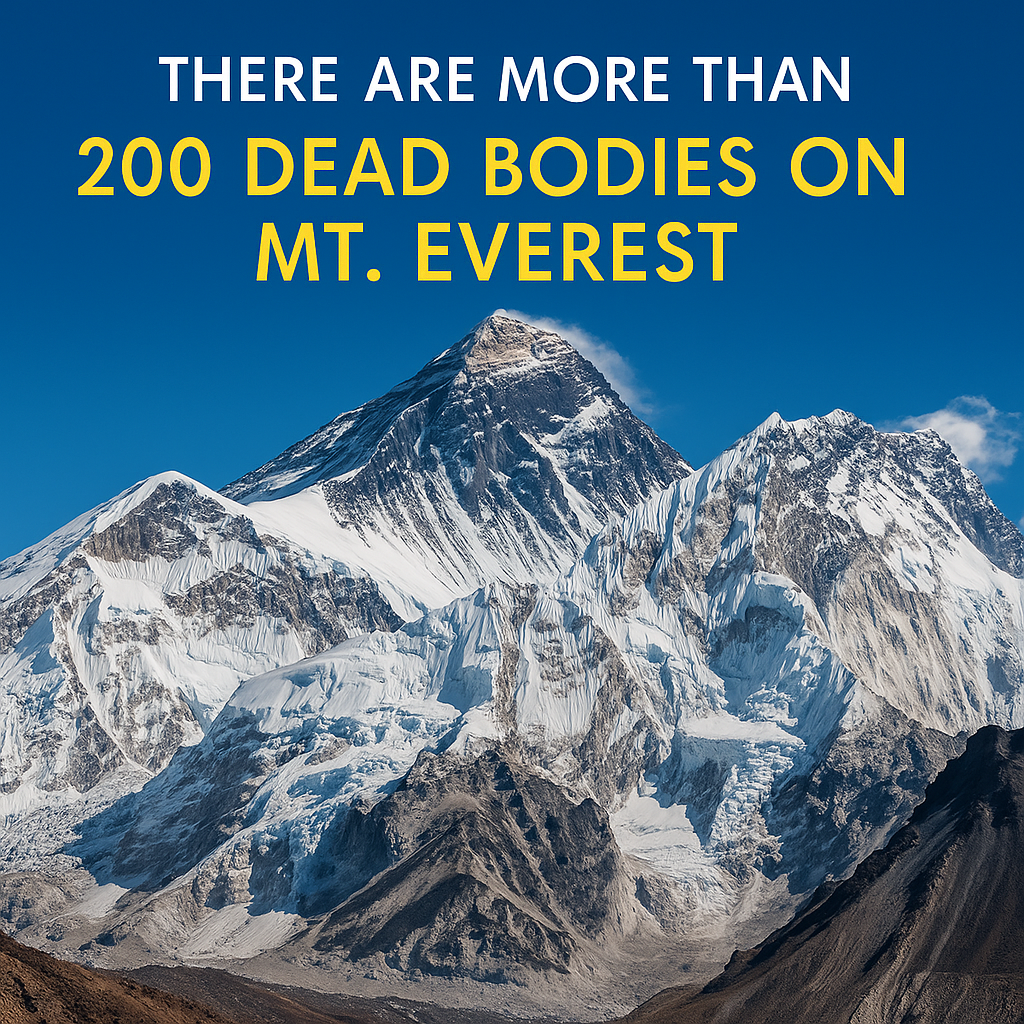
But alongside tales of triumph lies a darker truth. Over 200 bodies remain scattered across Everest’s slopes, preserved by the freezing temperatures. They serve as haunting reminders of the mountain’s deadly power, silent witnesses to the risks climbers face in pursuit of glory.
👉 “There Are More Than 200 Dead Bodies on Mt. Everest”
In this in-depth exploration, we’ll uncover why so many lives have been lost, the challenges of recovery, famous cases that made headlines, and the moral dilemmas surrounding Everest’s grim graveyard.
The Harsh Reality of Everest
Climbing Mount Everest is not like any other mountain expedition. The “Death Zone”, located above 8,000 meters, is a place where oxygen levels are dangerously low. Human bodies cannot acclimatize, and every second spent there brings climbers closer to exhaustion and death.
- Extreme Altitude: Oxygen levels drop to just one-third of what they are at sea level. Without supplemental oxygen, most people cannot survive long.
- Freezing Temperatures: Average temperatures can plunge to -40°C, instantly freezing exposed skin and tissue.
- Avalanches and Falls: Unpredictable snow and ice collapses have claimed many lives.
- Exhaustion: Even simple movements become monumental tasks. Many climbers collapse just short of the summit.
These conditions explain why more than 200 climbers have perished and why their bodies remain on the mountain.
Why Are the Bodies Left Behind?
A common question arises: Why aren’t the bodies retrieved? The answer lies in the extreme difficulty and danger of recovery operations.
- Weight and Altitude: Carrying a 100+ kg body down at high altitude is nearly impossible, even for Sherpas.
- Costs: A single body retrieval can cost $40,000 to $70,000 USD, requiring a large team and risking additional lives.
- Frozen State: Bodies are often frozen solid into the ice, making removal nearly impossible.
- Priorities: On Everest, climbers focus on survival. Stopping to help or retrieve someone often means risking your own life.
Thus, many victims remain where they fell, becoming part of the mountain itself.
Famous Cases of Everest’s Frozen Dead
1. “Green Boots”
Perhaps the most infamous body on Everest, “Green Boots” is the nickname given to a climber (believed to be Tsewang Paljor, an Indian mountaineer) who died in 1996. His body, wearing neon green boots, lay in a small cave along the main route and became a grim landmark for decades.
2. George Mallory
One of Everest’s most legendary mysteries involves George Mallory, who disappeared in 1924 during an attempt to summit. His body was discovered in 1999, perfectly preserved. To this day, climbers debate whether Mallory reached the summit before dying.
3. Francys Arsentiev – “The Sleeping Beauty”
In 1998, American climber Francys Arsentiev attempted to summit without supplemental oxygen. Tragically, she collapsed on descent. Multiple teams passed her but could not save her. Her body became known as “The Sleeping Beauty,” remaining visible for years.
4. David Sharp
In 2006, British climber David Sharp died while attempting a solo ascent. Over 40 climbers passed him as he lay dying near “Green Boots’ Cave,” sparking worldwide controversy over the ethics of Everest climbing.
5. Hannelore Schmatz
In 1979, German climber Hannelore Schmatz became the first woman to die on Everest’s upper slopes. Her body, sitting upright with eyes open, haunted climbers for years before finally being blown off the ridge.
You may also be interested in: Top Famous Restaurants in Bruges You Must Try
The Death Zone: Science Behind the Danger
The human body simply isn’t designed for such altitudes. Above 8,000 meters:
- Oxygen deprivation leads to hypoxia, confusion, and poor decision-making.
- Pulmonary edema (fluid in lungs) and cerebral edema (fluid in the brain) can strike suddenly.
- Simple tasks like eating, drinking, or adjusting gear feel nearly impossible.
- Frostbite sets in quickly, leading to lost limbs or death.
It is in this zone where most deaths occur and where most bodies remain.
The Ethics of Everest: Should Bodies Be Removed?
The presence of bodies on Everest has sparked heated debates:
- Respect for the Dead: Some argue that bodies should be retrieved for dignity and for families.
- Risk vs. Reward: Others say that risking more lives for retrieval is unjustifiable.
- Tourism & Morality: Climbers often step over dead bodies to continue their journey. Does the pursuit of glory outweigh human compassion?
- Cultural Perspective: In Nepal, many Sherpas view the bodies as part of the mountain, sacred and untouchable.
This ongoing debate highlights the moral complexity of Everest expeditions.
Everest as a Graveyard: The Psychological Impact
Climbers often describe Everest as both inspiring and horrifying. Passing by frozen bodies can have deep psychological effects:
- Motivation vs. Fear: For some, it’s a chilling reminder to push forward cautiously. For others, it fuels anxiety and despair.
- Normalization of Death: Regular exposure to corpses has led some climbers to treat them as landmarks rather than human beings.
- Mental Trauma: Survivors often experience PTSD after witnessing death so closely.
Can Everest Deaths Be Prevented?
Improvements in Technology
- Better Gear: Modern clothing, oxygen tanks, and communication devices have saved lives.
- GPS Tracking: Climbers can now be located more easily in emergencies.
Climbing Regulations
- Permits: Nepal has introduced stricter rules on who can attempt Everest.
- Guided Climbs: Many climbers now ascend with experienced Sherpas and guides.
Personal Responsibility
- Fitness & Training: Everest is not for amateurs. Many deaths occur because climbers underestimate the challenge.
- Decision-Making: Knowing when to turn back is crucial. “Summit fever” has killed countless climbers who ignored warning signs.
Beyond Everest: Other Deadly Peaks
While Everest is the tallest, it’s not the deadliest. Other mountains have even higher death rates:
- K2 (Pakistan): Known as the “Death Mountain,” it has claimed 1 in 4 climbers.
- Annapurna (Nepal): Statistically, the deadliest of all 8,000m peaks.
- Nanga Parbat (Pakistan): Nicknamed the “Killer Mountain.”
Yet Everest’s fame makes its tragedies more visible.
Modern Cleanup Efforts
In recent years, Nepal and China have launched initiatives to clean up Everest, removing tons of trash and some bodies. But the scale of the problem remains massive.
- Environmental Impact: Leftover gear, oxygen bottles, and waste litter the slopes.
- Recovery Attempts: Some bodies have been brought down, but many remain unreachable.
- Future Plans: Discussions continue about creating designated memorial zones instead of risky recoveries.
Yearly Deaths on Mount Everest
| Year | Number of Deaths | Notable Events |
|---|---|---|
| 1922 | 7 | First recorded Everest deaths (avalanche during British expedition). |
| 1924 | 2 | George Mallory & Andrew Irvine disappeared; mystery remains. |
| 1933 | 1 | British attempt fatal fall. |
| 1953 | 0 | Sir Edmund Hillary & Tenzing Norgay successfully summit. |
| 1963 | 6 | U.S. expedition, multiple fatalities. |
| 1970 | 8 | Avalanches and falls (Japanese expedition). |
| 1974 | 6 | Indian expedition disaster. |
| 1979 | 2 | Including Hannelore Schmatz, first woman to die on upper slopes. |
| 1982 | 11 | Severe storms hit climbers. |
| 1988 | 7 | Multiple fatalities due to bad weather. |
| 1996 | 15 | Infamous Everest Disaster, storm kills climbers from several expeditions. |
| 2006 | 11 | Season of controversy, including David Sharp’s death. |
| 2014 | 16 | Avalanche in Khumbu Icefall killed Sherpas. |
| 2015 | 22 | Earthquake-triggered avalanche at Base Camp. |
| 2019 | 11 | Overcrowding in Death Zone causes multiple fatalities. |
| 2023 | 17 | One of the deadliest climbing seasons in recent history. |
📊 Summary:
- Total deaths on Everest exceed 320 climbers (as of 2024).
- Most occur in the Death Zone (above 8,000 m).
- The deadliest single year remains 2015, due to the Nepal earthquake avalanche.
Conclusion: Everest’s Deadly Legacy
Mount Everest will always symbolize human ambition, courage, and determination. But it also serves as a chilling reminder of mortality. More than 200 bodies remain frozen in time, each telling a story of hope, struggle, and tragedy.
For some, Everest is a dream worth dying for. For others, it is a graveyard in the sky.
🔔 For more tutorials like this, consider subscribing to our blog.
📩 Do you have questions or suggestions? Leave a comment or contact us!
🏷️ Tags: mount everest, everest deaths, green boots, sleeping beauty, himalayas tragedy, mountaineering risks, death zone, sherpas, famous climbers, extreme survival
📢 Hashtags: #MountEverest, #EverestDeaths, #DeathZone, #GreenBoots, #SleepingBeautyEverest, #ExtremeClimbing, #Mountaineering, #Himalayas, #EverestHistory, #FrozenGraveyard
