


⏲️ Estimated reading time: 11 min
Table of Contents
Cybertruck Door Design Under Fire After Student Dies in Fire. A wrongful-death lawsuit alleges that a 19-year-old college student was unable to escape a burning Tesla Cybertruck after its powered doors locked, raising serious questions about safety design, regulatory oversight, and corporate responsibility.
Cybertruck Door Design Under Fire After Student Dies in Fire
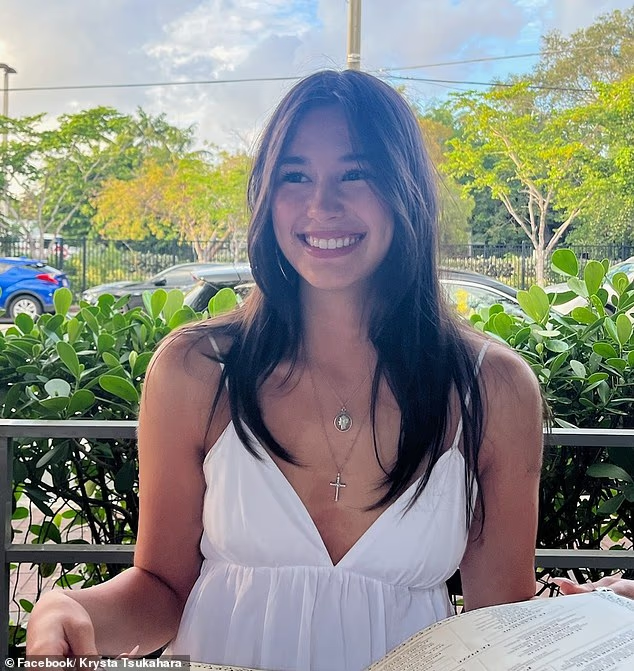
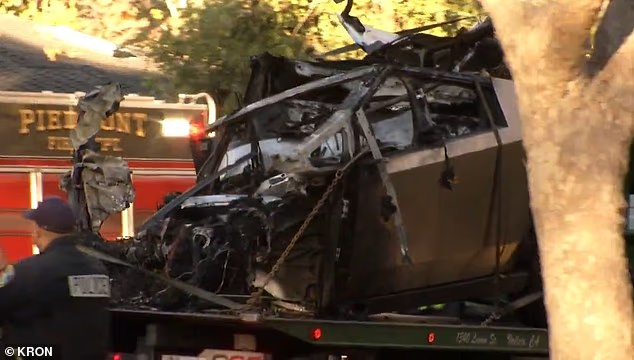
In November 2024, a Tesla Cybertruck crashed into a tree and erupted in flames in Piedmont, California. Three occupants died, including 19-year-old college student Krysta Tsukahara. Her family now claims that she survived the impact but was trapped because the Cybertruck’s power-dependent door system failed effectively locking her inside. (The Guardian)
The lawsuit accuses Tesla of negligence, alleging the vehicle lacked an accessible, intuitive mechanical emergency release if electric power fails. (People.com) The case has sparked renewed scrutiny of Tesla’s door systems, consumer safety standards, and how far design innovation should go before sacrificing fundamental safety. (AP News)
Below, we examine the facts, technical issues, legal context, broader implications, and lessons for automakers, regulators, and consumers.
Factual Summary: What Is Known (and What Isn’t)
The Incident
- On November 27, 2024, a Cybertruck crashed into a tree in Piedmont (a suburb of San Francisco). (The Guardian)
- The crash resulted in a fire. (AP News)
- All but one of the four occupants perished. (The Guardian)
- The survivor escaped after bystanders broke open the windshield. (The Guardian)
According to the lawsuit filed by Tsukahara’s parents:
- Krysta reportedly sustained only minor injuries at impact but could not exit before the fire overtook her. (People.com)
- The Cybertruck lost power in the crash, disabling its electric door control system. (The Guardian)
- The rear passengers, including Krysta and her friend Jack Nelson, allegedly had to rely on a hidden mechanical cable release under a rubber mat which the suit claims was nonintuitive in smoke and chaos. (People.com)
- The suit claims Tesla was already aware of door system complaints in prior models. (AP News)
Tesla has reportedly not publicly responded. (AP News)
Legal Action and Claims
- The Tsukahara parents filed a wrongful death suit in Alameda County, California. (The Guardian)
- A parallel complaint was filed by the family of Jack Nelson. (People.com)
- The lawsuits argue that Tesla’s design is defectively dangerous: reliance on electric power for door latching, and a manual override that is too obscure. (AP News)
- The suits allege Tesla had knowledge of reports of door malfunction in earlier vehicles. (The Guardian)
- Plaintiffs seek unspecified punitive damages. (AP News)
- Meanwhile, the U.S. National Highway Traffic Safety Administration (NHTSA) is reportedly investigating stuck-door complaints in Tesla vehicles. (AP News)
Caveats, Uncertainties, and Other Factors
- The cause of the crash (speeding, impairment) is under review. California Highway Patrol notes indicate “impaired driving and speeding” were contributing factors. (AP News)
- The plaintiffs’ narrative is based on allegations not yet proven in court.
- Tesla has not published its internal data or mechanical design detail in public.
Because of these uncertainties, the following sections are a mix of known fact, plausible engineering critique, and legal hypothesis.
Technical Issues: Electric Doors, Failures, and Design Trade-Offs
To understand how a door could become a death trap, we need to examine how Tesla’s door systems work, what failure modes exist, and how they compare to conventional designs.
Tesla’s Door Mechanism (High Level)
Tesla vehicles including the Cybertruck use largely electronic actuation for door handles and latching:
- The door handles are motorized or electrically actuated (i.e. retract or extend on demand).
- The latching mechanism often relies on a 12V control system.
- In many vehicles, a manual override (mechanical cable) is embedded to allow exit when electrical systems fail.
The key risk: if a crash severs power or damages the control circuitry, the door actuator might not respond. The manual override must then be accessible, intuitive, and usable under duress.
Failure Modes in Crash & Fire Conditions
Here are ways in which door systems can fail under crash or fire conditions:
- Loss of electrical power
A severe crash may disconnect wiring or disable the 12 V battery, rendering the actuator inoperable. - Latch jamming or deformation
Structural deformation may jam the latch mechanism, making it impossible to unlatch even with power. - Circuit damage or short
Fire or impact could damage control circuitry or fuses. - Inaccessible manual override
If the mechanical override is hidden, covered by interior trim, or counterintuitive to reach, a user under stress may not locate it in time. - Smoke, disorientation, low visibility
In a post-crash meltdown, smoke and panic compromise ability to find hidden levers.
In the Tesla case, the plaintiffs contend that the manual cable release was hidden under a rubber mat in the door panel hardly intuitive under stress. (People.com)
Comparison with Conventional Door Designs
In more traditional (mechanical) designs:
- Many vehicles use a direct mechanical linkage: pulling a handle physically operates the latch (less vulnerable to power loss).
- Emergency escape features (e.g., manual release levers) are typically well labeled and accessible.
- Regulations and standards often require fail-safe operation (i.e. occupants must be able to open doors even if the electrical system is fully disabled).
The tension arises when automakers push toward sleekness, fewer moving parts, and electronic “smart” features. When aesthetics and automation override basic safety, risk emerges.
Prior Reports & Allegations
The lawsuit claims Tesla had prior knowledge of door system problems. (AP News) Indeed, media accounts and owner complaints have surfaced about Tesla doors especially rear doors not opening when power is off.
Also, Tesla’s marketing of handleless or flush door systems may have prioritized design over redundancy.
Legal, Regulatory, and Corporate Accountability
The tragic death has brought to light a convergence of legal obligations, regulatory duties, and design ethics.
You may also be interested in: Tesla Pi Phone: Is Elon Musk’s $789 Phone Real?
Legal Theories in Play
The plaintiffs’ key legal claims will likely include:
- Product liability (defect theory): The door system is defectively designed (design defect).
- Negligence: Tesla had a duty to design safe doors, breached that duty by reliance on vulnerable systems.
- Failure to warn: Tesla may have failed to inform buyers of caveats or emergency procedures.
- Negligent failure to recall or retrofit: If Tesla knew of the issue, failing to issue a remedy could amount to negligence.
Tesla’s defense may counter:
- The crash was caused by external factors (speeding, intoxication) not the door design.
- The door system functioned as intended, and the override was present.
- The plaintiffs cannot prove that, had the doors opened, Krysta would have escaped (i.e. causation).
- Assumption of risk or contributory conduct by passengers.
Proving product liability in automobile safety defects often requires showing that a safer alternative design (SAD) was feasible and that Tesla’s design fell short.
Regulatory Oversight: NHTSA & Safety Standards
The case intensifies focus on how vehicle safety is regulated in the U.S.
- NHTSA Investigation: The agency is reportedly investigating stuck-door complaints in Teslas. (AP News)
- If defect is confirmed, Tesla could face recall mandates.
- This case could push regulators to adopt stricter standards for door release systems, emergency egress, and redundancy in EVs.
Precedents and Industry Implications
Tesla has faced past litigation over safety systems (e.g., Autopilot). A high-profile ruling here could influence future standards across the EV industry.
It could also lead to stricter consumer expectations: that even “smart” systems must not compromise escape in emergencies.
Broader Implications & Ethical Considerations
Beyond this tragic case, it prompts reflection on how innovation should be bounded by safety.
Innovation vs. Safety Trade-offs
- Automakers must balance sleek, high-tech designs with fail-safe mechanical systems.
- The allure of “futuristic” doors must not override the fundamental requirement: occupants must be able to exit under any condition.
Consumer Trust & Disclosure
- If overrides are buried or obscure, users may never know how to use them until it’s too late.
- Manufacturers must provide clear training, instructions, and visible emergency handles.
Policy and Standards Reform
- EV-specific safety standards (for battery fires, power loss) may need revision.
- Regulators may require mandatory mechanical overrides that work independently of power systems.
Moral Accountability
- Corporations have not just legal duty, but ethical duty to anticipate worst-case scenarios.
- In life-or-death systems, “elegance” cannot supersede safety.
Pros & Cons: Tesla’s Door Design (as Alleged)
| Aspect | Potential Advantages | Risks / Disadvantages |
|---|---|---|
| Sleek flush or motorized handles | Modern aesthetics, lower drag, premium feel | Vulnerable to power loss or mechanical failure |
| Electronic control & interlock | Convenience, software integration, locking logic | Failure in crash disables door actuation |
| Hidden mechanical override | Keeps interior clean, design continuity | Too obscure or unintuitive under stress |
| Reliance on redundancy (software failsafe) | Can detect fault, attempt fallback modes | If physical override is weak, redundancy fails |
Pros (in theory):
- A modern, seamless user experience
- Tighter integration with electronic security and locking systems
- Potential for alerts or diagnostics if door systems fail
Cons (as alleged):
- Loss of escape in electrical failure catastrophic risk
- Hidden or unintuitive manual override
- Insufficient redundancy in a crash scenario
- Liability risk and public backlash if failure leads to death
Case Studies & Analogies
Previous Tesla Door/Lock Complaints
While less dramatic, Tesla owners have reported stuck rear doors when battery power was cut or when the electrical system failed. These reports help establish that the risk was known before. (As alleged in the lawsuit.) (AP News)
Non-Tesla Safety Failures in Crash
In automotive safety history, we find many cautionary tales:
- Some earlier car models had doors that jammed in side impacts, leading to design revisions.
- Aircraft and train doors often have manual override mechanisms precisely because power failure is expected in emergencies.
These analogies underscore that life-critical systems almost always require mechanical fallback.
Contrast: Cars with well-designed emergency egress
Some specialty vehicles (e.g. race cars, aircraft) place mechanical override levers in bold, accessible locations, often color-coded and redundantly placed. These designs prioritize human factors under duress.
What Happens Next: What to Watch
- Discovery and engineering disclosure
The plaintiffs will likely demand internal Tesla documents, design specs, test data, defect reports, and emails revealing prior complaints. - Expert testimony and crash reconstruction
Experts will evaluate whether a safer alternative design was feasible, whether Krysta could have escaped under different conditions, and whether Tesla’s override design was unreasonably obscure. - Regulatory findings
NHTSA may conclude whether Tesla’s door design violates safety standards or merits a recall. - Court decision or settlement
Tesla may opt to settle to avoid reputation risk, or risk a trial verdict with punitive damages. - Industry response
Other automakers may revisit door systems, especially in EVs, to prevent similar liability. Regulatory standards could tighten.
Recommendations & Lessons for Stakeholders
Automakers / Designers
- Always build robust, intuitive manual overrides that do not depend on power.
- Use human factors testing (simulated smoke, darkness, stress) to validate accessibility during emergencies.
- Document and address consumer complaints proactively consider retrofits if a failure trend appears.
- Disclose override procedures clearly in manuals and onboard instructions.
For Regulators
- Mandate minimal requirements for egress systems independent of power.
- Require crash test scenarios that validate door operability under power-loss conditions.
- Audit and follow up on consumer safety complaints aggressively.
For Consumers / Car Buyers
- Learn the location and mechanism of manual overrides in your vehicle don’t assume software handles everything.
- Push for safety features and redundancy, not just flashy tech.
- Stay aware of recalls or technical bulletins about door or lock systems in your vehicle.
Final Thoughts A Possible “Afterburn”
This case could become a landmark in EV safety law. If Tesla is found liable, it may trigger not just financial consequences but design overhauls across the automotive industry.
At its core, this tragedy highlights a harsh reality: design decisions carry moral weight. When innovation replaces basic mechanical reliability, the stakes can become literally life or death. As we push cars to be “smarter” and more integrated, designers and regulators must never lose sight of the imperative that people trapped inside must be able to get out mechanically, reliably, in chaos and smoke.
⚖️ We may someday look back on this lawsuit as a turning point: the moment when vehicles had to prove they could fail safe, not just fail smart.
🔔For more tutorials like this, consider subscribing to our blog.
📩 Do you have questions or suggestions? Leave a comment or contact us!
🏷️ Tags: Tesla Cybertruck, electric vehicle safety, door design, product liability, NHTSA, wrongful death lawsuit, automotive engineering, safety regulation, EV industry, human factors
📢 Hashtags: #TeslaCybertruck #EVSafety #ProductLiability #CarDesign #DoorMechanism #WrongfulDeath #AutoRegulation #EngineeringSafety #TeslaLawsuit #SafetyStandards
