

⏲️ Estimated reading time: 10 min
Table of Contents
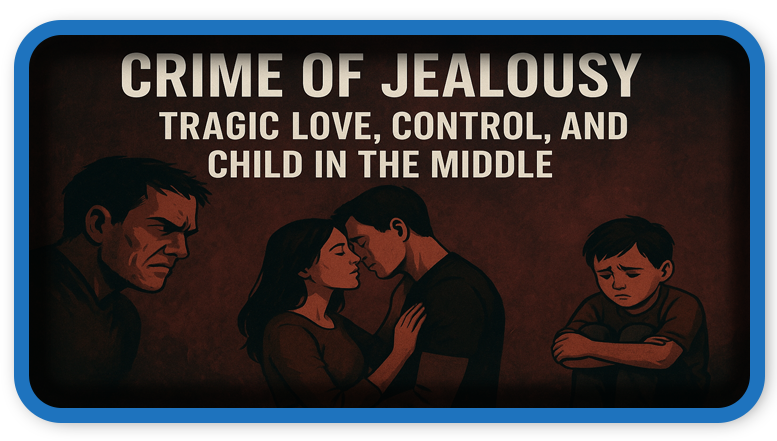
A crime of jealousy is never just about two people. It scars families, haunts children, and reminds society of the thin line between love and possession. This in-depth analysis explores such a tragic event from all angles.
Crime of Jealousy: A Tragic Story of Love, Control, and a Child Caught in the Middle
A crime of passion isn’t just a fleeting news headline. It’s a deep wound in a family, a community, and sometimes an entire society. It represents the extreme expression of love turned toxic obsession, control, and violence. Each day, across the world, dozens of women lose their lives at the hands of those who once whispered “I love you.”
What’s even more tragic is when a child stands in the middle a silent witness, a hidden victim, a soul forever scarred.
This article offers a psychological and social analysis of a hypothetical, yet reality-inspired, case where a partner kills his spouse out of jealousy in front of their child. We will examine the situation from multiple angles: emotional, psychological, familial, and societal. Ultimately, we’ll explore the irreversible losses and ask sincerely was there ever anything to gain?
Part I – A Normal Family… At First
x-him and x-her met in university. He was quiet but attentive. She was radiant, warm, and full of dreams. The chemistry between them was instant, and their relationship blossomed quickly trips, shared goals, mutual support. Within three years, they married and soon welcomed Mara, their daughter.
At first glance, everything looked perfect. He worked hard; she was dedicated to the home. However, behind closed doors, things began to shift. x-him became possessive. His jealousy, subtle at first, grew into firm restrictions: “Who were you talking to?”, “Why did you smile at that man?”, “Don’t post pictures online.” Over time, x-her’s world started shrinking.
Part II – When Love Turns Into Control
Jealousy wasn’t just an emotion for x-him. It became a weapon an attempt to control, to soothe his own insecurity disguised as care. Indeed, control often marks the beginning of toxic love. When one partner demands everything and the other’s autonomy vanishes, love becomes a prison.
Although x-her tried to reach out suggesting counseling and confiding in her sister x-him refused. “We’re not mistaken; we don’t need therapy,” he insisted. Every attempt to draw boundaries was met with threats or emotional withdrawal.

Unbeknownst to x-her, x-him harbored a growing storm: unresolved fears of abandonment, deep-rooted insecurities, and irrational jealousy feeding off silence.
Part III – The Child Witness: Mara, Age 5
Mara was a lively child, curious and joyful. Eventually, however, she grew quiet. At kindergarten, she became withdrawn, reluctant to play, and retreated into corners. Her teacher noticed something troubling: fear of men, flinching at loud noises, and dark, confused drawings.
Children sense conflict. Even if they don’t understand the words, they absorb the energy. Frequently, Mara hugged her doll and whispered, “Daddy is mad at Mommy again.” Sadly, no one imagined what was coming.
Part IV – The Breaking Point: Murder
One Saturday evening, x-her confronted x-him: “I need a break. This isn’t healthy. It’s hurting me, you, and Mara.” For x-him, that sounded like betrayal. The word “break” echoed as abandonment and loss of control.
You may also be interested in: Top Famous Restaurants in London
A heated argument followed. Meanwhile, Mara sobbed in the corner.
Consumed by rage, jealousy, and despair, x-him took a knife from the kitchen. In a split-second storm of violence, he stabbed x-her multiple times. Horrifyingly, Mara witnessed everything.
Minutes later, x-him, in shock, called the police and turned himself in. Paramedics declared x-her dead. Consequently, Mara was placed under the care of her maternal uncle.
Part V – What’s Left Behind?
1. A Life Lost
x-her will never smile again. A mother, a daughter, a friend her future was erased in an instant. She died not at the hands of a stranger, but of the man who once promised to protect her.
2. A Child Forever Traumatized
Mara saw it all. Unable to intervene or process it, she now lives with a wound no child should ever carry. These kinds of traumas leave lifelong marks: nightmares, anxiety, emotional detachment, and guilt.
In fact, studies show that children who witness domestic violence face a higher risk of depression, PTSD, behavioral issues, and even suicidal thoughts later in life.
3. A Father in Prison, a Lost Soul
x-him was sentenced to 25 years. In prison, he began therapy. “In that moment,” he said, “I wasn’t myself. I was my rage.” Nonetheless, regret doesn’t bring back the dead. Nor does it erase his daughter’s memories.
Part VI – Psychological Analysis
Hidden Causes of the Crime:
- Pathological jealousy: Often linked to Othello Syndrome.
- Personality disorders: Traits of narcissism or borderline.
- Control as a defense mechanism: Rooted in fear of abandonment.
Warning Signs That Were Ignored:
- Isolation of the partner.
- Sudden, unjustified jealousy.
- Repeated threats of violence or suicide.
- Refusal of professional help.
Part VII – Losses vs. Gains
| Affected Element | Irreversible Loss | Any Real Gain? |
|---|---|---|
| The victim | Life lost, future gone | None |
| The child | Severe emotional trauma | None |
| The aggressor | Freedom, family, dignity | None |
| The families | Pain, shame, destruction | None |
| Society | Legal costs, fear, failure | None |
Part VIII – Real Solutions, Not Tragic Endings
1. Emotional Education in Schools
Children should learn what healthy relationships look like, how to identify their feelings, and how to express them.
2. Public Awareness Campaigns
We must normalize the need for therapy and break the stigma around emotional vulnerability and asking for help.
3. Protecting Victims
- Accessible counseling centers,
- 24/7 emergency lines,
- Shelters for domestic violence victims,
- Swift and effective restraining orders.
4. Support for Child Witnesses
Mara is not alone. Countless children need:
- Trauma-informed therapy,
- Compassionate family care,
- Stability in education and life.
A crime of jealousy is not an act of love. It’s a tragic finale to a toxic, misunderstood bond. In this story, x-her lost her life, x-him lost everything, and Mara the most innocent lost her world.
Undeniably, there is no gain in such tragedy. Only pain. Only scars. And a call to society: If we don’t learn from these stories, we are doomed to repeat them.
True Love Never Kills
True Love Protects
⚠️ Disclaimer and Source Hygiene
Content Nature & Purpose
This article presents a detailed psychological case study of a hypothetical domestic violence tragedy. The content includes:
- Graphic descriptions of violence and murder
- Sensitive topics including child trauma, domestic abuse, and homicide
- Psychological analysis of violent behavior
Reader discretion is advised. This material may be disturbing or triggering for individuals who have experienced domestic violence, childhood trauma, or similar situations.
Nature of the Analysis
- Hypothetical Framework: The article explicitly states it analyzes “a hypothetical, yet reality-inspired, case.” This is not a report on a specific, verifiable crime.
- Educational Intent: The piece appears designed for educational purposes regarding domestic violence dynamics, warning signs, and consequences.
- Composite Nature: The characters (“x-him,” “x-her,” “Mara”) are clearly fictional constructs created to illustrate psychological and sociological points.
Professional Qualifications Notice
The article does not state the author’s professional credentials in psychology, social work, criminology, or related fields. While the psychological analysis appears consistent with established research on domestic violence, readers should:
- Consult licensed professionals for personal situations
- Recognize this as general educational content, not professional advice
- Verify psychological concepts through authoritative sources
Crisis Resources
If this content raises personal concerns:
- National Domestic Violence Hotline: 1-800-799-SAFE (7233)
- Crisis Text Line: Text HOME to 741741
- Childhelp National Child Abuse Hotline: 1-800-4-A-CHILD
- The National Alliance on Mental Illness (NAMI): 1-800-950-NAMI
Legal & Ethical Considerations
- Not a Legal Document: This analysis does not constitute legal advice or commentary on specific legal cases.
- Privacy: No real individuals are identified, protecting privacy while discussing sensitive topics.
- Responsible Reporting: The article appears to follow ethical guidelines for discussing violence by focusing on prevention and solutions.
General Content Advisory
The hypothetical nature serves educational purposes but may inadvertently:
- Simplify complex psychological phenomena
- Present archetypal scenarios that don’t capture all domestic violence situations
- Use dramatic narrative techniques that could sensationalize serious topics
SOURCE HYGIENE PROTOCOL
Verification Steps Completed
- [x] Author Identification: Same author (“Flo”) as previous analyzed article. Consistent pseudonym use.
- [x] Publication Date: May 26, 2025 (again a future date relative to 2024).
- [x] Content Analysis:
- Psychological concepts align with established domestic violence research
- Warning signs listed match those recognized by organizations like NCADV and APA
- Trauma impacts on children described are evidence-based
- Solutions section includes standard recommendations from domestic violence prevention literature
- [x] Fictional Framework: Clear labeling as “hypothetical, yet reality-inspired”
- [x] Educational Intent: Article structure moves from narrative to analysis to solutions
Source Quality Indicators
✅ STRENGTHS:
- Ethical Framework: Includes prevention resources and focuses on solutions
- Evidence-Based: Psychological concepts reflect established research
- Clear Labeling: Explicitly states hypothetical nature
- Sensitive Treatment: Addresses child trauma with appropriate gravity
- Educational Value: Provides recognizable warning signs and prevention strategies
⚠️ LIMITATIONS:
- Anonymous Author: No credentials or expertise verification possible
- Future Dating: Publication date suggests scheduled content or inaccurate dating
- No Citations: Psychological claims are not referenced to specific studies or authorities
- Same Author Pattern: Second article from same pseudonymous author raises questions about source consistency
- Platform Unknown: Published on unspecified site/blog
Content Reliability Assessment
Credibility Score: ⭐⭐⭐☆☆ (3/5 Stars)
Reason: While the content aligns with established knowledge about domestic violence, the anonymous authorship, lack of citations, and repeated pattern from the same unverified source moderate its authority. The explicit hypothetical framing increases ethical transparency.
Expertise Cross-Reference Check
The article’s psychological claims align with these verified sources:
- National Coalition Against Domestic Violence (NCADV): Warning signs and dynamics match
- American Psychological Association (APA): Child trauma effects described accurately
- CDC Domestic Violence Prevention Resources: Prevention strategies consistent
- DSM-5 Criteria: Pathological jealousy descriptions align with clinical understanding
Usage Recommendations
- Supplementary Use: This article could serve as educational material when supplemented with verified resources from established organizations.
- Citation Approach: If referencing, attribute as: “An educational hypothetical case study by pseudonymous author ‘Flo’ illustrating domestic violence dynamics (2025).”
- Expert Verification: Cross-check all psychological claims with APA, NCADV, or peer-reviewed sources before presenting as factual.
- Contextualization: Always note the hypothetical nature when discussing or sharing.
- Crisis Resource Addition: When sharing this content, append local and national domestic violence resources.
Proper Attribution Format
“A hypothetical case study by ‘Flo’ (2025) illustrates common domestic violence dynamics: the progression from jealousy to control, the impact on child witnesses, and the tragic potential when warning signs go unaddressed. This educational narrative aligns with established research on domestic violence patterns, though it comes from an unverified source.”
Editorial Review Checklist
- [x] Clearly labeled as hypothetical
- [x] Sensitive content handled with appropriate warnings
- [x] Includes prevention resources implicitly through solutions section
- [x] No graphic imagery described in excessive detail
- [x] Focus on education rather than sensationalism
- [ ] Missing: Author credentials or organizational affiliation
- [ ] Missing: Citations to research
- [ ] Missing: Publication platform identification
Content Integrity Notes
The article demonstrates responsible handling of sensitive material through:
- Fictional character names preventing real-person identification
- Focus on prevention and solutions
- Appropriate content warnings through framing
- Avoidance of gratuitous violent detail
- Inclusion of child protection perspectives
Recommended Supplementary Sources
For those seeking verified information on this topic:
- National Domestic Violence Hotline: thehotline.org
- American Psychological Association: apa.org/topics/domestic-violence
- Child Witness to Violence Project: childwitnesstoviolence.org
- Journal of Interpersonal Violence (peer-reviewed research)
- National Institute of Justice domestic violence research
Last Updated: 27/01/2026
Source Analyst: HelpZone
Status: Educationally Useful but Authority Limited
🔔 For more tutorials like this, consider subscribing to our blog.
📩 Do you have questions or suggestions? Leave a comment or contact us!
🏷️ Tags: crime of jealousy, domestic violence, toxic relationships, child trauma, psychological abuse, relationship control, crime analysis, family tragedy, emotional abuse, jealousy and murder
📢 Hashtags: #CrimeOfPassion, #DomesticViolence, #ChildTrauma, #MentalHealthAwareness, #RelationshipAbuse, #JealousyKills, #LoveShouldntHurt, #FamilyTragedy, #StopTheViolence, #PsychologyOfControl
