

⏲️ Estimated reading time: 27 min
Table of Contents
A viral hot-pan experiment reignited the debate between Coca-Cola Original and Coke Zero Sugar. We examine the visible sugar residue, ingredient differences, taste preferences, caffeine-free European release, sweetener safety, and why moderation matters more than choosing a winning side.
See also: Top 10 G-Shock Men’s Watches to Buy in 2026
Coke Zero vs Regular Coke: A Debate Bigger Than Taste
Few products inspire loyalty quite like Coca-Cola.
Some people cannot imagine replacing the familiar sweetness of Coca-Cola Original Taste. They associate it with family meals, summer afternoons, cinema visits, celebrations, and the satisfying sound of a cold can opening.
Other consumers have moved almost completely to Coke Zero Sugar. They enjoy its stronger cola profile without the sugar and calories found in the traditional drink.
This long-running disagreement recently gained fresh attention through an online exchange. A Coke Zero supporter described full-sugar Coke drinkers as being “behind the times.” The user presented Coke Zero as a cleaner, more modern option.
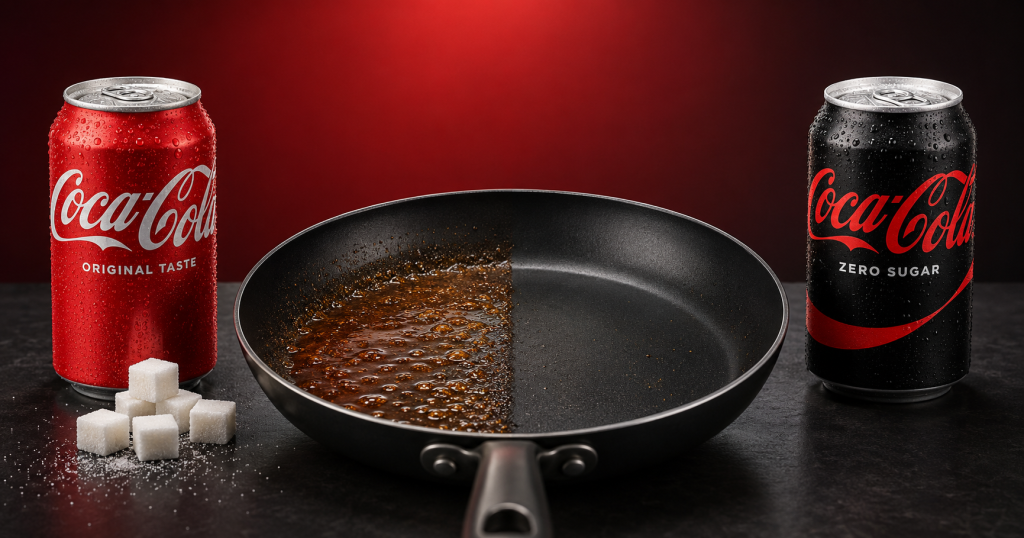
A hot-pan demonstration strengthened the argument visually. Regular Coke was heated until most of its water disappeared, leaving a dark and sticky residue. Coke Zero left considerably less material behind.
The demonstration looked dramatic. It also reminded viewers that a typical can of regular Coca-Cola can contain around 39 grams of sugar, depending on the serving size and market.
However, the experiment does not prove that Coke Zero is universally healthy or that regular Coke is inherently toxic. It simply demonstrates an important physical difference between the two drinks.
Regular Coke contains a substantial quantity of sugar. Coke Zero uses intense sweeteners in much smaller amounts.
That distinction affects calories, flavor, texture, aftertaste, blood-glucose response, consumer preference, and the way each drink behaves when heated.
The debate is therefore more complicated than one sticky pan.
Why the Hot-Pan Coke Experiment Became So Convincing
Food labels communicate information through numbers. Unfortunately, many people find nutrition labels abstract.
A statement such as “39 grams of sugar” may not create an immediate mental image. Most consumers do not measure 39 grams of sugar before drinking a soda.
The pan demonstration transforms that number into something visible.
When regular Coca-Cola is heated, its water gradually evaporates. Carbon dioxide escapes, and the remaining ingredients become increasingly concentrated. Much of the thick residue comes from the sugars that were already dissolved in the drink.
As heating continues, the mixture becomes darker and stickier. Sugar caramelization and other heat-related reactions can change its color, texture, smell, and chemical structure.
Coke Zero behaves differently because it does not contain a comparable mass of sugar. Its sweeteners provide intense sweetness in much smaller quantities.
Consequently, less solid material remains after the water evaporates.
The difference is real, but viewers must interpret it correctly.
What the Experiment Actually Demonstrates
The hot-pan test can effectively demonstrate several facts:
- Regular Coke contains much more dissolved sugar than Coke Zero.
- Water makes up most of the volume in both beverages.
- Evaporating the water concentrates the remaining ingredients.
- Sugar can form a thick residue when heated.
- Coke Zero requires far less sweetening material because its sweeteners are highly concentrated.
The test therefore offers a striking visualization of ingredient quantity.
What the Experiment Does Not Demonstrate
The experiment cannot determine:
- A person’s complete health risk
- The long-term effects of either beverage
- Whether one drink is suitable for every individual
- How the digestive system processes each ingredient
- Whether an occasional serving will cause disease
- The safety of approved sweeteners
- The quality of someone’s overall diet
A frying pan is not a human digestive system.
The body does not boil a soft drink until only a black residue remains. Digestion, absorption, metabolism, hormone activity, kidney function, and individual health conditions all influence what happens after consumption.
The visual remains useful, but it should start a conversation rather than end one.
How Much Sugar Is in Regular Coca-Cola?
Sugar content differs according to country, recipe, and container size. Consumers should always read the label on the product available in their market.
A commonly cited 355-milliliter can of regular Coke sold in the United States contains approximately 39 grams of added sugar. European serving sizes and formulations may produce different totals.
Thirty-nine grams equals roughly ten level teaspoons of granulated sugar, although teaspoon conversions vary according to how the sugar is measured.
That does not mean someone literally pours ten visible teaspoons into every can at home. The comparison simply helps readers understand the quantity.
Sugar contributes more than sweetness. It also affects:
- Mouthfeel
- Body
- Flavor release
- Perceived acidity
- Finish
- Texture
- Energy content
This helps explain why many loyal drinkers say the original version feels fuller and more satisfying.
Coke Zero can reproduce much of the recognizable cola profile. Nevertheless, it cannot duplicate every physical function of sugar with sweeteners alone.
Why Liquid Sugar Deserves Special Attention
The body can obtain carbohydrates from fruit, vegetables, grains, dairy products, and many other foods. However, sugary beverages have a distinctive characteristic: they make it easy to consume a considerable amount of sugar very quickly.
A can of soda requires almost no preparation or chewing. It can disappear during a short meal, car journey, or work break.
Liquid calories may also feel less filling than calories from solid food. A sugary drink can therefore add energy without replacing an equivalent amount of food later.
This does not mean one can of regular Coke automatically damages someone’s health. Frequency and quantity matter enormously.
A person who drinks one occasionally has a different consumption pattern from someone who drinks several large bottles every day.
Context matters as well. Sleep, physical activity, dental hygiene, overall calorie intake, genetics, medical conditions, and the rest of the diet all influence health outcomes.
The Established Health Concerns Around Excess Sugar
Health organizations generally advise limiting free or added sugars. Their guidance focuses on repeated consumption patterns rather than treating one food or drink as uniquely dangerous.
High consumption of sugary drinks can make several problems more likely.
Increased Calorie Intake
Sugar provides energy. A regular soft drink can add well over 100 calories without providing fiber, protein, or substantial micronutrients.
Those calories can contribute to a sustained energy surplus when they are not balanced by activity or reduced intake elsewhere.
Over time, a regular surplus may lead to weight gain.
Greater Risk of Tooth Decay
Oral bacteria can use fermentable carbohydrates, including sugar. This process creates acids that attack tooth enamel.
Cola drinks are also acidic. Therefore, frequent sipping can repeatedly expose teeth to both sugar and acidity.
How someone drinks soda may matter almost as much as the amount. Slowly sipping a beverage for several hours can prolong exposure.
Drinking it with a meal, avoiding constant sipping, and maintaining good dental hygiene may reduce some risk. Water remains the most tooth-friendly everyday beverage.
Blood-Glucose Considerations
Regular Coke contains rapidly available carbohydrates. It can raise blood glucose, which makes portion awareness especially important for people with diabetes or impaired glucose regulation.
Individual medical advice should come from a qualified healthcare professional. A general internet article cannot replace a personalized care plan.
Possible Contribution to Metabolic Disease
A dietary pattern rich in sugar-sweetened beverages has been associated with weight gain and a higher risk of several metabolic health problems.
Association does not mean every occasional soda directly causes disease. It does show why public-health advice emphasizes reduced routine intake.
The frequency, serving size, lifestyle, and total diet remain essential parts of the picture.
What Is Inside Coke Zero Sugar?
Coke Zero Sugar removes the large sugar load while attempting to maintain a bold Coca-Cola-style flavor.
Recipes can vary by country, so consumers should check their local label. A typical formulation may include:
- Carbonated water
- Caramel color
- Phosphoric acid
- Natural flavorings
- Aspartame
- Acesulfame potassium, also called Ace-K
- An acidity regulator
- Caffeine in the standard version
The Coca-Cola Company states that Coke Zero Sugar commonly uses a blend of aspartame and Ace-K. The combination creates sweetness without the sugar and calories of the original formula.
Because these sweeteners are far more intense than ordinary sugar, manufacturers only need small amounts.
That explains why the pan contains so little residue after Coke Zero evaporates. It does not need 39 grams of sweetener to achieve a sweet taste.
How Aspartame Works
Aspartame is an intense low-calorie sweetener. It is considerably sweeter than table sugar, so products need a relatively small quantity.
After consumption, the digestive system breaks aspartame into components that are processed by the body.
Regulatory agencies have studied the ingredient extensively. The U.S. Food and Drug Administration says its scientists do not have safety concerns when aspartame is consumed under approved conditions. European authorities have also established permitted uses and intake limits.
However, people with phenylketonuria, commonly called PKU, must avoid or strictly control phenylalanine. Products containing aspartame therefore carry a warning that they contain a source of phenylalanine.
Anyone with PKU should follow professional medical guidance rather than relying on general dietary articles.
What Acesulfame Potassium Adds
Acesulfame potassium is another high-intensity sweetener. Manufacturers often combine it with other sweeteners because a blend can create a more balanced taste.
Each sweetener has a slightly different sweetness curve.
One may appear quickly on the tongue, while another may last longer. Combining them can reduce certain aftertaste characteristics and create a profile closer to sugar.
Ace-K also contributes little or no meaningful energy at the quantities used in beverages.
Its presence is one reason Coke Zero tastes different from a simple unsweetened cola. It also helps explain why Coke Zero and Diet Coke are not identical products.
Coke Zero and Diet Coke Are Not the Same Drink
Consumers often use “diet cola” as a general category. Nevertheless, Coke Zero Sugar and Diet Coke have different flavor goals.
Coke Zero was developed to provide a taste profile closer to Coca-Cola Original Taste. It aims for a darker, bolder, and more traditional cola character.
Diet Coke has its own recipe and identity. Many drinkers describe it as lighter, sharper, and more distinctive.
One is not simply the other in different packaging.
The difference becomes obvious in blind taste tests. Some people immediately recognize Diet Coke because of its brighter flavor and characteristic finish. Others prefer the fuller profile of Coke Zero.
The official Coca-Cola product information similarly distinguishes Coke Zero as a product designed around a classic Coca-Cola-style experience, while Diet Coke maintains a separate taste profile.
A Simple Taste Comparison
| Product | Sugar | Calories from sugar | Usual flavor goal | Standard caffeine |
|---|---|---|---|---|
| Coca-Cola Original Taste | Yes | Yes | Full, classic and sugar-sweetened | Usually yes |
| Coca-Cola Zero Sugar | No | Essentially none | Closer to the original Coke profile | Usually yes |
| Diet Coke | No | Essentially none | Lighter and more distinct | Usually yes |
| Coke Zero Sugar Zero Caffeine | No | Essentially none | Coke Zero-style taste without caffeine | No |
Exact recipes, calorie declarations, and caffeine quantities vary by region.
Why Coke Zero Does Not Taste Exactly Like Regular Coke
Taste involves more than sweetness.
Sugar changes the physical body of a drink. It affects viscosity, flavor delivery, and the way sweetness develops across the tongue.
Intense sweeteners activate sweetness receptors at very low concentrations. However, they may produce a different onset, peak, and finish.
Some consumers notice:
- A longer sweet finish
- A slightly bitter edge
- A metallic impression
- A thinner mouthfeel
- A different sensation after swallowing
Others notice almost no meaningful difference, especially when the drink is very cold or served with food.
Temperature, ice, container type, freshness, and expectations can all affect perception.
A person who expects sweeteners to taste unpleasant may focus more closely on the aftertaste. Likewise, a dedicated Coke Zero fan may find regular Coke unusually thick or syrupy after years without it.
Taste preferences adapt.
Why Full-Sugar Coke Still Has Loyal Defenders
Regular Coke supporters do not necessarily ignore nutrition.
Many understand the sugar content perfectly well and still choose the original product occasionally because they enjoy it more.
Food does not serve a purely biological purpose. It can also provide pleasure, tradition, comfort, identity, and social connection.
For some consumers, original Coca-Cola offers:
- A richer mouthfeel
- A familiar sweetness
- A cleaner finish than certain sweeteners
- Nostalgia
- Better pairing with specific foods
- A stronger sense of satisfaction
An occasional beverage chosen deliberately can fit into many balanced diets.
Problems are more likely to emerge when an occasional pleasure becomes an automatic daily habit, particularly in large portions.
Calling all regular Coke drinkers “behind the times” therefore oversimplifies the issue.
A modern diet does not require everyone to select the same product. It requires awareness, proportion, and informed choice.
Why Coke Zero Fans Consider It the Better Everyday Option
Coke Zero supporters usually focus on a straightforward advantage: it provides a sweet cola experience without a large dose of sugar.
Replacing a daily regular soda with a zero-sugar version can significantly reduce weekly sugar and calorie intake.
Suppose someone drinks one can containing 39 grams of sugar every day. Across seven days, that pattern represents 273 grams of sugar from soda alone.
Switching to a zero-sugar version removes that particular source. However, it does not automatically improve the rest of the diet.
The change can still be useful, especially if the alternative is continued consumption of the same quantity of sugary soda.
Common reasons people choose Coke Zero include:
- Reducing added sugar
- Managing calorie intake
- Avoiding rapid carbohydrate intake
- Preferring a stronger cola taste than Diet Coke
- Maintaining a familiar beverage ritual
- Enjoying sweetness without regular sugar
- Supporting a gradual transition away from sugary drinks
For some people, Coke Zero acts as a practical bridge. It may help them move from several sugary beverages toward lower-sugar habits.
The New Evening Option: Coke Zero Sugar Zero Caffeine
Caffeine creates another important part of the discussion.
Standard Coca-Cola and regular Coke Zero generally contain caffeine. Although their caffeine levels are usually lower than many coffee or energy-drink servings, individual sensitivity varies widely.
Some people can drink cola with dinner and sleep normally. Others notice restlessness after consuming caffeine late in the afternoon.
Coca-Cola Europacific Partners announced a refreshed European push for Coca-Cola Zero Sugar Zero Caffeine in 2026. The product combines three characteristics:
- Zero sugar
- Virtually zero calories
- Zero caffeine
The refreshed version uses black-and-gold packaging and is positioned partly around evening occasions. Availability can differ between countries and retailers.
The European relaunch announcement describes a wider campaign intended to meet interest in caffeine-free evening choices. A separate Great Britain announcement confirmed the refreshed packs arrived on British shelves in March 2026.
This version may appeal to people who enjoy cola with dinner but prefer to avoid caffeine later in the day.
Caffeine-Free Does Not Mean Sleep-Inducing
The caffeine-free version does not make someone sleepy. It simply removes a stimulant that can interfere with sleep in sensitive individuals.
Other factors still matter:
- Drinking a large volume before bed may cause nighttime bathroom visits.
- Carbonation can feel uncomfortable for some people.
- Acidity may aggravate reflux in susceptible individuals.
- Sweet taste may maintain an evening craving habit.
- Screen exposure, stress, room temperature, and sleep schedules remain important.
The product is therefore an option, not a sleep treatment.
Are Aspartame and Ace-K Safe?
This question produces some of the most emotional arguments surrounding zero-sugar drinks.
Regulatory authorities evaluate sweeteners before approving them for food use. They consider toxicology data, exposure levels, metabolism, and acceptable daily intake.
The FDA’s aspartame guidance states that the agency does not have safety concerns when aspartame is used under approved conditions. It also notes that authorities in other countries have evaluated the sweetener.
That conclusion does not mean unlimited intake is encouraged. “Approved” means an ingredient may be used within established conditions and safety limits.
Understanding Acceptable Daily Intake
An acceptable daily intake, or ADI, estimates the amount a person can consume every day over a lifetime without an appreciable health risk.
Authorities express the limit according to body weight.
The ADI is not a recommended consumption target. It is a safety threshold that usually includes conservative margins.
Someone does not receive a health benefit from trying to reach the limit. The sensible objective remains moderation and dietary variety.
What About the IARC Classification?
In 2023, the International Agency for Research on Cancer classified aspartame as “possibly carcinogenic to humans,” also known as Group 2B.
That wording caused understandable concern. However, hazard classification and individual risk are not the same concept.
A hazard assessment asks whether a substance could potentially cause harm under some circumstances. A risk assessment considers dose, frequency, and actual exposure.
At the same time, the Joint FAO/WHO Expert Committee on Food Additives maintained its established acceptable daily intake for aspartame.
Readers should not interpret the classification as proof that one occasional zero-sugar drink causes cancer. It also should not be dismissed as meaningless.
The balanced response is to respect intake guidance, follow future research, and avoid treating any highly processed beverage as a dietary necessity.
WHO Guidance Requires a More Careful Interpretation
The World Health Organization published guidance advising against relying on non-sugar sweeteners as a long-term strategy for weight control or prevention of diet-related disease.
That recommendation does not declare every approved sweetener poisonous.
Instead, it reflects uncertainty about whether habitual sweetener use produces the desired long-term health benefits at population level. It also encourages people to reduce their overall preference for intense sweetness.
The WHO guideline on non-sugar sweeteners focuses on long-term dietary patterns.
This creates an important distinction:
A zero-sugar drink may reduce sugar and calories compared with regular soda. However, building a healthier diet still requires more than replacing sugar with sweeteners.
Water, unsweetened tea, and other minimally sweet beverages remain useful everyday options.
Is Coke Zero Healthier Than Regular Coke?
The answer depends on what “healthier” means and how the drink is used.
If the comparison focuses only on sugar and calorie content, Coke Zero has a clear advantage. It contains no sugar and almost no calories.
If someone routinely drinks full-sugar soda, replacing it with Coke Zero can reduce that person’s intake of added sugar.
However, Coke Zero is not nutritionally equivalent to water. It remains an acidic, flavored soft drink. It does not provide meaningful fiber, protein, vitamins, or minerals.
A useful answer therefore sounds like this:
Coke Zero is generally the lower-sugar and lower-calorie choice, but neither version needs to become the foundation of someone’s hydration.
When Coke Zero May Be the More Practical Choice
It may be helpful for someone who:
- Wants to reduce added sugar
- Is trying to lower calorie intake
- Drinks soda frequently and needs a realistic substitute
- Enjoys cola but does not want liquid sugar
- Prefers a strong cola taste
- Needs a caffeine-free evening alternative
When Someone May Still Choose Regular Coke
A person may reasonably select a small original Coke when:
- They drink it only occasionally
- They dislike the taste of sweeteners
- They want the traditional flavor
- The portion fits their broader dietary needs
- They prefer one satisfying serving rather than repeated substitutes
The key is honest portion awareness.
Could Coke Zero Increase Sweet Cravings?
Research on sweet taste, appetite, and non-sugar sweeteners remains complex.
Some people report that a zero-sugar drink satisfies their craving and prevents them from choosing a sugary alternative.
Others believe intense sweetness keeps them interested in desserts and sweet beverages.
Individual behavior matters.
A product can help one person reduce sugar while encouraging another person to maintain a strong preference for sweetness.
Consumers can evaluate their own pattern by asking:
- Does this drink replace a sugary beverage?
- Does it make me want more sweet foods?
- Can I also enjoy plain water?
- Am I drinking it from habit rather than thirst?
- Has my consumption increased because it contains zero calories?
“Zero sugar” should not become permission for unlimited consumption.
Dental Health Still Matters With Coke Zero
Removing sugar may reduce one important contributor to tooth decay, but it does not make cola neutral for teeth.
Both regular and zero-sugar colas are acidic.
Frequent acidic exposure can contribute to dental erosion. This process differs from bacterial tooth decay, although both can affect enamel.
Practical steps may include:
- Avoiding constant sipping throughout the day
- Drinking soda with a meal
- Following it with water
- Avoiding holding the drink in the mouth
- Waiting before brushing immediately after acidic exposure
- Following advice from a dentist
A straw may reduce contact with some front teeth when used correctly, but it does not eliminate exposure.
Why “Chemical-Free” Is the Wrong Standard
Discussions about soda often divide ingredients into “natural” and “chemical” categories.
That framing is misleading because everything we eat and drink consists of chemicals. Water is a chemical substance. Sugar, caffeine, citric acid, and vitamins are also chemicals.
A better set of questions includes:
- What is the ingredient?
- How much is present?
- How often is it consumed?
- What does reliable evidence show?
- Does the person have a condition requiring avoidance?
- What food or drink does it replace?
Regular Coke is not automatically safe because its sweetness comes from sugar. Coke Zero is not automatically dangerous because it uses ingredients with unfamiliar names.
Likewise, regulatory approval should not be interpreted as a recommendation to consume unlimited quantities.
Dose, exposure, and context remain central.
Why People Detect an Artificial Aftertaste
Taste receptors do not respond to every sweetener in exactly the same way.
Aspartame and Ace-K can create a sweetness profile that differs from sugar. Some drinkers are especially sensitive to lingering bitter or metallic notes.
Genetics may influence taste perception. Habit and expectation also matter.
A person who has consumed regular Coke for decades may detect a difference immediately. Someone accustomed to Coke Zero may find original Coke overly syrupy.
Serving conditions can change the experience.
Coke Zero often tastes closest to regular Coke when it is:
- Properly chilled
- Freshly opened
- Served without excessive melting ice
- Consumed with a meal
- Stored away from heat
- Within its recommended quality date
Heat and loss of carbonation can make aftertaste more noticeable.
The Role of Marketing in the Coke Debate
Coca-Cola products do more than satisfy thirst. Each version communicates a slightly different identity.
Regular Coca-Cola emphasizes heritage, enjoyment, celebration, and authenticity.
Diet Coke developed its own lifestyle image and loyal audience.
Coke Zero initially targeted consumers who wanted a masculine or less “diet-branded” alternative. Over time, its appeal expanded far beyond that positioning.
Current zero-sugar marketing often emphasizes three ideas:
- Full or bold taste
- No sugar
- No calories
The caffeine-free version adds a fourth message: suitability for more moments of the day.
Marketing does not invalidate the nutritional differences. However, consumers should recognize when a factual advantage becomes a broader lifestyle promise.
Zero sugar is a measurable statement. “Guilt-free,” “clean,” or “better” can be much more subjective.
Is Coke Zero Really a “Cleaner” Drink?
The word “clean” has no universal nutritional definition.
Some people use it to mean lower in sugar or calories. Under that informal definition, Coke Zero may appear cleaner.
Others use “clean” to describe products with fewer additives or less processing. Under that definition, they might reject both drinks.
The pan demonstration may leave Coke Zero looking physically cleaner because less residue remains. Yet residue quantity does not measure nutritional purity.
A more accurate description would be:
Coke Zero contains no sugar and almost no calories, while regular Coke contains a substantial quantity of sugar. Both are processed, acidic soft drinks designed primarily for enjoyment.
That wording is less dramatic, but it is far more useful.
A Better Way to Compare the Four Coca-Cola Choices
| Consideration | Original Coke | Coke Zero | Diet Coke | Coke Zero Zero Caffeine |
|---|---|---|---|---|
| Added sugar | High | None | None | None |
| Calories | Higher | Very low | Very low | Very low |
| Classic Coke similarity | Original reference | Designed to be close | Intentionally distinct | Designed to resemble Coke Zero |
| Sweeteners | Sugar or market-specific caloric sweetener | Usually aspartame and Ace-K | Recipe varies | Usually intense sweeteners |
| Caffeine | Usually present | Usually present | Usually present | Absent |
| Best suited to | Occasional traditional experience | Lower-sugar cola preference | Fans of lighter Diet Coke taste | Evening or caffeine avoidance |
| Main consideration | Sugar and calories | Sweetener preference and acidity | Sweetener preference and acidity | Sweeteners, acidity and local availability |
Always verify the packaging because ingredients vary among countries and product versions.
How to Make a More Informed Choice
The best choice is not necessarily the product with the most passionate online supporters.
Consider your consumption pattern.
Check the Serving Size
A small can and a large bottle create very different exposures.
Do not compare nutrition numbers until you confirm whether the label refers to 100 milliliters, one serving, or the entire package.
Count Frequency, Not Just Individual Cans
An occasional soda and a daily habit have different implications.
Weekly consumption often provides a clearer picture than focusing on one isolated drink.
Identify the Real Alternative
If Coke Zero replaces regular Coke, it reduces sugar.
If it replaces water, the comparison changes.
If a small regular Coke prevents someone from drinking several unsatisfying substitutes, that context also matters.
Consider Caffeine Timing
People sensitive to caffeine may benefit from the zero-caffeine version later in the day.
Those with persistent sleep problems should examine all caffeine sources, including coffee, tea, chocolate, energy drinks, supplements, and medication.
Respect Medical Requirements
People with PKU must avoid or control phenylalanine sources according to professional advice.
Anyone managing diabetes, reflux, kidney disease, dental erosion, pregnancy-related concerns, or another medical condition should seek personalized guidance.
Practical Moderation Without Food Guilt
Moderation sounds vague until it becomes specific.
A practical approach might include:
- Keeping water as the main daily drink
- Choosing smaller soda portions
- Avoiding automatic refills
- Reserving regular Coke for selected meals
- Using Coke Zero when it genuinely replaces sugary soda
- Selecting caffeine-free versions later in the day
- Taking occasional soda-free days
- Avoiding moral labels such as “good” and “bad”
- Monitoring the total diet instead of obsessing over one ingredient
Guilt rarely creates a sustainable relationship with food.
Awareness works better.
Why Online Debates Become So Hostile
People rarely argue only about the beverage.
A Coke preference can represent personal history, body image, health beliefs, distrust of corporations, confidence in science, fear of additives, or resistance to dietary judgment.
When someone calls full-sugar drinkers outdated, regular Coke fans may hear an attack on pleasure and tradition.
When another person calls Coke Zero poisonous, zero-sugar drinkers may hear a rejection of their practical effort to reduce sugar.
Both reactions can become defensive.
A better conversation recognizes several truths at once:
- Excess added sugar deserves attention.
- Approved sweeteners have established intake limits.
- Scientific evidence continues to develop.
- Taste is personal.
- Occasional enjoyment differs from heavy daily consumption.
- Water remains the simplest everyday beverage.
- No single drink defines the quality of an entire diet.
Frequently Asked Questions
Does a can of regular Coke really contain 39 grams of sugar?
A typical 355-milliliter U.S. can is commonly labeled with approximately 39 grams of added sugar. The amount can differ by country, recipe, and container size. Always check the local nutrition label.
Does boiling Coke prove that it is dangerous?
No. The experiment demonstrates that regular Coke contains substantial dissolved sugar. Heating removes water and concentrates the remaining ingredients. It is not a medical test and cannot measure long-term health risk.
Does Coke Zero leave no residue at all?
It may leave a small amount because it contains acids, colors, flavoring ingredients, minerals, and sweeteners. It leaves much less than regular Coke because it contains no comparable mass of sugar.
Is Coke Zero healthier than regular Coke?
It contains far less sugar and almost no calories, making it the more practical choice for reducing those two factors. However, it remains an acidic soft drink and should not replace water as the main source of hydration.
What is the difference between Coke Zero and Diet Coke?
Coke Zero aims to resemble the bold profile of Coca-Cola Original Taste. Diet Coke uses a distinct formula with a lighter taste. Both are generally sugar-free, although recipes vary by market.
Does Coke Zero contain aspartame?
Many Coke Zero formulations use aspartame together with acesulfame potassium. Consumers should check the local ingredient list because formulations can vary.
Is aspartame approved for use?
Yes. Major food-safety regulators permit aspartame within established conditions and intake limits. People with PKU must avoid or restrict it because it provides phenylalanine.
Can I drink Coke Zero before bed?
The standard version usually contains caffeine. People sensitive to caffeine may prefer Coke Zero Sugar Zero Caffeine in markets where it is available. Even caffeine-free cola may affect reflux or nighttime comfort in some individuals.
Is Coke Zero Sugar Zero Caffeine available throughout Europe?
Coca-Cola Europacific Partners announced a European relaunch and wider activation in 2026. Retail availability still varies by country, store, package size, and distribution region.
What is the best everyday alternative to both drinks?
Plain water remains the simplest everyday choice. Unsweetened sparkling water or unsweetened tea can also provide variety without sugar. People who enjoy cola can keep it as one part of a broader, balanced routine.
The Winner Depends on the Role of the Drink
The viral pan demonstration made one fact impossible to ignore: regular Coke contains a large amount of sugar compared with Coke Zero.
That fact matters.
Someone who drinks soda frequently can considerably reduce added sugar by moving from the original version to Coke Zero. The new zero-caffeine option also expands the category for evening use and caffeine-sensitive consumers.
Yet the sticky residue does not settle every question.
Coke Zero relies on intense sweeteners. Some people dislike their aftertaste, while others enjoy the drink and value its lack of sugar. Approved use levels provide a regulatory safety framework, but moderation still makes sense.
Regular Coke remains meaningful to consumers who cherish its authentic taste, richer mouthfeel, and emotional connection. An occasional serving does not make someone outdated or irresponsible.
The most useful question is not, “Which team wins?”
Ask instead, “How often am I drinking this, how much am I consuming, and what role does it play in my overall diet?”
That answer provides far more value than any viral argument.
⚠️ Disclaimer and Source Hygiene
This article provides general educational information and does not offer medical, nutritional, or dental advice. Product recipes, serving sizes, availability, and nutrition values can vary between countries. Check the local packaging and consult a qualified healthcare professional for advice related to diabetes, PKU, weight management, dental health, pregnancy, caffeine sensitivity, or other medical concerns.
The article draws on product information and guidance from Coca-Cola, Coca-Cola Europacific Partners, the World Health Organization, and the U.S. Food and Drug Administration. Social-media demonstrations and consumer opinions are discussed as cultural examples, not treated as medical evidence.
🔔 For more tutorials like this, consider subscribing to our blog.
📩 Do you have questions or suggestions? Leave a comment or contact us!
🏷️ Tags: Coke Zero vs Regular Coke, Coca-Cola Zero Sugar, full-sugar Coke, Coke Zero ingredients, aspartame safety, Coke Zero caffeine free, sugar in Coca-Cola, Diet Coke comparison, zero-sugar drinks, Coca-Cola health debate
📢 Hashtags: #CokeZero, #CocaCola, #ZeroSugar, #RegularCoke, #Aspartame, #SugarAwareness, #CaffeineFree, #SoftDrinks, #NutritionFacts, #HealthyChoices
Sources and References
- Coca-Cola Europacific Partners: Zero Sugar Zero Caffeine relaunch
- Coca-Cola Great Britain: 2026 caffeine-free relaunch
- Coca-Cola: Coke Zero Sugar products and ingredients
- The Coca-Cola Company: Ingredients FAQ
- FDA: Aspartame and other sweeteners in food
- FDA: How sweeteners are evaluated
- World Health Organization: Non-sugar sweetener guideline
Secondary Sources and Consumer Testimonials
Consumer comments about taste, aftertaste, nostalgia, and satisfaction represent subjective experiences. They can help explain why the debate remains popular, but they do not establish scientific conclusions.
Viral pan tests similarly offer a visual demonstration of dissolved solids after evaporation. They should be interpreted alongside nutrition labels, established research, and guidance from qualified authorities.
