

⏲️ Estimated reading time: 41 min
Table of Contents
A BYD-linked electric hypercar, a claimed 312 mph speed, and more than 3,000 horsepower have sparked global excitement. But what actually happened, where was the record set, and how much is officially confirmed? We examine the engineering, performance figures, safety questions, and future of electric hypercars.
The BYD Hypercar Story That Has Everyone Talking
Imagine driving along a motorway in the United Arab Emirates when someone tells you that an electric hypercar can reach 312 mph, or approximately 503 km/h. Now imagine learning that the vehicle reportedly produces more than 3,000 horsepower. Those numbers sound almost impossible, even in an era when electric cars can accelerate faster than many traditional supercars. Yet claims like these are becoming part of the conversation surrounding BYD, the Chinese automotive manufacturer that has rapidly expanded its presence in the global electric vehicle industry.
The excitement is understandable. For decades, extraordinary top speeds belonged mainly to expensive, combustion-powered hypercars built by specialist manufacturers. Electric vehicles were initially celebrated for efficiency, quiet operation, and environmental benefits. Today, advanced electric powertrains are challenging long-established assumptions about acceleration and outright performance. BYD’s Yangwang luxury division has become an important name in that conversation. However, one crucial distinction must remain clear: a dramatic social media claim is not automatically an independently verified speed record.
The headline raises several fascinating questions. Can an electric car genuinely travel beyond 500 km/h? How can engineers produce thousands of horsepower without a conventional engine? Does such a demonstration represent a new world record, or is it simply an impressive engineering achievement? Most importantly, has BYD really rewritten the hypercar rulebook? To answer these questions responsibly, we need to separate confirmed technical achievements from viral descriptions and examine the engineering behind the numbers.
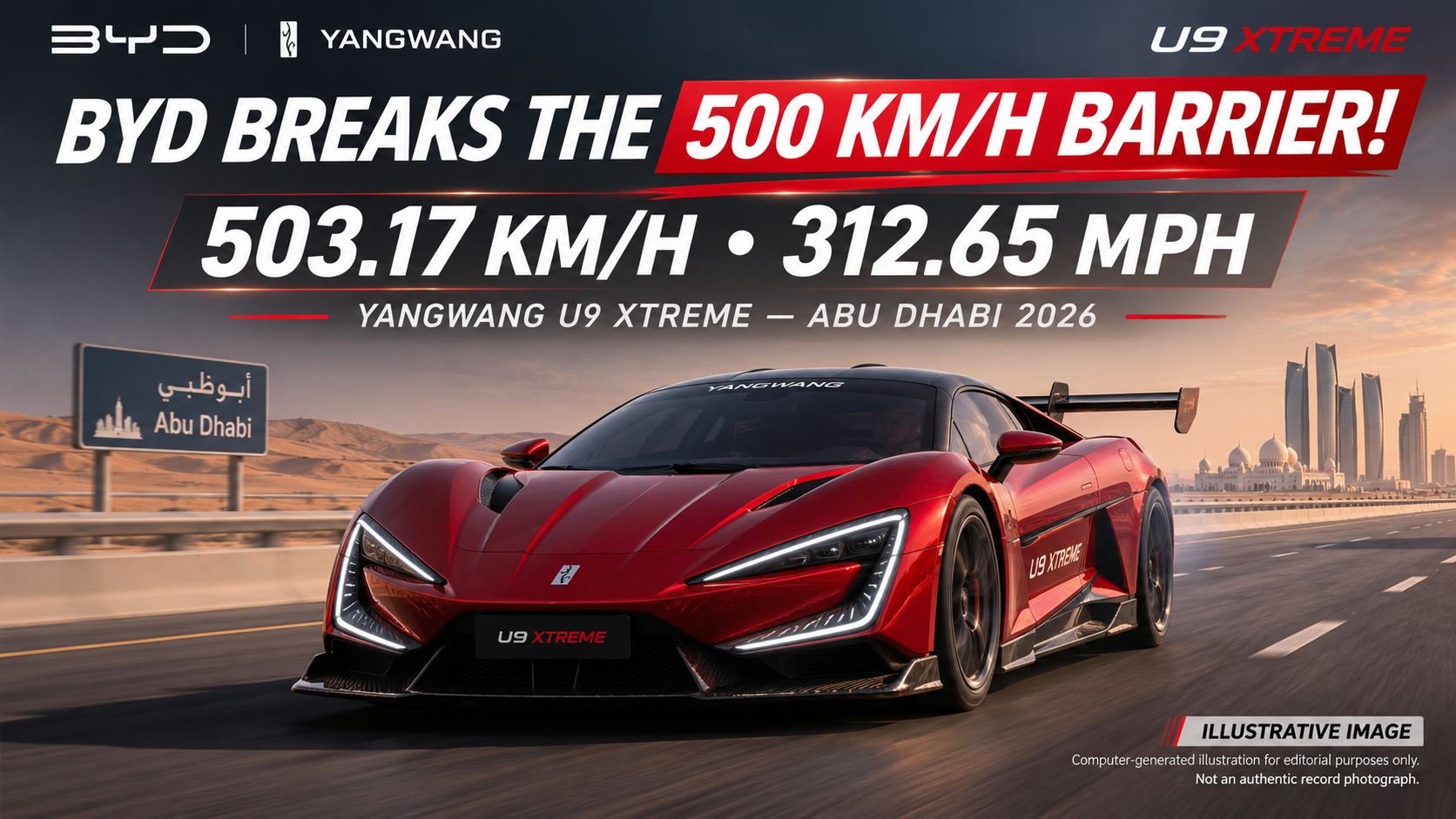
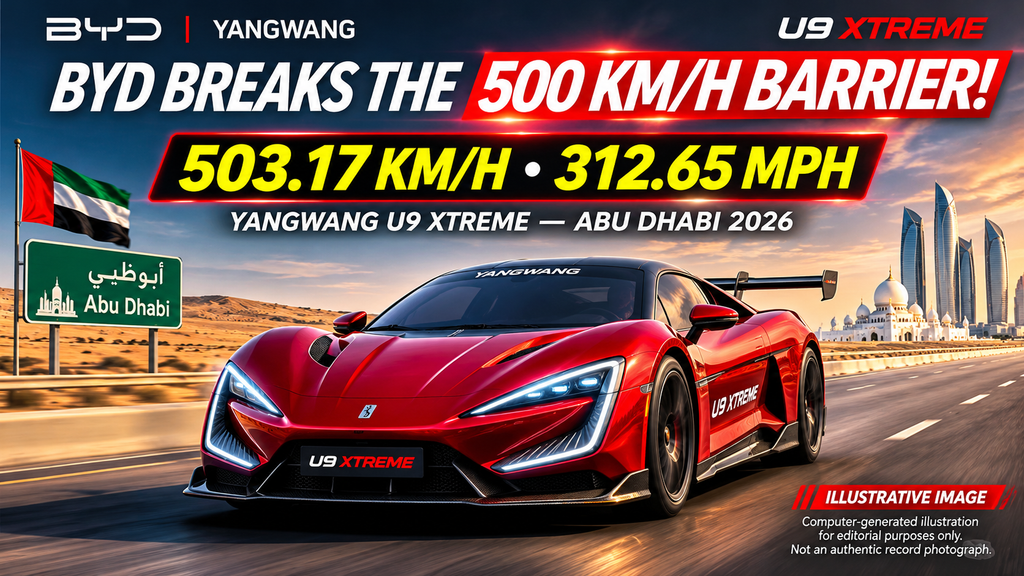
Editor’s verified update – November 6, 2026: The story is now officially confirmed. The Yangwang U9 Xtreme reached 503.17 km/h (312.65 mph) on November 1, 2026, in Abu Dhabi. The FIA has recognised the achievement, and Guinness World Records has awarded two single-direction speed records. The road was closed to ordinary traffic for the attempt. Federation Internationale de l’Automobile
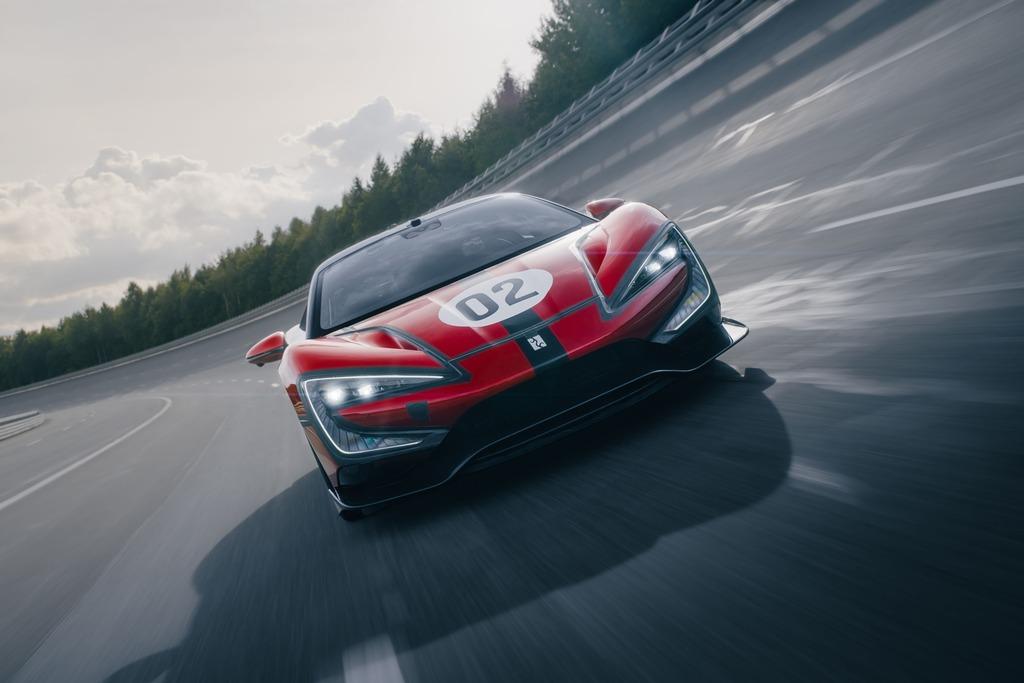
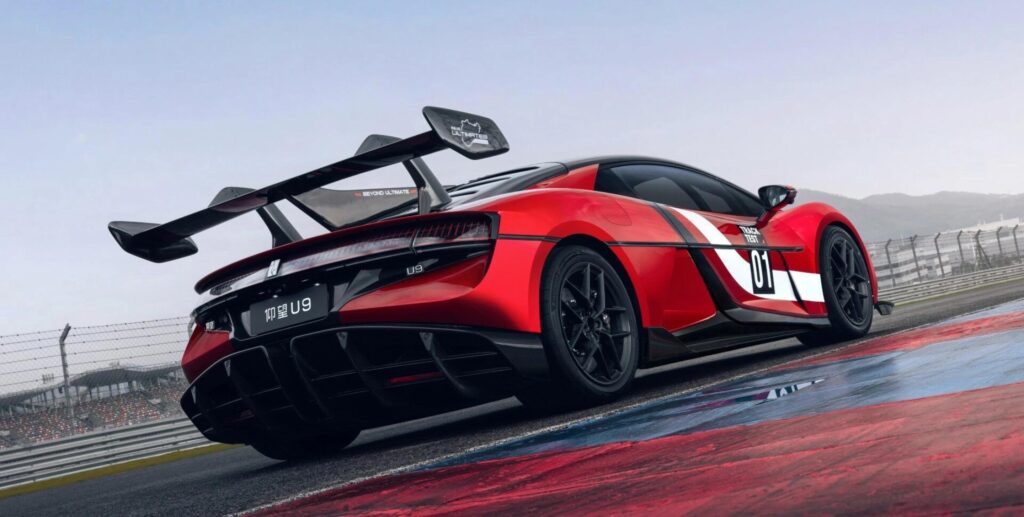
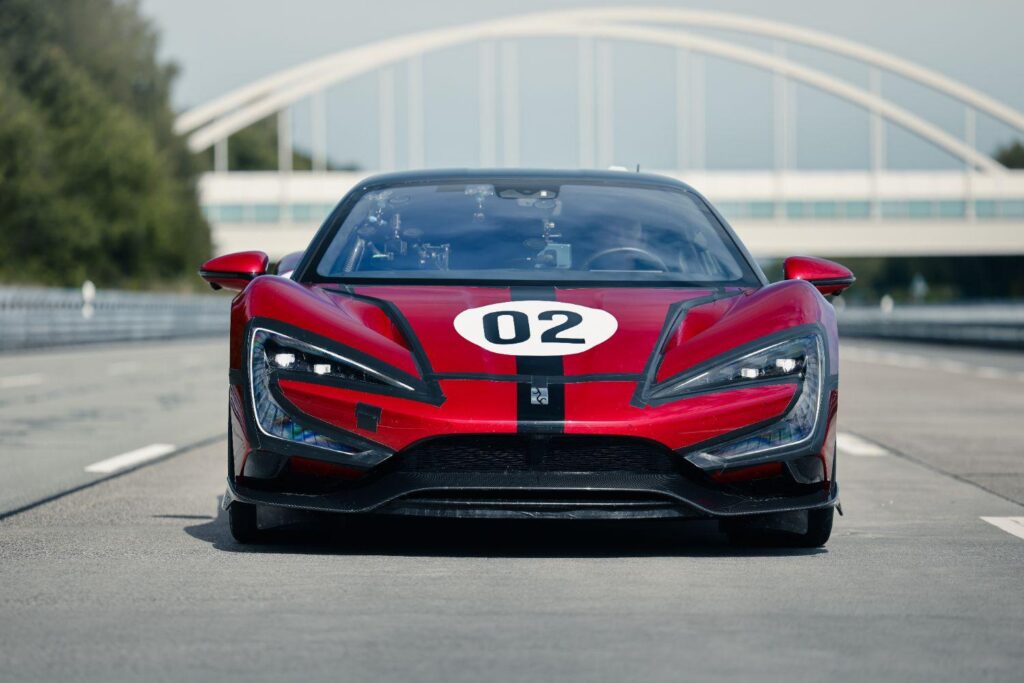
Yangwang U9 Xtreme – the BYD luxury division’s record-breaking electric hypercar.
What Actually Happened on the UAE Motorway?
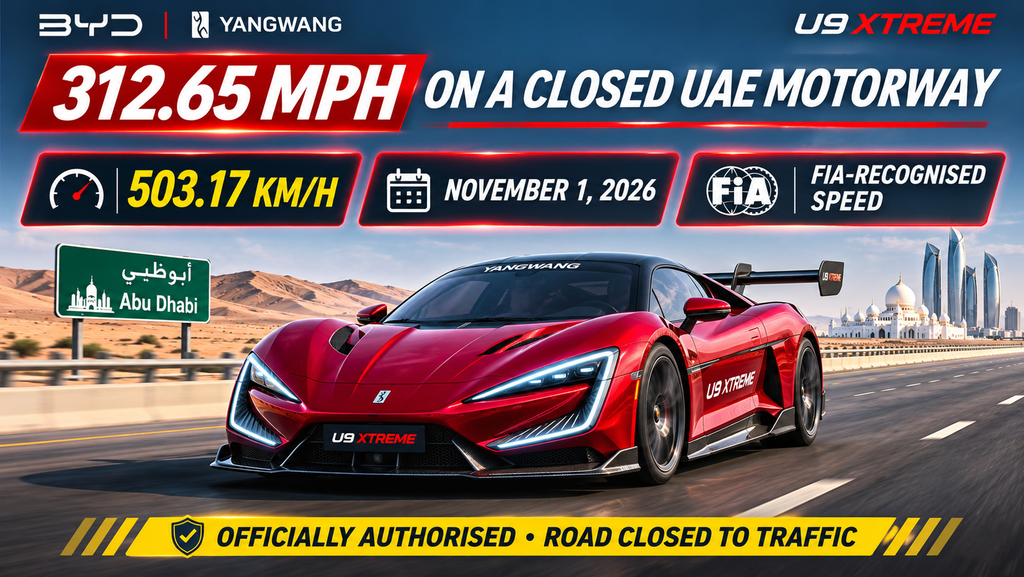
The record-breaking attempt took place on Sheikh Khalifa Bin Zayed International Road, also known as the E11, in Abu Dhabi’s Al Dhafra region. This was not an ordinary driver testing the limits of a powerful car during a daily commute. Local authorities cooperated with the organisers to close a 10-kilometre section of road, including approximately seven kilometres of straight roadway. The team could therefore conduct its high-speed testing without exposing regular motorway traffic to the extraordinary risks involved.
German racing driver Marc Basseng took the wheel of the Yangwang U9 Xtreme. His experience in sports-car and endurance racing made him an appropriate choice for such a demanding challenge. At more than 500 km/h, even a small change in wind, road surface, tyre behaviour, or steering input can have enormous consequences. The driver must remain precise while the engineering team monitors the vehicle’s performance. The achievement was the result of coordinated professional testing rather than an improvised demonstration. Federation Internationale de l’Automobile
How the Record Attempt Developed
The attempt unfolded over two days. On October 31, 2026, the team completed two initial high-speed runs, reaching approximately 490 km/h. Although that speed was already exceptional, the engineers continued refining the vehicle. They adjusted its aerodynamic configuration, suspension settings, and tyre pressures to improve stability and extract additional performance. These changes may sound minor to an everyday driver, but at extreme speeds, small engineering decisions can significantly affect safety and the car’s ability to maintain its intended direction.
On November 1, the team conducted two more runs. During the second, the U9 Xtreme reached 503.17 km/h, exceeding its previous 496.22 km/h benchmark from Germany. That improvement of 6.95 km/h was enough to cross a symbolic barrier that production-car manufacturers had pursued for years. The FIA recognised the achievement, while Guinness recorded the results in its single-direction production-car categories. The precise category matters because a single-direction maximum speed is not the same measurement as an average of two opposite-direction runs. Federation Internationale de l’Automobile
The Official Numbers Behind the 312 MPH Record
Figures based on BYD’s official technical announcements and the FIA’s November 6, 2026 recognition. PS and mechanical horsepower use different units. BYD Official
One detail deserves special attention: the difference between metric horsepower and mechanical horsepower. BYD describes the vehicle as producing 3,019 PS, a metric measurement commonly used by European and Asian manufacturers. Converting that figure gives approximately 2,978 mechanical horsepower. Consequently, the widely repeated description of more than 3,000 horsepower is accurate when referring to metric PS, but slightly imprecise when interpreted as American mechanical horsepower. That distinction does not diminish the engineering achievement. It simply helps readers understand what the numbers mean.
How Fast Is 503.17 km/h in Everyday Terms?
At its recorded maximum speed, the Yangwang U9 Xtreme was travelling almost 140 metres every second. That is more than the length of a standard football pitch in a single second. In just three seconds, the car would cover approximately 419 metres if it maintained that speed. A distance of one kilometre would take only about 7.15 seconds. These calculations describe constant-speed travel, not the time required to accelerate from rest, which is a separate performance measurement.
To understand the difference, imagine a conventional motorway speed of 120 km/h. A vehicle travelling at that speed covers roughly 33 metres per second. The U9 Xtreme, at its record speed, moves more than four times as far during the same second. More importantly, the kinetic energy associated with motion increases with the square of speed. Assuming equal vehicle mass, travelling at 503 km/h involves approximately 17.6 times the kinetic energy of travelling at 120 km/h. This helps explain why tyres, braking systems, aerodynamic stability, and professional safety controls are so important.
Distance covered per second at constant speed
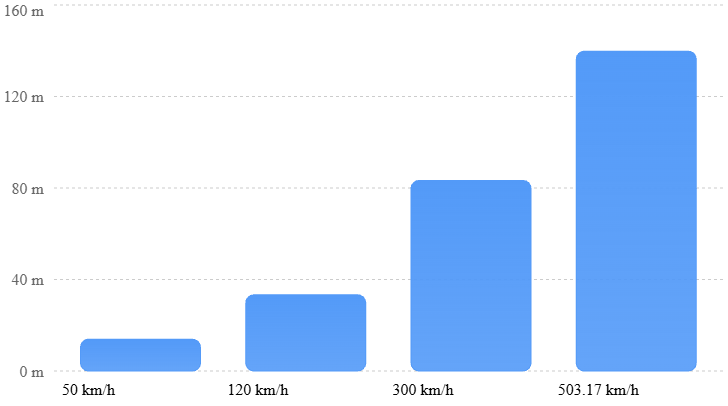
Calculated from speed ÷ 3.6; rounded to one decimal place.
Meet the Yangwang U9 Xtreme: BYD’s Electric Hypercar
The U9 Xtreme is a high-performance development of the Yangwang U9, a sports car introduced by BYD’s premium automotive division. Yangwang focuses on advanced technology, luxury, and performance, allowing BYD to explore engineering solutions beyond those used in its mainstream passenger vehicles. The Xtreme version takes that philosophy further, combining an upgraded electric powertrain with specialised suspension, aerodynamics, cooling, and tyres. It is designed to demonstrate what electric propulsion can achieve when maximum performance becomes a central development objective.
The distinction between the regular U9 and the U9 Xtreme is important. A standard production model cannot automatically be assumed to deliver the same power, top speed, or track performance as the limited Xtreme edition. BYD developed the U9 Xtreme around an upgraded 1,200-volt architecture and four extremely high-speed motors. The company has also stated that production will be limited to no more than 30 vehicles. That makes the Xtreme a highly exclusive hypercar rather than a conventional electric sports car intended for widespread ownership. BYD
How Four Electric Motors Generate Extraordinary Power
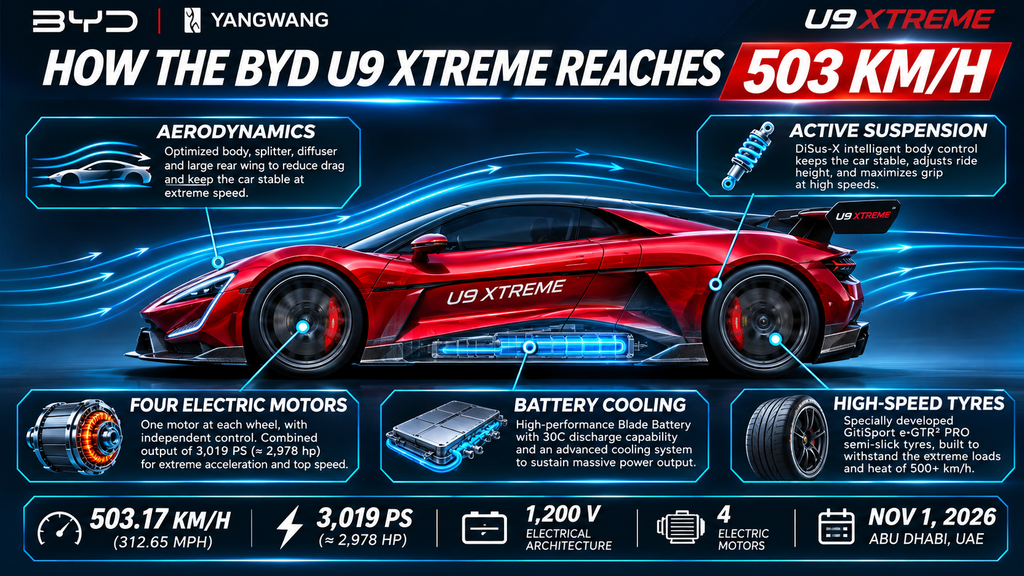
The Yangwang U9 Xtreme uses four independently controlled electric motors, one for each wheel. This configuration allows the vehicle to distribute power with remarkable precision. Instead of relying on a single engine and a conventional mechanical drivetrain to distribute torque, the car can manage the contribution of individual motors electronically. That creates opportunities for improved traction, stability, and responsiveness, particularly when the vehicle operates close to the limits of its performance envelope. It also introduces significant challenges involving software, cooling, electrical loads, and mechanical durability.
Each motor can operate at rotational speeds of up to 30,000 revolutions per minute, according to BYD. The combined system produces approximately 2,220 kilowatts, equivalent to 3,019 metric horsepower. Such figures require more than powerful electric motors alone. Engineers must also ensure that the battery can deliver electricity at the necessary rate, that the power electronics can manage the current, and that heat does not overwhelm critical components. Every part of the system must work together to sustain the vehicle’s performance safely. BYD
Why Independent Motor Control Matters
Consider an ordinary car accelerating on a road where one side has slightly less grip than the other. A conventional traction-control system may reduce engine power or apply the brakes to prevent excessive wheelspin. An independently controlled four-motor system can also adjust the torque delivered to individual wheels. This gives engineers another way to influence the vehicle’s behaviour. For example, during cornering, carefully managed torque differences can help support the intended direction of travel, although the actual response depends on the software and driving conditions.
This technique is known as torque vectoring. It is particularly useful in high-performance electric vehicles because electric motors respond quickly to electronic commands. However, torque vectoring cannot eliminate the laws of physics. Tyres still have finite grip, and a vehicle travelling at extreme speed remains vulnerable to disturbances. Engineers must coordinate motor output with steering, suspension, stability systems, and aerodynamic forces. The result is a sophisticated control strategy rather than simply four motors producing maximum power at all times.
Why Peak Horsepower Is Not the Whole Story
A car with enormous horsepower is not automatically the fastest car in the world. Power represents the rate at which energy can be delivered, but top speed also depends on aerodynamic drag, rolling resistance, gearing, tyre limitations, and drivetrain efficiency. At very high speeds, overcoming aerodynamic resistance becomes one of the greatest challenges. Engineers cannot simply double a car’s top speed by doubling its horsepower. In otherwise similar conditions, the power needed to overcome aerodynamic drag grows approximately with the cube of speed.
For example, increasing speed from 400 km/h to 500 km/h raises the aerodynamic power requirement by roughly 95%, assuming the same drag coefficient, frontal area, and air density. This explains why an additional few kilometres per hour can require extensive development. Engineers may spend months improving airflow, reducing unwanted lift, adjusting suspension behaviour, and controlling heat. The Yangwang U9 Xtreme demonstrates how electric power, aerodynamic development, and vehicle control must work together to produce a record-breaking result.
Why BYD Uses a 1,200-Volt Electrical Architecture
Most people associate electric vehicle performance with battery size or motor power. However, the electrical architecture also plays an essential role. BYD equipped the U9 Xtreme with a 1,200-volt system, compared with the 800-volt architecture used by the earlier U9 platform. Higher operating voltage can help engineers deliver substantial electrical power while reducing the current required for a given power level. That matters because electrical resistance creates heat, and managing that heat becomes increasingly difficult as current rises.
Imagine two systems transferring the same amount of electrical power. In a simplified calculation, delivering 1,200 kilowatts at 800 volts requires 1,500 amperes. At 1,200 volts, the same power requires 1,000 amperes. This example does not describe the exact operating conditions of the U9 Xtreme, but it illustrates the engineering principle. Lower current can reduce resistive losses in comparable conductors, although real-world performance also depends on component design, efficiency, temperature, and the electrical system’s operating limits.
How Higher Voltage Supports Extreme Performance
A high-voltage platform affects much more than the battery pack. Engineers must design compatible inverters, wiring, insulation, connectors, protection systems, and thermal-management equipment. Components must withstand demanding electrical conditions while remaining reliable under vibration and rapid changes in power demand. For a hypercar, these requirements become particularly challenging because the vehicle must combine enormous performance with compact packaging. Every additional component also adds weight, which can influence acceleration, handling, and energy consumption.
The advantage of higher voltage is therefore part of a broader engineering strategy. It allows designers to explore power levels that would otherwise demand extremely high currents. However, a 1,200-volt rating does not automatically mean faster charging, better efficiency, or superior everyday performance. Those outcomes depend on the complete vehicle design. In the U9 Xtreme, the architecture primarily supports the demanding requirements of an exceptionally powerful electric drivetrain. BYD
The Blade Battery and the Challenge of Delivering 3,000 PS
The battery is one of the most important components in any electric hypercar. It must store energy, deliver substantial power, manage heat, and operate within carefully controlled safety limits. BYD’s U9 Xtreme uses a high-performance lithium iron phosphate Blade Battery configuration with a reported discharge capability of 30C. This specification is particularly interesting because it highlights the difference between storing a large amount of energy and releasing that energy rapidly when the vehicle demands maximum performance.
The C-rate describes the relationship between electrical current and battery capacity. In simplified terms, a battery operating at 1C would theoretically deliver its rated capacity over one hour. At 30C, the corresponding current is thirty times greater. That does not mean a vehicle can safely sustain such an extreme discharge indefinitely. Actual performance depends on the battery’s design, state of charge, temperature, protection systems, and operating limits. The rating instead indicates the battery’s ability to support very demanding short-duration power requirements. BYD
Why Battery Cooling Is Essential
Whenever a battery delivers high electrical power, some energy becomes heat. If engineers cannot remove that heat effectively, temperatures can rise and the system may need to reduce power to protect itself. This behaviour, commonly called thermal derating, is important in high-performance electric vehicles. A car may produce exceptional power briefly but struggle to maintain it during repeated acceleration or prolonged high-load operation. Consequently, a record-setting hypercar needs a cooling system designed around its expected performance demands.
BYD has described significant cooling-system development for the U9 Xtreme, including changes intended to support demanding circuit performance. That work matters because extreme speed testing is not only about reaching a number on a display. The car must maintain stable electrical and mechanical conditions throughout the run. Cooling must support the battery, motors, and power electronics while preserving aerodynamic efficiency. Large cooling openings can increase drag, so engineers must balance thermal performance against the need for a streamlined body. BYD
Aerodynamics: The Invisible Force Behind 503 KM/H
At ordinary motorway speeds, drivers may notice aerodynamic effects through wind noise and fuel or electricity consumption. At 500 km/h, airflow becomes one of the defining engineering challenges. The air pushes against the vehicle with enormous force, while aerodynamic lift and downforce influence how securely the tyres remain in contact with the road. Even small changes to the shape of a front splitter, underbody, rear diffuser, or wing can alter the vehicle’s behaviour. Engineers must carefully control these forces to preserve stability.
A hypercar designed exclusively for maximum straight-line speed might prioritise low aerodynamic drag. A vehicle intended for circuit driving also needs sufficient downforce to corner effectively. These goals can conflict. Larger wings and aggressive aerodynamic surfaces may increase grip but also create additional resistance. The U9 Xtreme therefore presents an interesting engineering problem: it must achieve extraordinary straight-line speed while retaining the capabilities needed for demanding track driving. Its aerodynamic development reflects that difficult compromise.
Why a Small Aerodynamic Adjustment Can Matter
Consider a vehicle approaching 500 km/h with a slightly unstable aerodynamic balance. If airflow creates excessive lift at one end, the driver may experience reduced steering confidence or an unwanted change in handling. Engineers can respond by adjusting aerodynamic surfaces, ride height, or suspension settings. However, each change may influence drag, cooling, and tyre loading. Finding the correct balance requires simulation, controlled testing, and careful analysis of data gathered during actual runs.
This helps explain why the Abu Dhabi team made adjustments between its initial runs and the final record attempt. The official FIA account specifically mentions aerodynamic changes, suspension settings, and tyre pressures. Those modifications helped the team improve its result from approximately 490 km/h to more than 503 km/h. It would be inaccurate to attribute the entire improvement to one component, but the sequence demonstrates the importance of detailed vehicle setup. Federation Internationale de l’Automobile
The Special Tyres Needed to Survive 500 KM/H
Tyres are among the most overlooked parts of an extreme-speed record. Drivers often focus on horsepower, acceleration, and aerodynamic design, but none of those achievements would matter without tyres capable of supporting the vehicle. At 500 km/h, each tyre rotates extremely rapidly while carrying substantial loads. Centrifugal forces, deformation, heat, and road contact place enormous demands on the tyre structure. A failure at such a speed could have catastrophic consequences, which is why tyre development is central to professional high-speed testing.
BYD collaborated with Giti Tire to develop specialised high-performance tyres for the U9 Xtreme. The manufacturer has identified the GitiSport e·GTR² PRO semi-slick tyres as part of the vehicle’s track-focused engineering package. These are not ordinary road tyres that owners can select simply by matching the correct wheel diameter. Their construction and operating characteristics are designed around the demands of the vehicle. The exact tyre specification, condition, pressure, and temperature must all be considered during controlled testing. BYD
What Happens to a Tyre at Extreme Speed?
As a tyre rotates, its structure experiences repeated deformation. The tread enters the contact patch, supports the vehicle, and then returns to its original shape. This cycle produces heat, while centrifugal forces place additional stress on the tyre’s construction. At extreme rotational speeds, these effects become much more demanding. Engineers must ensure that the tyre maintains its shape, resists excessive heat, and provides predictable contact with the road. They also need to account for the aerodynamic forces acting on the vehicle.
Tyre pressure is another important variable. Pressure influences the tyre’s shape, contact patch, temperature behaviour, and structural response. However, there is no universal pressure setting that makes an ordinary tyre suitable for 500 km/h. The correct configuration depends on the specific tyre, vehicle, load, and testing conditions. That is why professional teams work closely with tyre manufacturers and follow controlled procedures. Motorists should never attempt to reproduce such speeds using standard road tyres or public roads.
DiSus-X Suspension: Keeping the Hypercar Stable
A powerful drivetrain can propel a car forward, but the suspension helps determine how the vehicle behaves while travelling. BYD’s DiSus-X intelligent body-control system is one of the technologies associated with the Yangwang U9 platform. For the Xtreme model, engineers revised the suspension to support the demands of high-speed and circuit driving. The system forms part of a broader approach to controlling vehicle movement, maintaining stability, and coordinating the car’s behaviour under challenging conditions.
Suspension development becomes especially important when a vehicle travels over an imperfect road surface. Even a seemingly smooth motorway contains small variations in elevation, texture, and surface condition. At very high speeds, those variations arrive rapidly. The suspension must respond while maintaining predictable tyre contact and controlling body movement. Engineers also need to manage changes in aerodynamic loading, because the forces acting on the car increase significantly with speed. BYD
Why Ride Height and Body Movement Matter
Imagine a vehicle moving at high speed while its front suspension compresses slightly. That movement can change the airflow beneath the car and around its aerodynamic components. Depending on the design, the resulting aerodynamic forces may influence the vehicle’s balance. A well-developed suspension system helps engineers maintain the intended operating position while allowing the tyres to follow the road surface. The challenge is to achieve stability without making the vehicle excessively rigid or unpredictable.
The U9 Xtreme combines its suspension technology with electronic power distribution and carefully developed aerodynamics. These systems serve different purposes, but they influence the same vehicle. A change in body movement can affect tyre loading, while torque distribution can influence the forces acting on individual wheels. The effectiveness of the complete package depends on how successfully engineers coordinate these interactions. No single technology can make a car immune to the risks associated with extreme speed.
Carbon-Ceramic Brakes and the Problem of Stopping
Reaching 503 km/h is only one part of a successful record attempt. The vehicle must also slow down safely and predictably. BYD has described an upgraded titanium-alloy carbon-ceramic braking system for the U9 Xtreme, developed to support its demanding performance requirements. High-performance braking components can provide strong braking capability while managing substantial thermal loads, but they still operate within physical limits. Tyre grip, aerodynamic forces, road conditions, and vehicle stability all affect the actual stopping process.
The kinetic energy of a moving vehicle increases with the square of its speed. As a result, a car travelling at 500 km/h carries much more kinetic energy than the same car travelling at 250 km/h. Specifically, doubling speed increases kinetic energy by a factor of four. During braking, that energy must be dissipated or recovered through the vehicle’s braking systems. In an electric hypercar, regenerative braking may contribute under suitable conditions, but friction brakes remain essential for demanding high-speed stopping situations. BYD
A Simple Example of Braking Distance
Suppose a vehicle is travelling at 503.17 km/h and achieves a constant deceleration of 1g, approximately 9.81 metres per second squared. Using a simplified physics calculation, the braking distance would be roughly 996 metres, excluding driver reaction time. This is an illustrative mathematical example, not a measured stopping distance for the Yangwang U9 Xtreme. Actual braking performance varies with tyre grip, aerodynamic forces, brake temperatures, road conditions, and how the vehicle’s systems respond.
At the same speed, a one-second delay before braking would add approximately 140 metres of travel. This makes the risks easier to understand. A driver has extremely little time to respond to unexpected obstacles, and the distance required to slow down can be enormous. The calculation also shows why record attempts require long, carefully prepared road sections. Professional teams must plan acceleration, maximum-speed measurement, and deceleration zones before any high-speed run begins.
How BYD Prepared the UAE Record Attempt
A successful speed-record attempt begins long before the driver enters the car. Engineers must inspect the vehicle, assess the testing environment, establish safety procedures, and coordinate with the authorities responsible for the location. For the Abu Dhabi achievement, the organisers used a closed section of the E11 motorway. The team had to consider the road’s straight-line length, surface condition, surrounding environment, and space available for acceleration and deceleration. These requirements distinguish a controlled record attempt from dangerous speeding on an open public road.
The choice of location was also significant because the United Arab Emirates presents environmental conditions that differ from a European proving ground. High ambient temperatures, desert dust, and wind can create additional challenges for vehicle performance. Engineers must assess how these conditions influence cooling, tyre behaviour, aerodynamics, and stability. Although the official reports do not disclose every detail of the team’s preparation, they confirm that the vehicle underwent multiple runs and setup adjustments before reaching the final speed. Federation Internationale de l’Automobile
The Importance of Controlled Testing
Professional high-speed testing relies on preparation and repeatable procedures. Teams establish responsibilities for the driver, engineers, safety personnel, and officials. They also examine technical information gathered during each run to identify unexpected behaviour. For example, engineers may compare temperatures, motor output, vehicle movement, and aerodynamic performance against expected operating ranges. If the data reveals a concern, the team can investigate before proceeding. The goal is not simply to achieve a headline-grabbing number but to understand how the vehicle behaves.
The Abu Dhabi attempt illustrates this process. After reaching approximately 490 km/h on October 31, the team refined the vehicle before returning for further testing on November 1. The final 503.17 km/h result emerged from this structured approach. The involvement of authorities and official recognition also gives the achievement a stronger foundation than an unsupported video circulating online. It demonstrates why the circumstances surrounding a speed claim matter just as much as the number itself.
Why the FIA and Guinness Recognition Matters
Automotive speed records often generate confusion because different organisations apply different rules. Some achievements involve prototype vehicles, while others focus on production cars available to customers. Certain categories require two runs in opposite directions, with the average speed determining the result. Other categories recognise the highest speed achieved in a single direction. These distinctions are important because wind, road gradient, vehicle configuration, and measurement procedures can influence a recorded result.
The Yangwang U9 Xtreme’s 503.17 km/h achievement received FIA recognition and two Guinness World Records in single-direction production-car categories. The awards cover the highest speed achieved by a production car and by an electric production car during a single-direction run. That makes the achievement officially recognised within those categories. However, it should not be described as a two-way average-speed record, because the published recognition identifies a different measurement standard. Federation Internationale de l’Automobile
Why a Single-Direction Record Is Different
Imagine a car travelling along a straight road with a favourable tailwind. The wind could help the vehicle achieve a slightly higher speed than it might reach under neutral conditions. Running in the opposite direction can help balance the influence of wind and road gradient. That is why some traditional speed-record procedures use the average of two opposite-direction runs. A single-direction record measures the highest qualifying speed achieved in one direction under the applicable category rules.
This does not make the U9 Xtreme’s achievement unimportant. Surpassing 500 km/h in a production-car category remains an extraordinary engineering accomplishment. The distinction simply ensures that readers understand exactly what has been recognised. Responsible automotive reporting should identify the speed, vehicle, location, date, driver, and record category rather than treating every headline as interchangeable. Clear reporting makes an impressive achievement more credible, not less.
From Germany to Abu Dhabi: BYD’s Speed Record Journey
The November 2026 record did not happen overnight. BYD’s engineers spent years developing the Yangwang U9 platform, improving its electric motors, suspension, battery technology, and aerodynamic performance. The original U9 reached 309 km/h during testing in China in January 2024. Later that year, it achieved 391.94 km/h at Germany’s ATP Papenburg testing facility. Those figures already placed the car among serious high-performance electric vehicles, but the engineering team continued pushing the platform further.
In August 2025, a U9 Xtreme development vehicle reached 472.41 km/h. The following month, Marc Basseng drove the car to 496.22 km/h at Papenburg. That performance became a major milestone for electric hypercars. Then, in November 2026, the same model crossed the 500 km/h barrier in Abu Dhabi. The progression illustrates how engineering development often happens through incremental improvements rather than a single breakthrough. Federation Internationale de l’Automobile
BYD’s Documented Speed Progression
Officially reported maximum speeds from BYD and FIA announcements; runs occurred at different locations and under different conditions.
Each step in this progression represents a different development milestone. The jump from 309 km/h to more than 503 km/h amounts to an increase of approximately 63% in maximum speed. However, the aerodynamic power required at these speeds grows much faster than the speed itself. This means the engineering challenges became increasingly demanding as the car approached the 500 km/h threshold. The final few kilometres per hour required careful attention to aerodynamic resistance, tyre performance, suspension settings, and the vehicle’s overall efficiency.
The latest result is especially meaningful because the previous 496.22 km/h achievement was already extraordinary. Increasing that figure by 6.95 km/h might seem modest compared with earlier improvements, but every additional increment at these speeds is difficult to achieve. The record shows that BYD continued developing the platform after its German success instead of treating that milestone as the end of the project.
The Nürburgring Record Shows Another Side of the U9 Xtreme
Top speed attracts headlines, but it does not reveal everything about a hypercar’s performance. A vehicle designed for straight-line acceleration might struggle on a demanding circuit filled with corners, elevation changes, and heavy braking zones. The Nürburgring Nordschleife in Germany is particularly challenging because it combines high-speed sections with technical corners and changing road surfaces. Achieving a competitive lap time requires more than powerful motors. The car must accelerate, brake, turn, and manage heat consistently throughout the lap.
On August 22, 2025, the Yangwang U9 Xtreme completed the 20.832-kilometre Nürburgring Nordschleife in 6 minutes and 59.157 seconds. BYD announced the result in October 2025 as a record for its electric super sports car category. The achievement demonstrated that the vehicle’s engineering extended beyond straight-line speed. Its suspension, tyres, braking system, and cooling architecture were developed to support demanding circuit performance as well. BYD
Why a Sub-Seven-Minute Lap Matters
Completing the Nordschleife in less than seven minutes requires a car to perform effectively across many different driving situations. The driver must navigate high-speed corners, slower technical sections, braking zones, and elevation changes. A vehicle with exceptional horsepower but poor handling may lose significant time in corners. Similarly, an electric hypercar that overheats or reduces power during the lap may struggle to maintain its performance. A competitive lap therefore provides useful evidence about the overall engineering package.
The U9 Xtreme’s Nürburgring performance complements its top-speed achievements. The two results measure different capabilities, and neither should replace the other when evaluating the vehicle. Together, they suggest that BYD has developed a serious high-performance platform rather than a machine built solely to produce one impressive number. Nevertheless, comparisons with other manufacturers should account for track conditions, vehicle specifications, tyres, and the record categories involved.
BYD vs Bugatti: Is the Electric Hypercar Era Here?
For many automotive enthusiasts, Bugatti Chiron Super Sport 300+ represents one of the greatest achievements in traditional hypercar engineering. In 2019, Bugatti demonstrated a maximum speed of approximately 490.484 km/h with a specially prepared vehicle. That achievement helped establish the modern 300 mph era. BYD’s Yangwang U9 Xtreme has now exceeded that speed with an electric powertrain, creating an important moment in the relationship between established combustion-engine hypercars and emerging electric competitors.
However, a comparison between these cars requires context. Their powertrains, development goals, production configurations, and speed-record procedures differ. A single maximum-speed figure cannot determine which vehicle offers the best driving experience, strongest engineering package, or greatest overall capability. Bugatti has decades of experience developing luxury high-performance automobiles, while Yangwang represents a newer approach based on advanced electric technology. The U9 Xtreme’s achievement demonstrates that electric propulsion can compete at the highest levels of outright speed. BYD+1
Comparing Important Performance Figures
| Vehicle | Reported top speed | Powertrain |
|---|---|---|
| Yangwang U9 Xtreme | 503.17 km/h | Four electric motors |
| Yangwang U9 Xtreme, 2025 run | 496.22 km/h | Four electric motors |
| Bugatti Chiron Super Sport 300+ test vehicle | 490.484 km/h | Quad-turbo W16 |
These figures describe reported maximum-speed achievements, not directly comparable two-way record results. The U9 Xtreme’s latest speed is FIA-recognised within its single-direction categories. Federation Internationale de l’Automobile
What BYD Has Proven Against Traditional Hypercars
BYD has demonstrated that an electric vehicle can achieve an officially recognised maximum speed beyond 500 km/h in the relevant production-car category. That is a major technical accomplishment because electric powertrains face their own challenges involving battery discharge, heat management, vehicle weight, and sustained performance. The result challenges the assumption that combustion engines must dominate the highest levels of automotive speed. It also places pressure on other manufacturers to reconsider the potential of electric propulsion.
What the achievement does not prove is that every electric hypercar is superior to every combustion-powered competitor. Driving enjoyment, braking, handling, endurance, charging infrastructure, reliability, and ownership experience remain important. Some enthusiasts value the sound and mechanical character of a traditional engine, while others appreciate the immediate response and advanced control capabilities of electric motors. Both approaches can produce exceptional cars. The most interesting outcome may be the competition between different engineering philosophies.
Can Electric Hypercars Become Faster Than 503 KM/H?
The Yangwang U9 Xtreme has crossed a symbolic threshold, but automotive engineering rarely stops at a round number. Manufacturers and specialist engineering teams may continue exploring higher speeds as electric motor technology, batteries, aerodynamics, and tyre construction improve. Nevertheless, exceeding 503 km/h does not guarantee that substantially higher speeds will become practical. The physical demands increase rapidly, and each improvement requires careful consideration of reliability and safety.
One of the greatest limitations is aerodynamic drag. As speed rises, the power needed to overcome air resistance increases dramatically. Tyres also face increasingly demanding operating conditions, while cooling systems must manage enormous electrical and mechanical loads. Engineers could potentially improve performance through lighter components, more efficient power electronics, advanced materials, or refined aerodynamic designs. Yet each solution introduces trade-offs involving cost, complexity, weight, or durability.
Why 600 KM/H Would Be a Different Challenge
A speed of 600 km/h would represent an increase of approximately 19.2% over the U9 Xtreme’s latest result. Although that percentage may not sound enormous, the aerodynamic power requirement would rise by approximately 70% under otherwise identical conditions. This simplified comparison considers aerodynamic drag rather than the vehicle’s complete power requirement. It nevertheless illustrates why pushing beyond 500 km/h becomes increasingly difficult.
At such speeds, tyre integrity, road preparation, stability, and stopping distance would become even more critical. A vehicle travelling at 600 km/h covers approximately 167 metres every second. Engineers would need to evaluate every component against those conditions, and any attempt would require a suitable controlled environment. There is no confirmed basis for claiming that BYD has announced or achieved a 600 km/h production-car record. For now, the documented 503.17 km/h achievement stands as the relevant milestone.
What This Record Means for Everyday Electric Cars
Most drivers will never experience anything close to the performance of a Yangwang U9 Xtreme. Ordinary roads have speed limits, and daily driving priorities include safety, comfort, efficiency, reliability, and affordability. Nevertheless, extreme-performance projects can contribute to broader automotive development. Technologies created for demanding applications sometimes influence more accessible vehicles over time, although the process is neither automatic nor guaranteed.
For example, research into efficient power electronics may help engineers reduce electrical losses. Improved cooling strategies could support better performance during sustained driving or charging. Advanced motor-control software may contribute to more precise traction and stability management. Battery development can also benefit from knowledge gained through high-power applications. However, a hypercar’s specialised components may be too expensive or unnecessary for ordinary passenger cars, so manufacturers must adapt the underlying ideas.
Why High-Performance Research Can Benefit EV Owners
Imagine an electric family SUV travelling through mountainous terrain on a hot summer day. The vehicle may face repeated acceleration, long climbs, and demanding battery temperatures. Lessons from high-performance thermal management could help engineers develop systems that maintain consistent operation under challenging conditions. Similarly, improved electrical architecture may eventually contribute to more efficient and capable mainstream vehicles. The benefits would come through careful engineering adaptation rather than direct installation of hypercar components.
The U9 Xtreme also demonstrates how software has become central to automotive performance. Modern electric vehicles depend on sophisticated systems that coordinate motors, batteries, braking, and stability control. As manufacturers improve these systems, everyday vehicles may gain smoother power delivery and more predictable handling. The record therefore has significance beyond the luxury hypercar market, even if its immediate commercial impact on affordable electric cars remains uncertain.
Is the Yangwang U9 Xtreme Available to Buy?
The Yangwang U9 Xtreme is intended for an exceptionally limited market. BYD announced that no more than 30 examples would be produced, making the vehicle a collector-oriented hypercar rather than a widely available performance model. This exclusivity reflects its specialised engineering, advanced components, and extraordinary capabilities. Buyers interested in such a vehicle would need to consider manufacturer availability, regional regulations, servicing arrangements, insurance, and the practical limitations associated with owning a rare high-performance automobile.
Reports surrounding the model’s 2026 presentation in China have described pricing above 20 million yuan, approximately $3 million at the exchange-rate comparison used in those reports. That figure should not be treated as a universal retail price, since taxes, regional availability, options, and market conditions may differ. Potential customers would need current information directly from Yangwang or an authorised representative. The car’s record-setting performance also should not be interpreted as permission to use those capabilities on public roads. BYD+1
What Ownership Would Actually Involve
Owning an electric hypercar with more than 3,000 PS involves considerations far beyond its purchase price. Specialised tyres, braking components, and suspension systems may require manufacturer-approved maintenance. Insurance could be expensive, while replacement parts and technical support might depend on the availability of authorised specialists. Charging compatibility, vehicle transport, storage, and local road-registration requirements would also deserve attention. The car’s limited production means ordinary ownership assumptions may not apply.
A buyer should also distinguish between the capabilities demonstrated during professional testing and the performance available in normal road use. Record attempts take place under controlled conditions with specialised preparation. Everyday operation must comply with traffic laws and manufacturer guidance. For most owners, the U9 Xtreme would likely serve as an extraordinary engineering collectible and occasional performance vehicle rather than practical daily transportation.
Why the UAE Was an Important Location for This Achievement
The United Arab Emirates has become closely associated with ambitious automotive projects, advanced infrastructure, and high-profile engineering demonstrations. Its extensive road networks and desert landscapes can offer distinctive environments for organised testing, provided the necessary permissions and safety measures are established. For the U9 Xtreme attempt, the organisers selected a section of the E11 in Abu Dhabi’s Al Dhafra region. The location allowed the team to conduct a controlled high-speed run outside a conventional proving ground.
That difference gives the achievement an unusual character. The vehicle reached its record speed on a road normally associated with transportation rather than a dedicated automotive test circuit. However, the section was closed to regular traffic during the attempt. This is an essential detail because describing the event simply as a car travelling at 312 mph on a motorway could wrongly suggest reckless driving among ordinary motorists. The official context is a professionally organised, authorised record attempt. Federation Internationale de l’Automobile
Why Public-Road Speed Records Need Clear Safety Rules
Extreme-speed testing on a road requires careful planning because the environment was not originally designed for routine operation at 500 km/h. Organisers must consider surface conditions, access points, emergency arrangements, and the distance required for acceleration and braking. They must also prevent unrelated vehicles and pedestrians from entering the controlled area. These responsibilities require cooperation between technical teams and the relevant authorities.
The Abu Dhabi achievement should therefore be understood as an exceptional engineering demonstration, not an example for ordinary drivers to follow. Speed limits and traffic regulations exist to protect road users, and even highly capable cars cannot overcome every unexpected hazard. Professional racing experience, sophisticated vehicle technology, and controlled conditions were essential parts of this record attempt.
Has BYD Officially Rewritten the Hypercar Rulebook?
The answer depends on what we mean by rewriting the rules. If the question concerns whether an electric production hypercar can surpass the 500 km/h barrier in an officially recognised single-direction speed category, the Yangwang U9 Xtreme has provided a clear answer. Its 503.17 km/h result represents a significant milestone in automotive engineering. The FIA recognition and Guinness awards give the achievement a documented status that goes beyond marketing claims or social media excitement.
However, the hypercar rulebook includes more than maximum speed. Manufacturers compete in acceleration, braking, handling, endurance, reliability, craftsmanship, exclusivity, and the emotional experience of driving. A car that dominates one category does not automatically lead every other category. The U9 Xtreme’s Nürburgring result strengthens its overall performance credentials, but broader comparisons still require consistent testing methods and clearly defined criteria.
A New Competitor at the Highest Level
Perhaps the most important change is the identity of the manufacturer. For decades, the fastest road-going hypercars were closely associated with specialist European brands and combustion-engine technology. BYD’s Yangwang division has now demonstrated that a Chinese electric vehicle manufacturer can compete in one of the most demanding areas of automotive performance. This achievement may encourage other manufacturers to invest more heavily in advanced electric hypercar technology.
The result also changes how enthusiasts discuss electric performance. Electric cars are no longer limited to conversations about instant acceleration or urban efficiency. The U9 Xtreme shows that carefully engineered electric powertrains can deliver extraordinary outright speed. Whether this becomes the beginning of a wider electric hypercar competition remains to be seen, but the engineering milestone is already significant.
Frequently Asked Questions
1. Did BYD really reach 312 mph in the UAE?
Yes. The Yangwang U9 Xtreme reached 503.17 km/h, equivalent to approximately 312.65 mph, on November 1, 2026. The attempt took place on a closed section of the E11 road in Abu Dhabi. The FIA recognised the achievement, and Guinness awarded two single-direction speed records. Federation Internationale de l’Automobile
2. Which BYD car achieved the 503 km/h record?
The vehicle was the Yangwang U9 Xtreme, also known as the U9X. It is a limited-production electric hypercar developed by BYD’s luxury Yangwang division. It differs substantially from the standard Yangwang U9 through its upgraded powertrain, electrical architecture, cooling, suspension, and high-performance components.
3. Does the Yangwang U9 Xtreme really have over 3,000 horsepower?
The manufacturer reports 3,019 PS, which means metric horsepower. That converts to approximately 2,978 mechanical horsepower. Therefore, the statement is correct when using the metric PS measurement, but the distinction between the two units should be explained in technical reporting.
4. Was the speed record achieved on an open public motorway?
No. Although the attempt took place on a road normally used for public transportation, the relevant section was closed to regular traffic. Local authorities cooperated with the organisers, allowing the professional team to conduct the attempt under controlled conditions.
5. Who drove the Yangwang U9 Xtreme during the record attempt?
German racing driver Marc Basseng was behind the wheel. He also drove the U9 Xtreme during its previous 496.22 km/h achievement in Germany in September 2025. His professional motorsport experience was important for such a demanding high-speed demonstration.
6. Is the Yangwang U9 Xtreme faster than the Bugatti Chiron Super Sport 300+?
In terms of the reported maximum speeds, yes. The Yangwang U9 Xtreme reached 503.17 km/h, while Bugatti’s 2019 demonstration reached approximately 490.484 km/h. However, record procedures and vehicle configurations differ, so these results should not be presented as identical categories of testing.
7. How many Yangwang U9 Xtreme cars will be manufactured?
BYD has announced a production limit of no more than 30 vehicles worldwide. This makes the U9 Xtreme an exceptionally rare electric hypercar. Availability, regional specifications, and purchase arrangements should be confirmed directly with the manufacturer.
8. What battery technology does the U9 Xtreme use?
The vehicle uses a high-performance version of BYD’s lithium iron phosphate Blade Battery technology. Its reported 30C discharge capability supports the enormous power demands of the electric drivetrain. The battery operates alongside advanced cooling and power-management systems.
9. Can the Yangwang U9 Xtreme reach 600 km/h?
There is no verified announcement establishing that the U9 Xtreme can reach 600 km/h. Its officially recognised November 2026 achievement is 503.17 km/h. Reaching 600 km/h would introduce substantially greater aerodynamic, mechanical, thermal, and safety challenges.
10. Is the 503.17 km/h achievement an official world record?
Yes, within the recognised single-direction categories. The FIA has recognised the speed, and Guinness World Records has awarded titles for the highest single-direction speed achieved by a production car and an electric production car. This should not be confused with a two-way average-speed record. Federation Internationale de l’Automobile
A Historic Moment for the Future of Electric Hypercars
The Yangwang U9 Xtreme’s 503.17 km/h achievement marks a remarkable chapter in automotive development. What once seemed beyond the capabilities of electric propulsion has now become an officially recognised performance milestone. Four independently controlled motors, a 1,200-volt electrical platform, advanced battery technology, specialised tyres, and carefully developed aerodynamics worked together to push the car beyond the 500 km/h barrier. The result reflects years of engineering rather than one extraordinary burst of acceleration.
Equally important is the context surrounding the achievement. The record took place on November 1, 2026, during an authorised, professionally organised attempt on a closed motorway in Abu Dhabi. It received FIA recognition and Guinness awards in defined single-direction categories. These details transform a sensational headline into a documented automotive achievement. They also remind us that responsible reporting should explain the circumstances of a record instead of focusing only on the largest number.
Has BYD rewritten the hypercar rulebook? In one important respect, it has demonstrated that electric vehicles can compete at the very highest level of production-car top-speed performance. The future will reveal whether other manufacturers can exceed this milestone and how the technologies developed for such exceptional machines might influence everyday electric vehicles. For now, the Yangwang U9 Xtreme has earned its place in the history of high-performance automotive engineering.
⚠️ Disclaimer and Source Hygiene
This article is intended for automotive news, education, and general information. Technical figures and record details are based on manufacturer announcements, FIA reporting, and supporting automotive journalism available as of November 6, 2026. Manufacturer specifications may differ from independently measured performance under other conditions. Prices, production availability, and technical details may change. Readers should consult official manufacturers, qualified automotive professionals, and relevant regulatory authorities before making purchasing or technical decisions.
The high-speed driving described in this article occurred under controlled and authorised conditions. It must not be attempted on public roads. Extreme-speed testing requires professional drivers, specialised equipment, appropriate facilities, and strict safety procedures. Illustrative images should be clearly distinguished from authentic photographs of the record attempt.
Sources and References
Official Primary Sources
1. FIA – Yangwang U9 Xtreme Surpasses 500 km/h, November 6, 2026. Official recognition, record date, location, driver, testing conditions, and Guinness record categories.
2. BYD UK Media – U9 Xtreme Sets New Speed Record in Abu Dhabi. Manufacturer confirmation of the 503.17 km/h achievement and powertrain specification.
3. BYD – Yangwang U9 Xtreme Reaches 496.22 km/h in Germany. Background on the September 2025 milestone and the vehicle’s technical architecture.
4. BYD – U9 Xtreme Nürburgring Lap Record. Technical information about the suspension, braking, tyres, and Nordschleife performance.
Secondary Sources and Testimonials
5. Motor1 – Chinese EV Hits 312 MPH to Become World’s Fastest Production Car. Independent automotive reporting on the Abu Dhabi attempt.
6. CarNewsChina – BYD’s Yangwang U9 Xtreme Tops 500 km/h. Additional coverage of the vehicle’s specifications, speed progression, and record achievement.
7. CnEVPost – Yangwang U9 Xtreme Breaks 500 km/h Barrier. Reporting on the latest record, powertrain, and limited production.
Editorial verification note: The official FIA and BYD announcements take priority over secondary reporting wherever details differ. Calculations explaining distance, energy, and aerodynamic power are illustrative physics examples rather than manufacturer test results. No fictional driver testimonials or unverified eyewitness accounts have been included.
