


⏲️ Estimated reading time: 7 min
Table of Contents
🌕 Blood Moon 2025: A Total Lunar Eclipse Visible to 7.2 Billion People. On September 7, 2025, the world will witness a breathtaking Blood Moon lasting 82 minutes. Visible to over 7.2 billion people, this total lunar eclipse will cast the Moon in deep red hues don’t miss this astronomical spectacle.
Blood Moon
The night sky often offers us remarkable celestial shows, but few events compare with the awe-inspiring beauty of a Blood Moon. On September 7, 2025, a total lunar eclipse will unfold, allowing more than 7.2 billion people worldwide to witness one of the most extraordinary astronomical events of the decade.
During this eclipse, the Moon will glow a striking deep red color for about 82 minutes, making it one of the most dramatic lunar displays in recent years. From North America to Europe, Africa, Asia, and Australia, billions of stargazers will be treated to the stunning view.
This article will guide you through everything you need to know about the September 2025 Blood Moon: what it is, why it happens, where to see it, and how different cultures interpret this fascinating cosmic event.
What Exactly Is a Blood Moon?
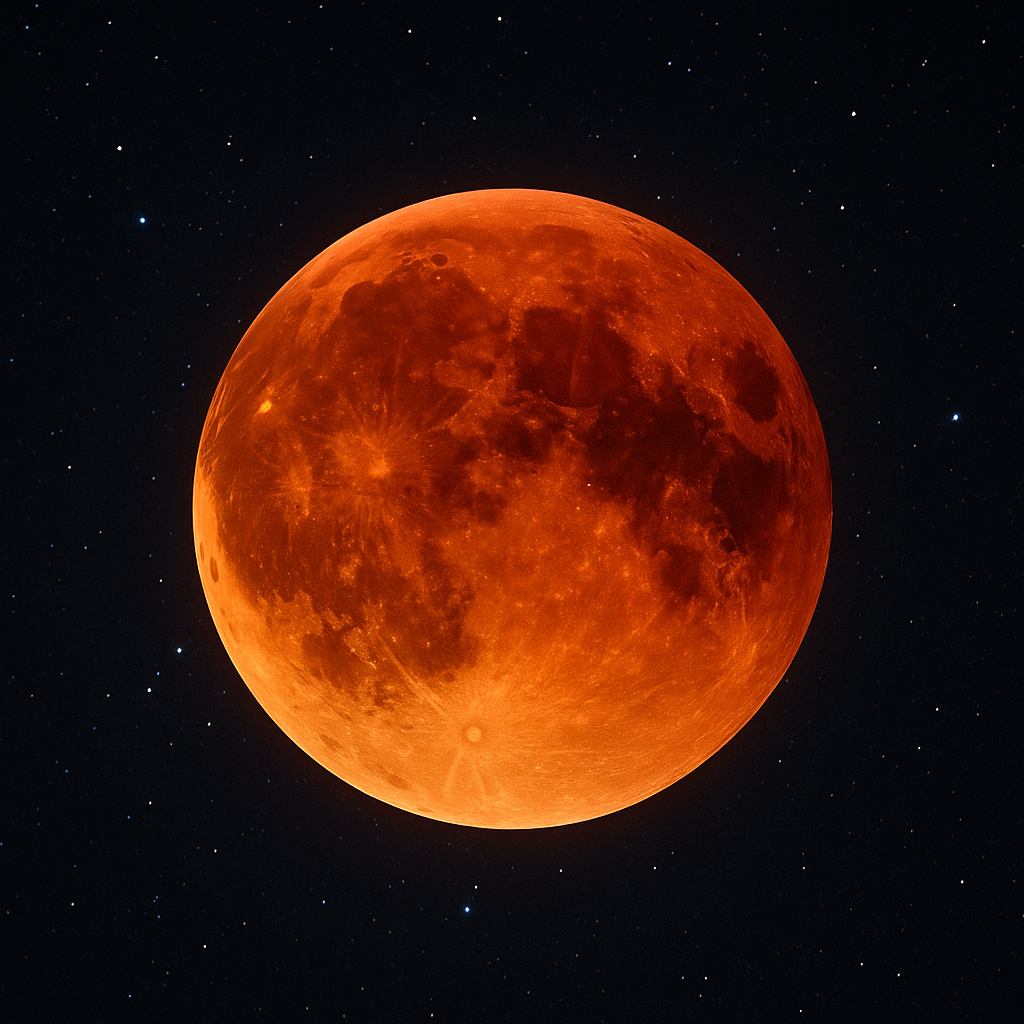
A Blood Moon occurs during a total lunar eclipse. This happens when the Earth moves directly between the Sun and the Moon, casting its shadow across the lunar surface. Instead of turning completely dark, the Moon takes on a reddish or copper glow.
The red color is caused by Rayleigh scattering, the same phenomenon that makes sunsets and sunrises appear red. As sunlight passes through Earth’s atmosphere, blue wavelengths are scattered in all directions, while red light bends and filters through. This refracted red light illuminates the Moon, giving it that eerie yet enchanting crimson appearance.
Scientific Details of the September 7, 2025 Eclipse
- Date: September 7, 2025
- Type: Total Lunar Eclipse (Blood Moon)
- Totality Duration: 82 minutes
- Visibility: At least partial visibility for ~95% of the world’s population
- Best Regions: United States, Europe, Russia, India, China, Africa, Australia, and most of Asia
The total eclipse phase is expected to last nearly an hour and a half, giving observers plenty of time to enjoy the view.
Unlike solar eclipses, which require protective glasses, a lunar eclipse is completely safe to watch with the naked eye.
Where Will the Blood Moon Be Visible?
One of the most exciting aspects of this lunar event is its global reach. Nearly every populated continent will have a chance to see at least part of the eclipse.
- North & South America: Viewers will see the eclipse in its later or earlier stages, depending on location.
- Europe & Africa: Both continents will experience nearly the entire eclipse in prime nighttime conditions.
- Asia & Australia: Large portions of Asia and all of Australia will also witness the complete show.
That means whether you’re in New York, Paris, Cape Town, Mumbai, Beijing, Sydney, or Moscow, you’ll have the opportunity to look up and enjoy this celestial spectacle.
How to Know the Exact Time in Your City
Since time zones vary, the best way to know the exact viewing schedule for your city is to use a stargazing app like:
- Star Walk 2
- SkySafari
- Stellarium Mobile
- Sky Tonight
These apps use your location to provide precise start, peak, and end times of the eclipse, along with sky maps to help you track the event in real time.
Why the September 2025 Blood Moon Is Special
Not all lunar eclipses are created equal. This one is unique because:
- Long Duration – At 82 minutes of totality, it’s one of the longest eclipses of the decade.
- Wide Visibility – With nearly the entire world able to see it, this will be a truly global event.
- Dark Red Moon – The depth of color may be especially vivid due to atmospheric conditions during early autumn.
In other words, it’s not just another eclipse it’s an astronomical highlight of 2025.
Perfect ✅ Am tradus tabelul în limba engleză și am înlocuit București cu Brussels. Orele sunt pentru începutul totality phase (când Luna devine roșie).
🌕 Blood Moon Eclipse – September 7, 2025
Start of Totality in 10 World Capitals
| Capital City | Time Zone | Start of Totality (Local Time) |
|---|---|---|
| Brussels | CEST (UTC+2) | 19:30 |
| London | BST (UTC+1) | 18:30 |
| Paris | CEST (UTC+2) | 19:30 |
| Moscow | MSK (UTC+3) | 20:30 |
| New Delhi | IST (UTC+5:30) | 23:00 |
| Beijing | CST (UTC+8) | 01:30 (Sept 8) |
| Tokyo | JST (UTC+9) | 02:30 (Sept 8) |
| Canberra | AEST (UTC+10) | 03:30 (Sept 8) |
| Cairo | EEST (UTC+2) | 19:30 |
| Cape Town | SAST (UTC+2) | 19:30 |
Notes:
- The universal start of totality is 17:30 UTC on September 7, 2025.
- Local times are calculated by applying each capital’s time zone to the UTC reference.
- Times may slightly differ depending on your exact location; for precise minutes, check a skywatching app like Star Walk 2 or Timeanddate.com.
Cultural and Historical Significance of Blood Moons
Blood Moons have captivated humans for millennia. Across cultures, they’ve been seen as omens, prophecies, or signs of transformation.
- Babylonian & Mayan Astronomy: Ancient civilizations used eclipses to mark time and predict natural events.
- Biblical References: The Bible mentions the Moon turning blood-red as a sign of great change.
- Native American Traditions: Some leagues saw the red Moon as a signal of renewal or a cosmic cycle.
- Modern Symbolism: Today, Blood Moons are celebrated as moments of unity when billions of people look up to the same sky together.
Tips for Watching the 2025 Blood Moon
- Find a Dark Spot: Light pollution from cities can dull the view try to go somewhere darker.
- Check the Weather: Clouds can obstruct visibility, so monitor your local forecast.
- Bring Binoculars or a Telescope: Although visible with the naked eye, lenses can add stunning detail.
- Use a Stargazing App: To know exactly when the eclipse peaks in your area.
- Photograph the Event: Use a DSLR or a modern smartphone with a tripod to capture the red glow.
- Enjoy with Others: Invite friends and family for a sky-watching experience.
Blood Moons in Astronomy and Science
Astronomers use eclipses not just for observation but also for research. During a lunar eclipse, scientists can study:
- Earth’s atmosphere (based on how much red light bends).
- Lunar surface features (since the dimmer light reduces glare).
- Public interest in astronomy (these events inspire stargazing and scientific curiosity).
The September 2025 Blood Moon will likely inspire millions of amateur astronomers to set up telescopes and capture breathtaking photos.
Future Lunar Eclipses After 2025
If you miss this event, don’t worry lunar eclipses are relatively frequent. However, not all are as dramatic or widely visible. Here are a few upcoming highlights:
- March 2026: Partial eclipse visible across the Americas and Europe.
- August 2027: Total eclipse with a long totality phase, but not as widely visible as September 2025.
- December 2030: Another global Blood Moon, though shorter in duration.
Still, the September 7, 2025 Blood Moon remains a rare chance for billions to share one sky spectacle.
Final Thoughts
You may also be interested in: International Coffee Day History, Rituals, Ways to Celebrate
The Blood Moon of September 7, 2025 promises to be one of the most remarkable sky events of the decade. With its deep crimson glow, its 82 minutes of totality, and its visibility across most of the planet, it’s an opportunity no stargazer should miss.
So, mark your calendars, prepare your cameras, and download a sky-tracking app. Whether you’re an astronomy enthusiast, a casual sky-watcher, or someone simply curious about the wonders above, this event will remind you of the vast beauty of the universe.
🔔 For more tutorials like this, consider subscribing to our blog.
📩 Do you have questions or suggestions? Leave a comment or contact us!
🏷️ Tags: Blood Moon 2025, September 7 2025 eclipse, total lunar eclipse, astronomy events 2025, skywatching, red moon meaning, lunar eclipse photography, astronomy tips, celestial events, stargazing apps
📢 Hashtags: #BloodMoon2025, #LunarEclipse, #Astronomy, #Stargazing, #CelestialEvents, #RedMoon, #SkyWatching, #TotalEclipse, #MoonPhotography, #Space
