

⏲️ Estimated reading time: 28 min
Table of Contents
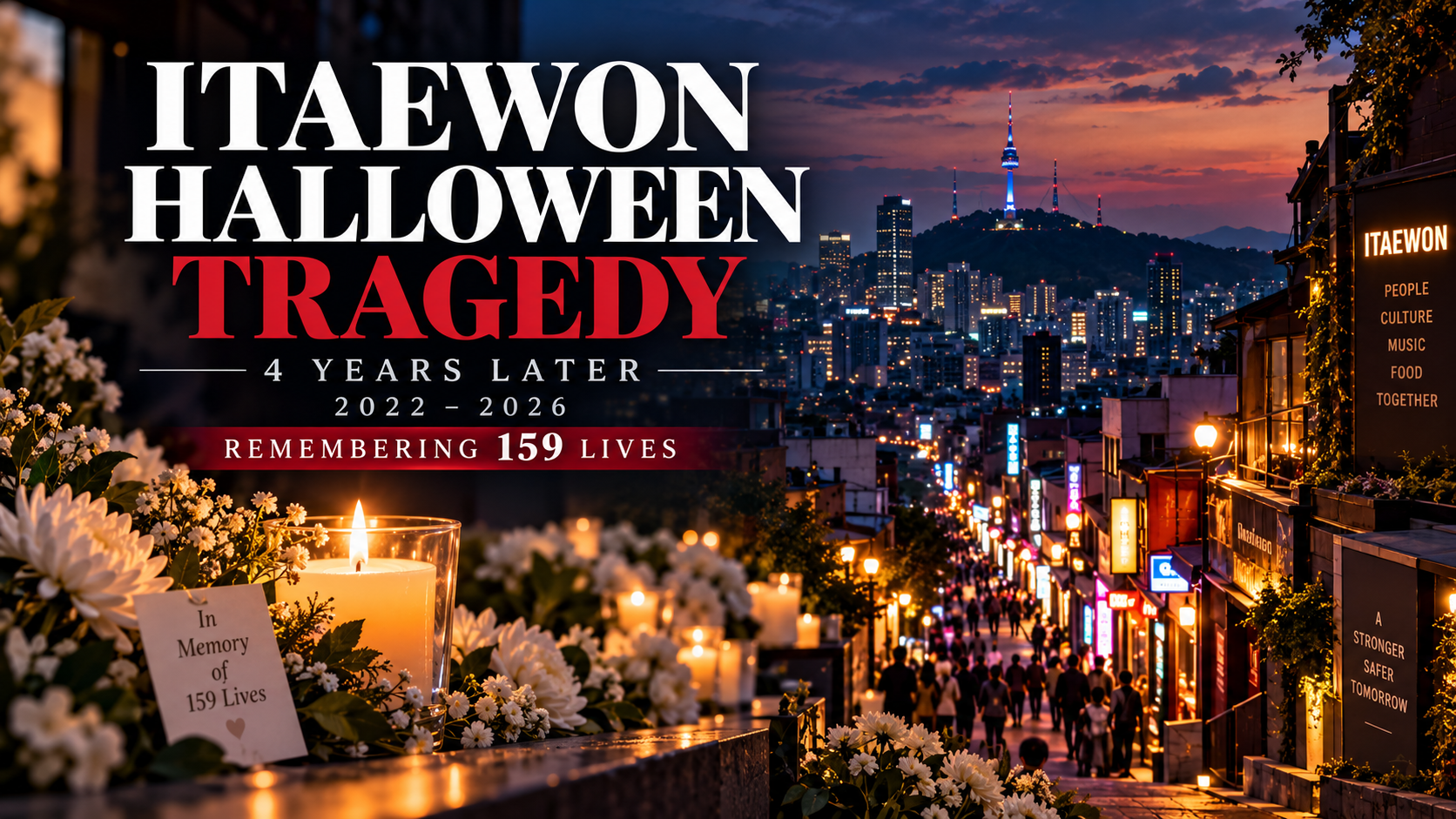
On October 29, 2022, a devastating crowd crush in Seoul’s Itaewon district claimed 159 lives. Four years later, South Korea continues to remember the victims while confronting difficult questions about public safety, emergency response, and accountability. Discover what happened, why it mattered, and the lessons that remain.
Remembering the Itaewon Halloween Tragedy Four Years Later
On the evening of October 29, 2022, thousands of people gathered in Itaewon, one of Seoul’s most recognizable entertainment districts. The neighborhood was filled with residents, international visitors, students, and young adults celebrating Halloween. What began as an evening of costumes, music, and social gatherings became one of the most devastating crowd disasters in South Korea’s recent history. In a narrow, sloping alley, extreme crowd pressure trapped people who could no longer move freely or escape. The resulting crowd crush claimed 159 lives and left many others injured. The tragedy shocked South Korea and drew international attention to the importance of crowd safety.
Four years later, the Itaewon Halloween tragedy remains a painful chapter in the country’s history. Behind the death toll were individuals with families, friendships, careers, and plans for the future. The disaster also raised difficult questions about how public authorities prepare for large gatherings, especially when celebrations take place across ordinary streets rather than inside controlled venues. The anniversary offers an opportunity to remember those who died, recognize the lasting impact on survivors and families, and examine the practical lessons that could help prevent similar disasters elsewhere.
What Happened in Itaewon on October 29, 2022?
Halloween Celebrations Draw Thousands to Seoul
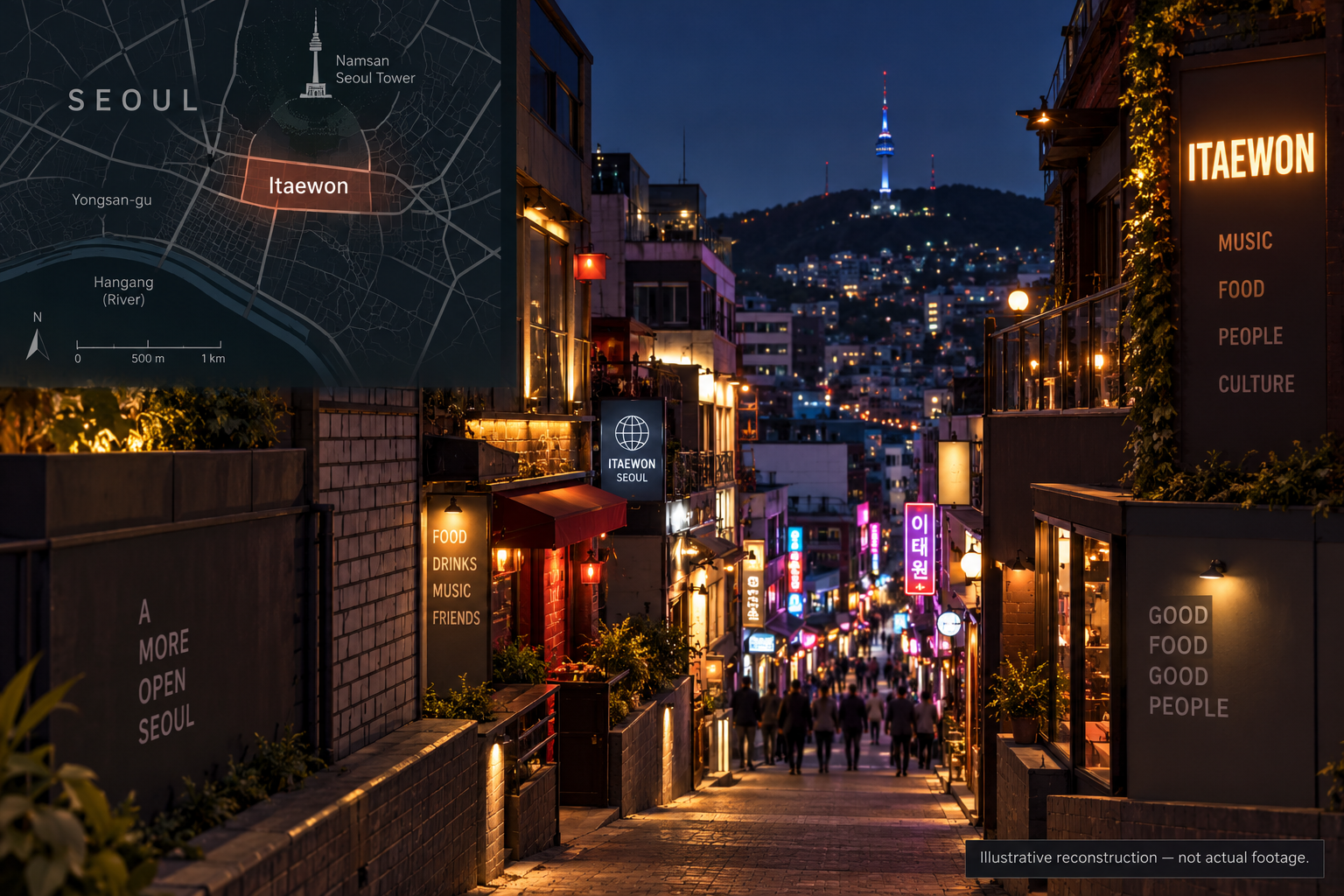
Itaewon has long been known for its international atmosphere, restaurants, nightlife, and cultural diversity. Located in Seoul’s Yongsan District, the neighborhood attracts both South Koreans and visitors from around the world. Halloween had become one of its busiest annual celebrations, particularly among younger adults. In 2022, the holiday also carried special significance because South Korea had eased many pandemic-related restrictions. Large numbers of people were eager to enjoy social activities after years of disruption. As evening approached, popular streets and entertainment areas became increasingly crowded, creating conditions that required careful attention to pedestrian movement.
Unlike a ticketed concert or a stadium event, the Halloween celebrations were decentralized. People entered the neighborhood through subway stations, streets, restaurants, and bars. There was no single entrance, organizer, or controlled capacity for the entire district. That distinction became important when investigators and safety experts later examined responsibility for managing the crowds. Although people gathered voluntarily across public spaces, the risks associated with predictable concentrations of pedestrians still required planning, communication, and appropriate emergency arrangements.
The Narrow Alley Where the Disaster Unfolded
The deadliest conditions developed in a narrow alley near the Hamilton Hotel, connecting a busy nightlife area with a larger street. The passage was sloped and became severely congested as people moved through the neighborhood. With individuals pressing from different directions, movement slowed until some people could no longer control their position. As crowd density increased, the force generated by surrounding bodies became dangerous. Those trapped in the congestion faced enormous pressure, while others struggled to understand what was happening farther along the passage.
The disaster was not simply the result of people falling or deliberately pushing one another. Extreme crowd density can produce powerful, involuntary movement that individuals cannot resist. Once pressure becomes sufficiently intense, people may be unable to expand their chests and breathe normally. This phenomenon is commonly associated with compressive or traumatic asphyxia. The Itaewon disaster demonstrated how quickly an ordinary pedestrian passage can become dangerous when the number of people exceeds the space’s safe capacity.
The Emergency Response
As conditions deteriorated, emergency calls and requests for assistance became increasingly urgent. Police officers, firefighters, medical personnel, and members of the public attempted to reach people trapped in the alley. Rescuers faced extraordinary difficulties because the surrounding streets were also congested. Removing people from the crowd, creating access for emergency vehicles, and providing immediate medical assistance all became urgent priorities. Witnesses and bystanders helped emergency personnel carry victims toward safer areas and performed cardiopulmonary resuscitation where possible.
The response continued through the night as authorities worked to identify victims, transport injured people, and notify families. Hospitals received casualties, while relatives searched for information about missing loved ones. The scale of the disaster placed immense pressure on emergency services and public institutions. In the following days, national attention turned toward the circumstances that allowed the dangerous crowd conditions to develop and whether earlier warnings, preventive measures, or better coordination could have reduced the loss of life.
The Human Cost: 159 Lives Lost
Understanding the Final Death Toll
The Itaewon Halloween crowd crush ultimately claimed 159 lives, including a survivor whose death was subsequently recognized as connected to the disaster. Early casualty figures changed as authorities identified victims, confirmed deaths, and updated official records. The final recognized total of 159 is widely used in accounts of the tragedy. Many victims were young adults, and the deceased included both South Korean citizens and foreign nationals. Their deaths affected families and communities across national borders, demonstrating how an event concentrated in one neighborhood could have consequences around the world.
The number 159 is an essential historical fact, but it cannot convey the full human cost. Each person who died had a unique identity and personal history. Families lost children, siblings, partners, and friends. Survivors faced physical injuries and, in some cases, prolonged emotional distress. Emergency workers and witnesses were also exposed to traumatic circumstances. Remembering the tragedy responsibly means acknowledging these experiences without reducing the victims to statistics or using their suffering as a source of spectacle.
The Impact on Families and Survivors
For bereaved families, the aftermath extended far beyond the initial days of mourning. Questions about what happened, why warnings were not acted upon effectively, and who should be held responsible became part of an ongoing search for answers. Families also had to navigate administrative procedures, investigations, public attention, and personal grief. Some joined memorial activities and advocacy efforts, seeking stronger safety measures and greater transparency from institutions responsible for protecting the public.
Survivors experienced different forms of recovery. Physical injuries could require medical treatment, while psychological effects might emerge gradually. People who witnessed the disaster or participated in rescue efforts could also experience distress. Recovery from a mass-casualty event does not follow a single timetable. Access to appropriate healthcare, mental health services, accurate information, and supportive communities can make a meaningful difference. Respectful remembrance recognizes that the impact of such an event continues long after emergency operations have ended.
Why Did the Itaewon Crowd Crush Become So Dangerous?
Extreme Crowd Density and Limited Movement
Crowd safety specialists distinguish between an ordinary busy gathering and a dangerously compressed crowd. In a normal pedestrian environment, individuals can change direction, maintain personal space, and leave when necessary. As density increases, these freedoms gradually disappear. At extreme levels, people may be carried by collective movement rather than walking independently. Pressure can travel through a crowd, creating sudden surges even when individuals are not intentionally pushing. Such conditions can be especially dangerous near walls, bottlenecks, barriers, and changes in elevation.
The Itaewon alley combined several hazardous characteristics. It was narrow, sloping, and connected areas with heavy pedestrian traffic. People entering the passage could not necessarily see the conditions ahead. Those already trapped had limited opportunities to move away from the pressure. The disaster illustrates why crowd management must focus on density, direction, available space, and early warning signs rather than waiting until injuries occur. Once dangerous compression develops, the ability of individuals to protect themselves becomes severely limited.
Why the Term Crowd Crush Matters
The Itaewon disaster is sometimes described as a stampede. However, crowd crush is generally a more accurate term for the mechanism involved. The word stampede can suggest a crowd running uncontrollably or acting irrationally. In many crowd disasters, the central danger comes from involuntary pressure created by extreme congestion. People may be standing still, trying to escape, or attempting to help others while being unable to control their movements. Describing the event accurately helps avoid unfairly blaming victims for conditions they could not control.
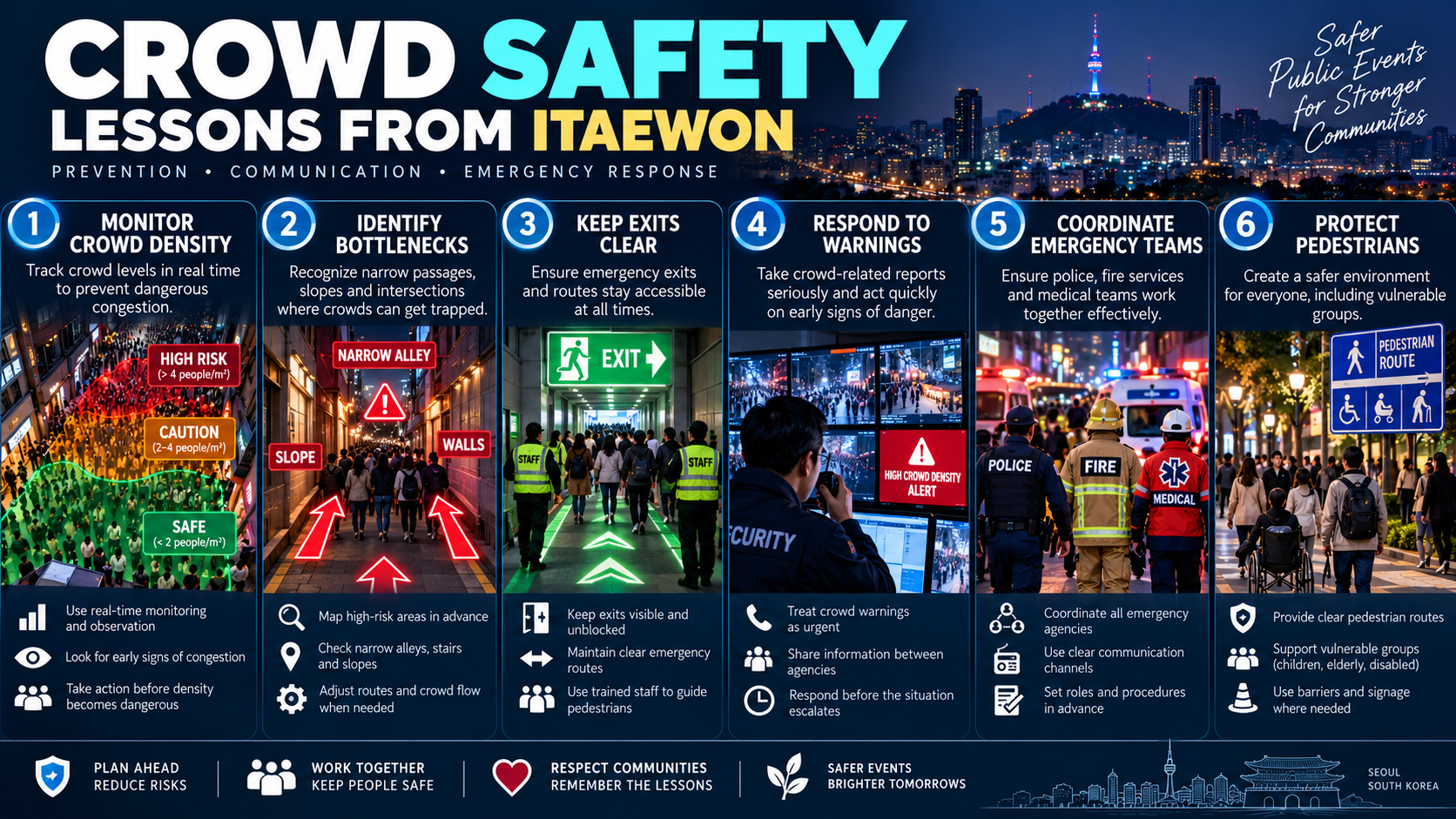
A better understanding of crowd dynamics also improves prevention. Safety planners must consider how people enter and exit a location, where movement may become restricted, and how congestion can spread. They should identify potential bottlenecks before an event begins and monitor changing conditions in real time. Clear pedestrian routes, controlled access where appropriate, trained personnel, and coordinated communication can reduce risk. These measures are relevant to festivals, concerts, sporting events, religious gatherings, transportation hubs, and other crowded public spaces.
Warnings, Emergency Calls, and Questions About Preparedness
Early Signs of Danger
One of the most troubling aspects of the Itaewon tragedy was the existence of emergency calls warning about dangerous congestion before the deadliest phase of the disaster. Investigations and public reporting examined how these calls were received, communicated, and handled. The warnings raised questions about whether authorities recognized the seriousness of the situation and whether available personnel could have intervened earlier. They also highlighted the importance of treating crowd-related emergency reports as potential indicators of an escalating public safety threat.
Warnings about dangerous density require more than routine acknowledgment. Effective systems need clear procedures for assessing the location, urgency, and potential consequences of reported congestion. Information should reach personnel who can make decisions, coordinate resources, and implement protective measures. In a rapidly changing crowd environment, delays can narrow the opportunity for prevention. The Itaewon case became an important example of why emergency communication and operational decision-making must function together rather than as separate administrative processes.
The Challenges of an Unorganized Public Celebration
Large gatherings without a formal organizer can create uncertainty over who is responsible for safety planning. Halloween in Itaewon involved numerous businesses and public spaces, rather than a single event with ticket sales and a designated management team. That made crowd monitoring and coordination particularly important. Public authorities must consider foreseeable risks even when no organization has formally registered an event. A celebration does not need a stage, parade route, or official program to attract enough people to create dangerous conditions.
The disaster encouraged broader discussion about how cities should classify and manage spontaneous or decentralized gatherings. Authorities may need to coordinate police, fire services, transportation agencies, local governments, and business operators before predictable periods of high attendance. Planning can include pedestrian circulation, emergency access, temporary traffic restrictions, and procedures for dispersing crowds safely. These measures must be adapted to the location and expected attendance, while respecting the public’s ability to use shared spaces.
Investigations and Accountability After the Itaewon Disaster
The Initial Police Investigation
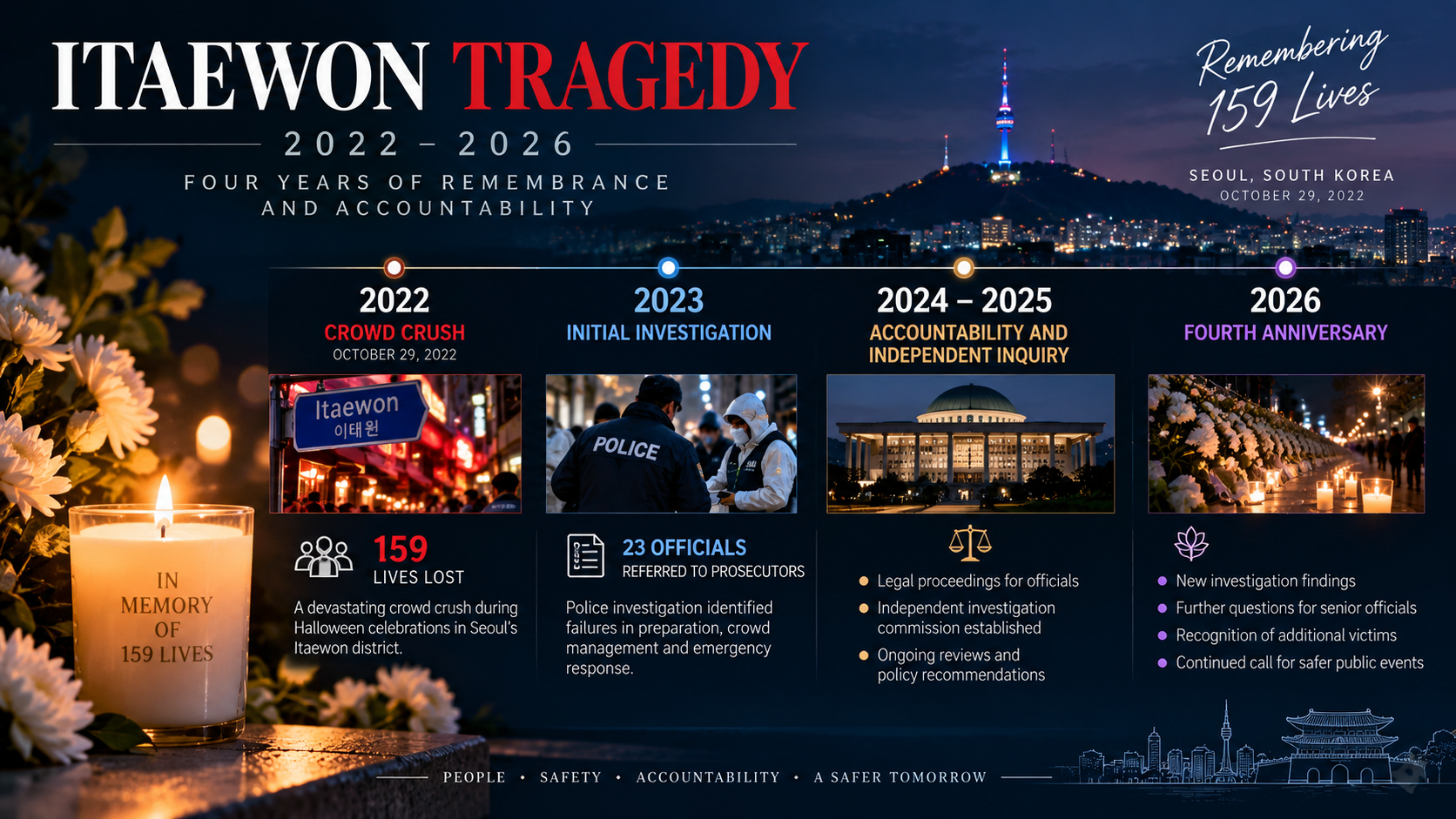
South Korean authorities launched investigations into the events leading up to the disaster. In January 2023, a special police investigation team announced that 23 officials had been referred to prosecutors. The investigation examined failures in preparation, crowd management, emergency communication, and institutional response. Investigators concluded that the disaster was preventable and identified shortcomings across several public agencies. These findings intensified debate over whether the tragedy resulted from isolated operational mistakes or broader weaknesses in the country’s public safety system. Yonhap News Agency+1
Legal proceedings subsequently examined the responsibilities of individual officials. In September 2024, a former local police chief received a three-year prison sentence at trial in connection with inadequate preparations. In October 2024, however, a court acquitted former Seoul Metropolitan Police Agency chief Kim Kwang-ho, finding that prosecutors had not sufficiently established the required legal connection between his alleged negligence and the disaster. These differing outcomes illustrate the distinction between identifying systemic failures and proving individual criminal responsibility under the law. Reuters
The Independent Investigation Commission
A major development came with the creation of the National Commission for the Investigation of the October 29 Itaewon Disaster and Prevention of Recurrence. Established under special legislation in September 2024, the commission was designed to investigate the disaster, examine institutional responsibility, support victims’ rights, and recommend measures to prevent similar events. Its work includes reviewing the circumstances of the tragedy, the response of public agencies, and the experiences of survivors and bereaved families.
The commission’s existence reflects the complexity of the disaster’s aftermath. Criminal proceedings can address specific allegations against individuals, but broader public inquiries may examine policies, organizational cultures, communication failures, and gaps in safety systems. Those questions matter because preventing another crowd disaster requires more than determining whether a particular official violated the law. It also requires understanding why the warning signs were not translated into effective protective action and how public institutions can respond more reliably in future emergencies.
Itaewon in 2026: What the Latest Investigation Reveals
New Findings Released Before the Fourth Anniversary
On October 27, 2026, just two days before the fourth anniversary, the special investigation commission presented interim findings that renewed scrutiny of the authorities’ response. According to KBS World, investigators found that police had failed to respond effectively to 11 reports warning of possible crowd-crush danger. The commission’s findings also challenged earlier accounts of police dispatches and raised questions about changes made to operational records. These developments show that the search for a complete account of the disaster remains active four years later. KBS World Radio
The interim investigation also examined deployment decisions and communication delays. Investigators reported that significant police resources had been assigned to other duties, while crowd-control personnel were not deployed to the area in a way that adequately addressed the risk. They also identified delays in the transmission of information and instructions among senior government officials and emergency agencies. Such findings are particularly important because the earliest stages of a developing crowd emergency can provide critical opportunities for intervention. The commission’s interim conclusions should not be confused with final judicial determinations of individual liability. KBS World Radio
Plans to Question Former Senior Government Officials
The commission also announced plans to question former President Yoon Suk Yeol and former Interior Minister Lee Sang-min about the government’s handling of the tragedy. According to an October 27, 2026 report from Yonhap News Agency, investigators intended to conduct those interviews in December. The proposed questioning forms part of the broader effort to examine decisions made at the highest levels of government and establish a clearer picture of institutional responsibility. Yonhap News Agency
These developments make the fourth anniversary more than a symbolic date. They demonstrate that important questions remain under examination. Families seeking answers continue to follow investigations, while the public has an opportunity to assess whether lessons from the disaster are being incorporated into practical safety policies. The central challenge is turning investigation findings into lasting improvements rather than allowing attention to fade as anniversaries pass.
The Broader Recognition of Victims in 2026
Another significant development occurred in August 2026, when the commission recognized two firefighters who had responded to the disaster and subsequently died following severe psychological trauma as official victims. Earlier recognition had also been extended to a business owner who assisted in rescue efforts. Yonhap reported that these decisions increased the commission’s broader official victim count to 162, a category that includes people recognized for subsequent disaster-related harm. Yonhap News Agency
This distinction is important for accurate reporting. The established death toll associated with the October 29, 2022 crowd crush remains 159, while the broader victim-recognition figure reflects additional decisions made by the commission. The developments also highlight the long-term effects of traumatic events on emergency responders and people who assist victims. Public safety discussions increasingly recognize that the consequences of a disaster may continue for years and that psychological support is an essential component of recovery.
How South Korea Remembers the Itaewon Victims
Memorials and the Importance of Public Remembrance
In the years following the tragedy, memorial activities became an important part of public remembrance. Flowers, photographs, messages, and commemorative gatherings offered spaces where families, friends, and members of the public could honor those who died. Such memorials carry personal and civic significance. They allow people to express grief while keeping attention focused on the individuals whose lives were lost. They also provide opportunities to reflect on the responsibilities of public institutions and the importance of protecting people during large gatherings.
The Itaewon tragedy became part of a wider national conversation about how South Korea remembers disasters and supports those affected by them. Memorial spaces can be emotionally meaningful, but they may also become subjects of disagreement over public policy, official recognition, and accountability. A respectful approach places victims and families at the center of remembrance. It avoids treating commemorations as entertainment and recognizes that different families may prefer different ways of honoring their loved ones.
Why Anniversaries Continue to Matter
Anniversaries provide a moment to revisit events that might otherwise disappear from everyday public discussion. For the families of the Itaewon victims, however, grief does not follow the calendar. The fourth anniversary may bring renewed public attention, but the consequences of the disaster remain part of daily life. Meaningful remembrance involves more than holding ceremonies. It also means maintaining access to reliable information, supporting survivors, and examining whether promised improvements have been implemented.
October 29, 2026 offers an opportunity to consider how much has changed since the tragedy. Investigations have continued, public debate has evolved, and questions about emergency preparedness remain relevant. The anniversary also reminds communities around the world that crowd safety is not solely a local issue. The same fundamental challenges can arise wherever large numbers of people gather in limited spaces, particularly when no single organization is responsible for managing the entire event.
Lessons in Crowd Safety That Every City Can Learn
Recognizing Dangerous Bottlenecks
A bottleneck occurs when pedestrian demand exceeds the capacity of a particular passage or space. Narrow alleys, stairways, bridges, transportation exits, and intersections can all become hazardous when too many people attempt to move through them simultaneously. The danger is not always obvious to those approaching from behind. A person entering a busy street may see only the people immediately ahead, without realizing that movement has stopped farther along the route. This makes early monitoring essential.
Cities can reduce risk by identifying locations where crowd density is likely to increase and developing appropriate management strategies. Depending on the setting, these may include temporary pedestrian restrictions, alternative walking routes, trained stewards, controlled entry, or real-time observation. Effective planning should also account for people with disabilities, children, older adults, and anyone who may need additional assistance. The objective is to prevent dangerous compression before emergency evacuation becomes necessary.
Planning for Gatherings Without Official Organizers
One of the most important lessons from Itaewon concerns predictable gatherings that lack a formal event organizer. A public celebration can attract tens of thousands of people without tickets, fences, or a central management structure. Authorities therefore need methods for identifying occasions when public spaces may become overcrowded. Historical attendance patterns, transportation data, business activity, and seasonal celebrations can help inform planning, although each source has limitations and should be assessed responsibly.
Clear responsibility is equally important. Local government, police, fire services, transport operators, and emergency medical teams need to understand their roles before a large gathering begins. Coordination should include procedures for sharing information and escalating concerns. When dangerous crowd conditions are reported, the response should be based on the seriousness of the risk rather than uncertainty about which agency has formal responsibility. The goal is a practical system that functions under pressure.
Improving Emergency Communication
Emergency communication systems must do more than receive calls. They need to identify patterns, recognize escalating threats, and direct accurate information to decision-makers. Multiple reports from the same area may indicate a developing crisis even when individual callers provide incomplete descriptions. In a crowded environment, callers may struggle to explain their precise location or the scale of the danger. Dispatchers and operational teams therefore need procedures for combining information and assessing its urgency.
Technology can support these processes, but it cannot replace trained judgment and effective leadership. Surveillance cameras, crowd-density monitoring, geographic information systems, and emergency communication platforms may help authorities recognize hazards. However, these systems require clear operational rules, privacy safeguards, maintenance, and personnel who know how to respond to alerts. Technology becomes valuable when it supports timely protective decisions, rather than simply collecting information that no one acts upon.
Preparing Emergency Access Routes
Emergency access is a critical part of crowd safety planning. Ambulances, firefighters, and police officers need reliable routes to reach people who require assistance. When surrounding streets become congested, emergency vehicles may be delayed even when personnel are ready to respond. In high-attendance areas, planners should consider designated access routes, temporary traffic arrangements, and coordination with transportation services. These preparations should be reviewed before major celebrations and adjusted as conditions change.
Public information can also contribute to safety. Clear signs, accessible announcements, and consistent instructions can help people understand where to move when conditions become unsafe. Communication should avoid creating panic or directing additional pedestrians toward already congested routes. Crowd management works best when prevention, observation, communication, and emergency response operate as connected parts of the same plan.
What Individuals Should Know About Crowd Crush Risks
Understanding the Warning Signs
Although the responsibility for safe crowd management rests primarily with organizers and relevant authorities, public awareness can help people recognize developing hazards. Warning signs include movement slowing unexpectedly, difficulty changing direction, sustained pressure from surrounding bodies, and an inability to maintain personal space. A particularly serious warning occurs when someone cannot freely move their arms or control their footing. In such conditions, leaving the area may already be difficult, making early recognition especially valuable.
People attending busy celebrations should pay attention to the layout of their surroundings and avoid entering visibly congested passages when safer alternatives exist. It can also help to identify multiple routes away from a gathering before the area becomes crowded. However, safety advice must not create the impression that individuals can always escape a dangerous crowd. Extreme compression can overpower even strong and experienced people. Prevention through effective planning remains the most reliable protection.
What to Do if Crowd Pressure Begins to Increase
If crowd pressure starts building and movement remains possible, seek a less crowded route without pushing against other people. Avoid moving toward narrow passages, walls, or other obvious bottlenecks. If trapped, try to remain upright, protect space around the chest where possible, and move with the crowd’s motion rather than attempting to force a path against overwhelming pressure. These are general harm-reduction principles, not guarantees of survival. Conditions can change rapidly, and no individual technique can make a severely overcrowded space safe.
Anyone witnessing dangerous congestion should alert nearby event staff or emergency services when it is safe to do so. Reports should include the location, visible conditions, and whether people appear unable to move or breathe normally. Following clear instructions from emergency personnel can help reduce additional congestion. The most important message is that crowd crush emergencies are preventable public safety hazards, not situations that should be managed solely through individual behavior.
How the Itaewon Tragedy Changed the Conversation About Public Safety
From Individual Behavior to Institutional Responsibility
The Itaewon disaster challenged assumptions about who is responsible when large crowds gather in public spaces. Discussions increasingly focused on whether institutions had sufficient information to anticipate the risk and whether they used their authority effectively. The findings of subsequent investigations reinforced the need to examine planning, communication, and operational coordination. Rather than treating crowd disasters as unpredictable accidents, safety experts emphasize that many dangerous conditions can be identified and reduced through systematic preparation.
This perspective is relevant far beyond South Korea. Cities around the world host public celebrations that involve multiple businesses, transportation networks, and streets with different physical capacities. Local authorities must balance access to public spaces with the need to protect pedestrians. The Itaewon tragedy demonstrates that the absence of a formal organizer does not eliminate the possibility of foreseeable risks. It also highlights why responsibility must be established before a dangerous situation develops.
Why Independent Oversight Matters
Independent investigations can help clarify complex events when public confidence has been damaged. They may examine documents, operational records, witness accounts, institutional decisions, and the experiences of affected families. Their findings can inform legislative reforms, administrative changes, training, and emergency planning. Transparency is especially important when different agencies provide conflicting accounts or when questions remain about how warnings were handled.
The work of South Korea’s Itaewon investigation commission illustrates the value of continued scrutiny. Four years after the disaster, investigators were still examining emergency reports and government decisions. Their findings may contribute to future recommendations, but the effectiveness of those recommendations will depend on implementation. Accountability is therefore not only about examining past actions. It also involves ensuring that public institutions have the procedures, resources, and incentives needed to prevent future harm.
Itaewon Halloween Tragedy: A Timeline From 2022 to 2026
October 29, 2022 – The Disaster
Halloween celebrations in Seoul’s Itaewon district ended in catastrophe when extreme crowd pressure developed in a narrow, sloping alley. Emergency responders and bystanders worked to assist victims as the scale of the disaster became apparent. The crowd crush ultimately caused 159 deaths and approximately 196 reported injuries. The tragedy prompted national mourning, international expressions of sympathy, and urgent questions about the management of crowded public spaces. ADRC
2023 – The First Major Investigation Findings
In January 2023, South Korean police investigators announced findings that identified failures in disaster prevention and emergency response. Twenty-three officials were referred to prosecutors in connection with the investigation. The findings shifted public attention toward institutional responsibility and the question of whether better preparation could have prevented the disaster. Families and civil society organizations continued to seek answers and stronger public safety protections. Yonhap News Agency
2024 – Legal Proceedings and Independent Oversight
Legal proceedings continued in 2024, producing different outcomes for officials accused of negligence. Meanwhile, South Korea established a special independent commission under legislation designed to protect victims’ rights, investigate the disaster, and prevent recurrence. The commission was formally launched in September 2024, creating a dedicated framework for examining questions beyond individual criminal cases.
2025 – Further Investigations and Government Attention
In June 2025, the independent commission began its substantive investigative activities, including examining the experiences of survivors and bereaved families. The following month, President Lee Jae Myung called for an additional joint police-prosecutor investigation to help establish a fuller account of the tragedy. These developments reflected continuing concerns about the adequacy of earlier investigations and the need for stronger institutional accountability. Yonhap News Agency
2026 – Four Years Later, Questions Remain
In 2026, the investigation continued to examine the disaster’s long-term consequences and the response of public authorities. The commission recognized additional individuals affected by the tragedy and released new findings about emergency warnings, police deployment, and government communication. Its October 27 interim report renewed attention to the events of 2022 shortly before the fourth anniversary. October 29, 2026 marks four years since the disaster, but the search for answers and meaningful safety improvements remains unfinished. Yonhap News Agency
Frequently Asked Questions – Itaewon Halloween Tragedy
1. What happened during the Itaewon Halloween tragedy in 2022?
On October 29, 2022, extreme crowd congestion developed in a narrow alley in Seoul’s Itaewon district during Halloween celebrations. People became trapped under intense crowd pressure, causing a mass-casualty disaster. The event raised major concerns about crowd management and emergency preparedness.
2. How many people died in the Itaewon disaster?
The established death toll from the 2022 crowd crush is 159. In 2026, a special investigation commission also recognized additional people who died following disaster-related trauma, bringing its broader official victim-recognition total to 162 as of August 2026. These figures describe different categories and should not be confused.
3. Where exactly did the Itaewon crowd crush happen?
The disaster occurred in a narrow, sloping alley near the Hamilton Hotel in Itaewon, within Seoul’s Yongsan District. The alley connected busy pedestrian areas and became dangerously overcrowded during the Halloween celebrations.
4. Why was the Itaewon crowd crush so deadly?
Extreme crowd density prevented people from moving freely. Intense pressure restricted breathing and caused severe injuries. The narrow, sloping location, congestion, and failures in crowd management contributed to the dangerous conditions.
5. Was the Itaewon disaster a stampede?
Crowd crush is generally a more accurate description. The primary danger came from extreme congestion and involuntary crowd pressure, rather than people deliberately running over others. This distinction matters because it helps explain the physical mechanisms involved without unfairly blaming victims.
6. Were government officials investigated after the disaster?
Yes. Police investigations, prosecutions, court proceedings, and an independent commission examined the actions of public officials and emergency agencies. Legal outcomes have differed, and the independent investigation continued in 2026.
7. What happened in the Itaewon investigation in October 2026?
On October 27, 2026, the special investigation commission released interim findings concerning emergency warnings, police responses, deployment decisions, and communication delays. It also announced plans to question former senior government officials. These findings were part of an ongoing investigation, not a final judicial verdict. Yonhap News Agency
8. Why is October 29, 2026 significant?
October 29, 2026 marks the fourth anniversary of the Itaewon Halloween tragedy. It is an important date for remembering those who died, supporting affected families, and reflecting on lessons in public safety and accountability.
9. What can other countries learn from the Itaewon disaster?
The tragedy highlights the need for crowd-density monitoring, effective emergency communication, safe pedestrian routes, clear institutional responsibilities, and preparation for large gatherings without formal organizers. These principles apply to public festivals, concerts, and other crowded environments worldwide.
10. How can people respectfully remember the Itaewon victims?
People can participate in appropriate memorial activities, learn from verified reporting, respect the privacy of affected families, and support responsible public safety improvements. Sharing accurate information without graphic or sensational content helps preserve the dignity of those affected.
Remembering 159 Lives and Building a Safer Future
Four years after the Itaewon Halloween tragedy, the events of October 29, 2022 remain a powerful reminder of the importance of protecting people in crowded public spaces. What began as a night of celebration became a national tragedy that affected families and communities around the world. The loss of 159 lives cannot be undone, and the emotional consequences continue for those who survived, witnessed the disaster, or lost someone close to them. Remembering the victims means recognizing their humanity, respecting the grief of their families, and refusing to allow their stories to disappear behind statistics.
The lessons of Itaewon extend beyond one city and one Halloween celebration. Crowded streets, narrow passages, communication failures, and unclear responsibilities can create dangerous conditions in many places. The investigations continuing in 2026 demonstrate that understanding a disaster requires persistence, transparency, and careful examination of evidence. Ultimately, the most meaningful way to honor those who died is to turn remembrance into practical improvements that protect lives. The memory of Itaewon should remain a lasting call for safer gatherings, stronger emergency preparedness, and genuine public accountability.
⚠️ Disclaimer and Source Hygiene
This article is provided for historical, educational, and public safety awareness purposes. It is based on authoritative institutional information, official investigation materials, and reporting from established news organizations, including Yonhap News Agency, KBS World, and Reuters. Figures and investigative developments are identified according to their reporting context. The historical crowd-crush death toll and later official victim-recognition decisions are presented separately to avoid confusion.
Information about legal proceedings and investigations may change as new evidence, official reports, or court decisions become available. General crowd safety guidance is not a substitute for professional event planning, emergency training, or instructions from local authorities. Readers seeking legal, medical, or psychological advice should consult qualified professionals. This article avoids graphic descriptions and does not reproduce unverified eyewitness claims.
Sources and References
The following sources provide historical records, official investigative context, and recent reporting about the Itaewon tragedy.
National Commission for the Investigation of the October 29 Itaewon Disaster
Official commission mandate, victim protection, fact-finding investigations, and recurrence prevention.Official commission website
Yonhap News Agency – October 27, 2026
Special commission’s interim findings and plans to question former government officials.Read the October 2026 investigation report
KBS World – October 27, 2026
Reporting on emergency calls, police response failures, and the commission’s latest findings.Read KBS World investigation coverage
Yonhap News Agency – January 13, 2023
Findings of the initial police investigation and referral of 23 officials to prosecutors.Read the initial investigation findings
Yonhap News Agency – August 25, 2026
Recognition of additional disaster-related victims and clarification of the expanded official victim count.Read the victim recognition report
Reuters – October 17, 2024
Independent reporting on the legal proceedings and the acquittal of a former Seoul police chief.Read Reuters legal coverage
Secondary Sources and Testimonials
Additional context can be found in reporting from South Korean broadcasters, public statements from bereaved families’ organizations, and the independent commission’s published materials. Survivor experiences and family statements should be consulted through reliable, attributed reporting rather than anonymous social media claims. The article does not invent testimonials or reproduce private accounts without verification.
