

⏲️ Estimated reading time: 18 min
Table of Contents
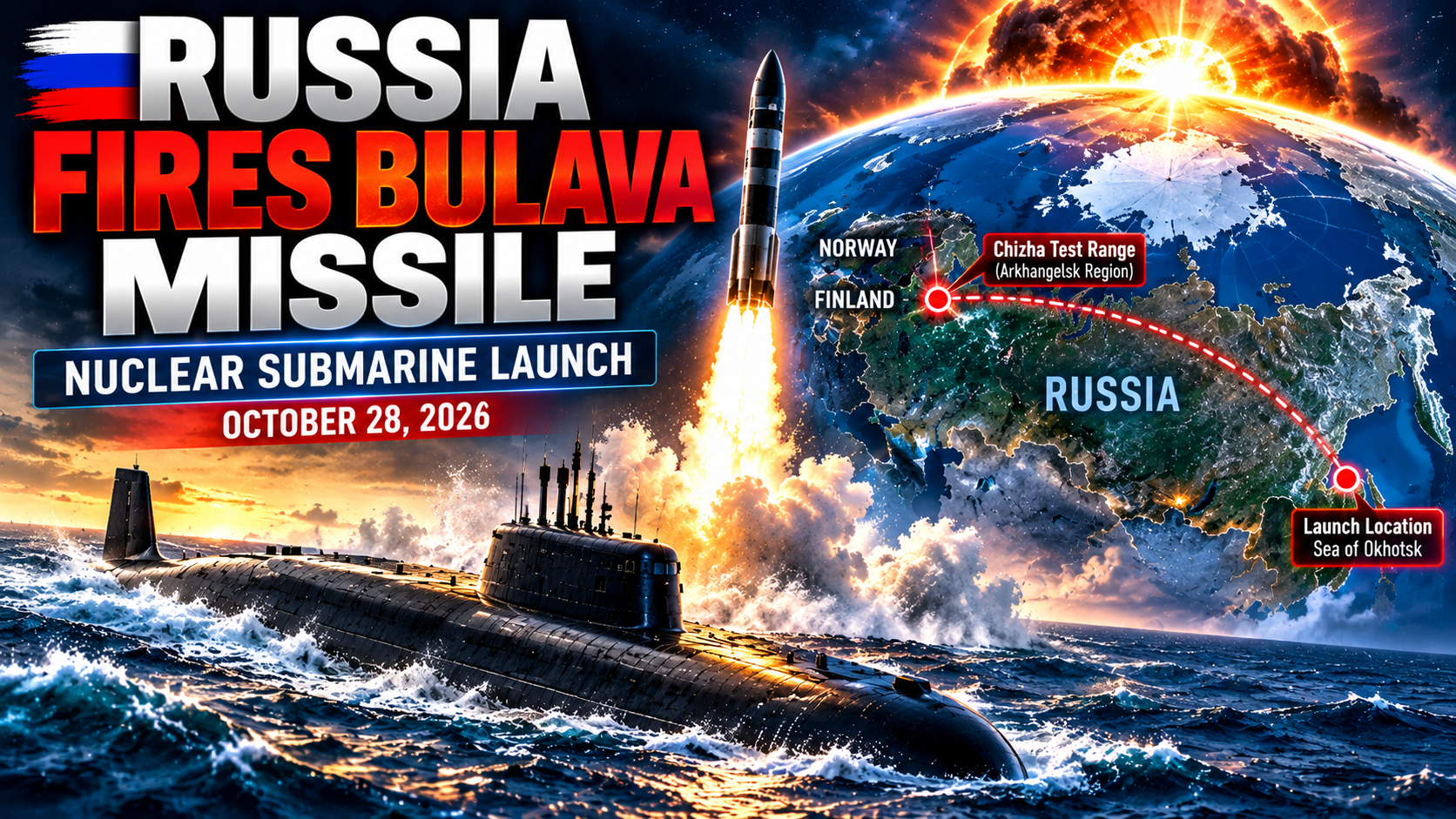
Russia has announced another long-range ballistic missile launch, this time involving one of its modern nuclear-powered submarines operating in the Pacific region. On Wednesday, October 28, 2026, the Russian Ministry of Defense reported that the submarine Generalissimo Suvorov had launched a Bulava intercontinental-range ballistic missile from a submerged position in the Sea of Okhotsk.
According to Russian military officials, the missile traveled across Russian territory toward the Chizha military testing range in the Arkhangelsk region, near the Arctic. The ministry stated that the missile’s warhead section reached the designated target area at the expected time. The reported result has not been independently verified through publicly available technical data.
The announcement comes at a time when military security, nuclear deterrence, and relations between Russia and NATO remain major international concerns. Although Moscow described the event as a scheduled military training exercise, the launch has attracted attention because of the weapon’s long-range capabilities and the location of its intended destination.
Published: – October 28, 2026
Category: – News & Trends / International Security / Military Technology
Updated: – October 28, 2026
Russia Confirms Bulava Missile Launch From the Sea of Okhotsk
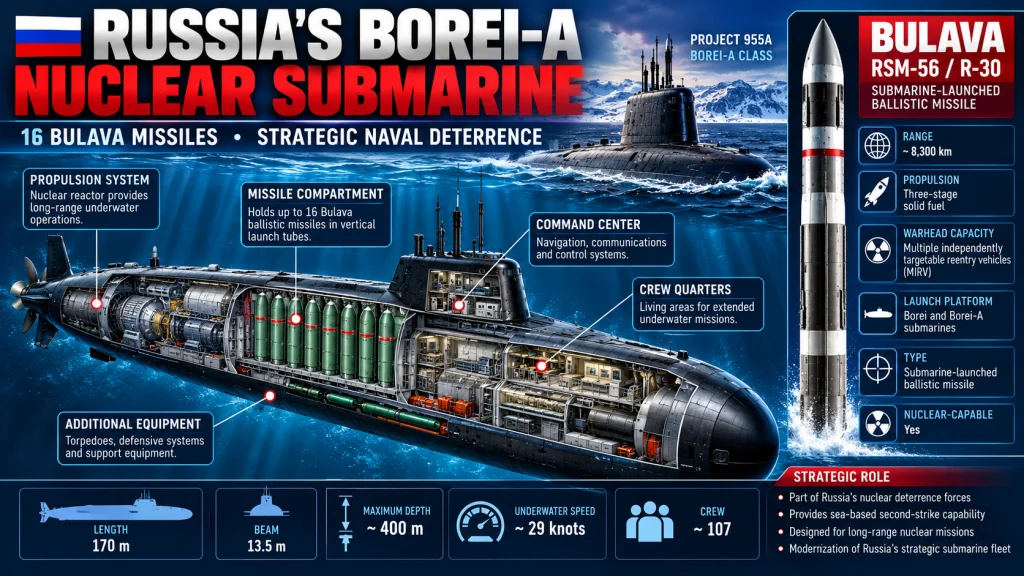
The Russian Ministry of Defense announced that the Pacific Fleet had conducted a ballistic missile firing exercise using the nuclear-powered submarine Generalissimo Suvorov. The vessel belongs to the Project 955A Borei-A class, a modern generation of Russian strategic submarines designed to carry submarine-launched ballistic missiles.
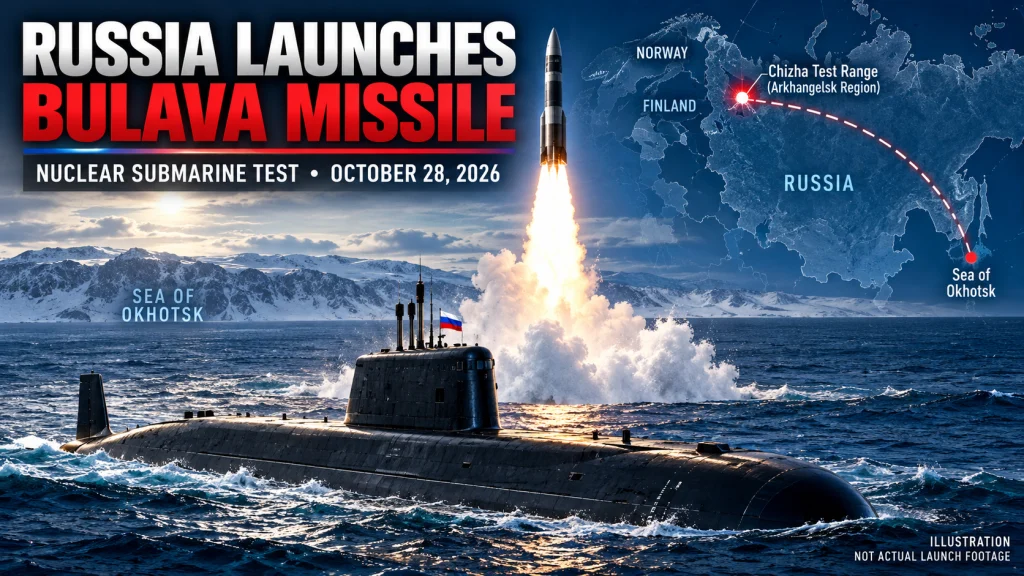
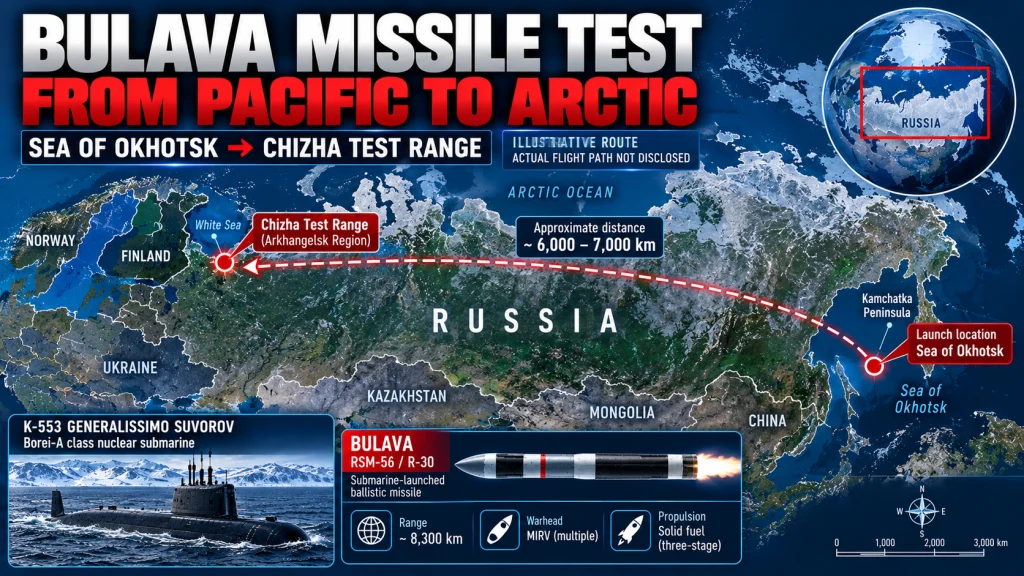
The missile was fired while the submarine remained underwater in the Sea of Okhotsk, a large body of water in Russia’s Far East. Its destination was the Chizha military range in the Arkhangelsk region of northern Russia, thousands of kilometers away. Russian authorities said the exercise formed part of the submarine crew’s established combat training program.
Military officials also released footage associated with the launch. According to their statement, monitoring systems recorded the missile’s arrival in the designated target area at the scheduled time. However, the announcement did not provide complete technical information about the missile’s trajectory, its exact flight distance, or the equipment used to assess the result.
What Has Been Confirmed About the October 28 Announcement?
Several details have been consistently reported by international defense publications and Russian news agencies. The submarine involved was identified as K-553 Generalissimo Suvorov, a strategic missile carrier assigned to Russia’s Pacific Fleet. The weapon was a Bulava submarine-launched ballistic missile, and the firing took place from a submerged position.
The Russian military identified Chizha as the intended testing range and described the operation as planned training. Independent reporting confirms that the ministry made these statements, but the publicly available evidence does not establish every technical detail of the launch. This distinction matters because military announcements often contain information that outside observers cannot immediately verify.
Where Did the Russian Bulava Missile Land?
The destination identified by Russia’s Defense Ministry was the Chizha military testing range in the Arkhangelsk region. This northern Russian facility lies near the White Sea and has been associated with strategic missile testing. Its location makes it suitable for certain long-distance training exercises conducted across Russian territory.
The missile was launched from the Sea of Okhotsk, near Russia’s Pacific coastline, before reportedly reaching the designated area in the country’s far northwestern region. The precise flight path has not been made public, so the exact distance traveled during this particular exercise cannot be established from the announcement alone.
The Chizha range is also geographically significant because of its relative proximity to northern Europe. Reports place the facility a little more than 600 kilometers from parts of Russia’s borders with Norway and Finland. Nevertheless, geographical proximity should not be confused with evidence that either NATO country was targeted.
Why Is the Arkhangelsk Region Strategically Important?
Arkhangelsk is an important region in Russia’s northern defense infrastructure. It is connected to naval activities, military installations, and facilities supporting Russia’s strategic forces. The wider Russian Arctic also has considerable military importance because it provides access to northern maritime routes and areas used by the country’s submarine fleet.
The region’s location near the White Sea makes it particularly relevant to naval operations and weapons testing. Russia has historically maintained significant defense infrastructure across its northern territories, including facilities linked to the development, maintenance, and deployment of strategic naval systems.
For international observers, a missile launch toward Arkhangelsk demonstrates how Russia can conduct long-distance exercises between distant parts of its territory. It also highlights the geographical scale of the country’s military infrastructure. However, the use of an established testing range does not automatically indicate preparations for an attack.
What Is the Russian Bulava Ballistic Missile?
The Bulava, also known as the RSM-56 or R-30, is a submarine-launched ballistic missile developed for Russia’s Borei-class strategic submarines. Unlike conventional cruise missiles, which typically travel through the atmosphere along relatively low-altitude routes, ballistic missiles follow a high-altitude trajectory after their powered flight phase.
The Bulava is designed to provide Russia with a sea-based strategic deterrent. Its purpose is to give the country a long-range nuclear-capable missile system that can operate from submarines rather than relying exclusively on land-based launchers or strategic aircraft.
The missile uses solid-fuel propulsion and is designed to carry multiple independently targetable reentry vehicles. This technology allows a single missile to deliver more than one warhead toward designated targets. The missile’s capabilities make it part of Russia’s strategic nuclear forces, although a test launch does not necessarily involve operational nuclear warheads.
Bulava Missile Technical Specifications
| Feature | Reported specification |
|---|---|
| Missile name | RSM-56 Bulava / R-30 |
| Missile category | Submarine-launched ballistic missile |
| Country | Russia |
| Propulsion | Three-stage solid fuel |
| Estimated operational range | Approximately 8,300 km |
| Launch platform | Borei and Borei-A submarines |
| Warhead capability | Multiple independently targetable reentry vehicles |
| Strategic role | Sea-based nuclear deterrence |
| Nuclear-capable | Yes |
These specifications reflect publicly reported estimates. Actual operational performance, payload configurations, and technical characteristics may vary, and some details remain classified.
Can the Bulava Missile Carry Nuclear Warheads?
Yes. The Bulava was designed as a nuclear-capable strategic ballistic missile. Its reported multiple-warhead configuration allows it to carry several independently targetable reentry vehicles, although exact operational configurations are not publicly established.
However, a nuclear-capable missile is not necessarily carrying nuclear warheads during a training exercise. Strategic missile tests can use instrumented or inert payloads to assess flight performance and targeting accuracy without conducting a nuclear explosion.
Russia did not publicly provide complete information about the payload configuration used in this exercise. Therefore, it would be inaccurate to claim that an operational nuclear weapon was detonated or that a nuclear explosion occurred. The reported event was a ballistic missile launch, not a confirmed nuclear weapons detonation.
The Generalissimo Suvorov Nuclear Submarine Explained
The submarine involved in the launch, K-553 Generalissimo Suvorov, is a Project 955A Borei-A-class nuclear-powered ballistic missile submarine. It represents part of Russia’s effort to modernize the sea-based component of its strategic forces and gradually replace older submarine designs.
Built at the Sevmash shipyard in Severodvinsk, the submarine entered Russian naval service in December 2022. It subsequently transferred to the Pacific Fleet, reaching its permanent operating region in Kamchatka in October 2023. The vessel is designed for extended underwater operations and carries advanced navigation, communication, and missile systems.
The Borei-A design builds on the earlier Borei class with improvements intended to support operational efficiency, acoustic discretion, and survivability. These characteristics are important for strategic submarines because their deterrent role depends partly on remaining difficult to locate during patrols.
How Many Bulava Missiles Can a Borei-A Submarine Carry?
Borei and Borei-A submarines are designed to carry up to 16 Bulava ballistic missiles. Each missile forms part of the submarine’s strategic weapons capability, making these vessels important components of Russia’s nuclear deterrence structure.
The submarines also carry other equipment needed for navigation, communications, defensive operations, and underwater maneuvering. Their nuclear reactors provide propulsion and electrical power, allowing them to operate for long periods without the fuel limitations associated with conventional diesel-powered submarines.
It is important to distinguish between nuclear propulsion and nuclear weapons. A nuclear-powered submarine uses a reactor to generate energy, while a nuclear-capable ballistic missile is a separate weapons system. Although the two technologies are often mentioned together, they serve very different purposes.
Why Russia Conducts Long-Range Ballistic Missile Tests
Strategic missile tests serve several military and technical purposes. They allow armed forces to evaluate the performance of complex weapons systems, assess crew readiness, and verify that launch procedures operate as expected under controlled conditions.
For submarine-launched ballistic missiles, the exercise also involves coordination between the submarine crew, launch equipment, communications systems, and monitoring infrastructure. A successful firing can provide useful information about system reliability and operational procedures.
These exercises also carry a political dimension. Countries possessing nuclear weapons frequently view strategic deterrence as a way to discourage potential adversaries from launching attacks. Demonstrating that long-range systems remain operational can therefore communicate military capability to domestic and international audiences.
Why Does Launching a Missile From Underwater Matter?
A submerged launch is a defining feature of modern submarine-launched ballistic missile systems. Unlike a surface vessel, a strategic submarine can operate underwater while preparing to launch its missiles, making its position more difficult for other forces to determine.
From an engineering perspective, underwater launches require carefully coordinated systems. The missile must leave its launch tube, emerge from the water, and transition into its powered flight phase. Each stage must operate within the design parameters established for the weapon.
Testing these procedures helps military planners evaluate the reliability of their systems. However, a single successful launch does not prove that every missile in a country’s inventory will perform identically or that a submarine would remain undetected during a real military confrontation.
Why the Missile Test Matters to Norway, Finland, and NATO
The Chizha testing range is located in northern Russia, within a region that has considerable strategic importance for European security. Its relative proximity to Norway and Finland has attracted attention because both countries are members of the North Atlantic Treaty Organization.
Finland joined NATO in April 2023, followed by Sweden in March 2024. These developments significantly changed the alliance’s northern geographical footprint. Norway was already a longstanding NATO member, and the three Nordic countries now form an important part of the alliance’s northern European security environment.
However, the October 28 missile exercise was reported as a launch between two locations associated with Russia. The available information does not establish that the missile was aimed at NATO territory or that the test constituted a direct attack against another country.
Does the Launch Mean Russia Is Preparing to Attack NATO?
There is no publicly verified evidence from this particular launch that Russia was preparing an immediate attack on NATO territory. Moscow described the operation as scheduled combat training, and the reported destination was a Russian military testing range.
Strategic missile exercises can generate concern because they involve weapons systems capable of carrying nuclear payloads. Their political significance may increase during periods of international tension, particularly when governments exchange warnings or disagree over military security.
Nevertheless, responsible analysis must distinguish between demonstrated military capability, political signaling, and evidence of actual attack preparations. The existence of a long-range missile test does not, by itself, establish an imminent military threat.
Russia’s Missile Launch and the War in Ukraine
The exercise took place against the background of Russia’s continuing war against Ukraine and the broader deterioration of relations between Moscow and Western governments. Nuclear deterrence has remained a prominent element of Russian military messaging throughout the conflict.
According to reports published on October 28, the launch announcement followed discussions involving Russian President Vladimir Putin, Finnish President Alexander Stubb, and Norwegian Prime Minister Jonas Gahr Støre. Those discussions reportedly addressed the war in Ukraine and the conditions for a possible peace settlement.
Although the timing is politically noteworthy, the publicly available information does not establish a direct causal connection between those diplomatic conversations and the missile exercise. Russia’s Defense Ministry described the launch as part of an established training plan rather than a response to a specific diplomatic event.
Could the Missile Test Increase International Tensions?
Strategic weapons exercises can influence international perceptions, particularly when they occur during an active conflict. Governments may interpret such activities differently depending on the wider political environment, the transparency of the exercise, and the military systems involved.
For NATO members, understanding the purpose and scope of Russian strategic exercises is part of routine security monitoring. Analysts generally examine official announcements, observable military activity, historical testing patterns, and available technical evidence before drawing conclusions.
The immediate significance of this event is therefore best understood as a reported demonstration of Russia’s sea-based missile capability. Any broader claims about changes in military readiness or intentions would require additional evidence.
How the 2026 Bulava Launch Compares With Previous Tests
Russia has conducted several Bulava missile tests involving Borei-class submarines over the past decade. These exercises have helped demonstrate the operational development of the missile system and its integration into Russia’s strategic submarine fleet.
In November 2022, Generalissimo Suvorov conducted a Bulava launch during state trials, firing from the White Sea toward the Kura testing range on the Kamchatka Peninsula. That launch traveled in the opposite broad direction from the exercise announced in October 2026.
Another notable exercise occurred in October 2024, when the Borei-A submarine Knyaz Oleg launched a Bulava missile from the Sea of Okhotsk during a wider Russian strategic forces exercise. The recurrence of similar tests shows that long-distance missile launches are an established element of Russian military training.
Selected Timeline of Russian Strategic Missile Exercises
| Date | Event |
|---|---|
| November 2022 | Generalissimo Suvorov launches Bulava during state trials |
| December 2022 | Generalissimo Suvorov enters Russian naval service |
| October 2023 | Submarine completes transfer to the Pacific Fleet |
| October 2024 | Knyaz Oleg launches Bulava during strategic forces exercises |
| October 2025 | Russia conducts additional strategic nuclear forces exercises |
| October 28, 2026 | Russia announces a Bulava launch toward the Chizha range |
This timeline provides historical context rather than evidence of a coordinated escalation. Military exercises may share similar characteristics while taking place under different operational and political circumstances.
What the Missile Launch Reveals About Nuclear Deterrence
Nuclear deterrence is based on the idea that the potential consequences of a nuclear attack can discourage an adversary from initiating one. Countries with strategic nuclear forces maintain different delivery systems to preserve their ability to respond to major threats.
Submarine-launched ballistic missiles are particularly important in this framework because submarines can operate across large maritime areas and are designed to remain difficult to detect. This contributes to what defense analysts call second-strike capability: the ability to respond after suffering an initial attack.
Russia’s Borei-A submarines form part of this sea-based deterrent. The October 2026 launch illustrates the continued importance Moscow places on demonstrating that its strategic naval systems can carry out long-distance missions.
Why Does Russia Maintain Nuclear Forces at Sea?
A strategic submarine fleet provides geographical flexibility and reduces dependence on fixed land-based facilities. Submarines can patrol remote maritime regions, making it more difficult for a potential adversary to know their exact locations.
For Russia, the Pacific Fleet and Northern Fleet serve different geographical areas while contributing to the country’s wider strategic deterrence system. Submarine-based weapons complement land-based ballistic missiles and nuclear-capable strategic bombers.
Maintaining multiple delivery systems is a longstanding feature of nuclear strategy among major nuclear powers. However, military capability alone does not determine political intent, and routine exercises should be assessed alongside diplomatic statements, military developments, and independently verified information.
Frequently Asked Questions
1. Did Russia launch a Bulava missile on October 28, 2026?
Russia’s Ministry of Defense announced on October 28, 2026, that a Bulava ballistic missile had been launched from a submarine in the Sea of Okhotsk. The ministry reported that the missile reached its designated testing area.
2. Which Russian submarine launched the Bulava missile?
The launch was attributed to K-553 Generalissimo Suvorov, a nuclear-powered strategic submarine belonging to the Project 955A Borei-A class and assigned to Russia’s Pacific Fleet.
3. Where was the Bulava missile launched?
According to Russian authorities, the missile was launched from a submerged position in the Sea of Okhotsk, located in Russia’s Far East.
4. Where did the Bulava missile land?
The Russian military reported that the missile’s warhead section reached the designated area of the Chizha military testing range in the Arkhangelsk region of northern Russia.
5. How far can a Bulava ballistic missile travel?
Public estimates commonly place the Bulava missile’s operational range at approximately 8,300 kilometers. Actual performance depends on several technical factors, including payload configuration.
6. Can the Bulava missile carry nuclear weapons?
Yes. The Bulava is a nuclear-capable submarine-launched ballistic missile designed to carry multiple warheads. This does not mean nuclear warheads were necessarily used in the October 2026 exercise.
7. Is the Chizha testing range close to NATO countries?
The testing range is in northern Russia, reportedly a little more than 600 kilometers from parts of the country’s borders with Norway and Finland. Both countries are NATO members.
8. Was the missile aimed at Norway or Finland?
No evidence in the reported launch announcement indicates that either country was targeted. The stated destination was the Chizha military testing range inside Russia.
9. How many Bulava missiles can a Borei-A submarine carry?
Borei-A-class strategic submarines are designed to carry up to 16 Bulava ballistic missiles in dedicated launch tubes.
10. Does the launch mean nuclear war is imminent?
A ballistic missile test does not, by itself, indicate that nuclear war is imminent. The event was described as a planned training exercise, and there is no verified evidence from this launch alone of an immediate nuclear attack plan.
A Strategic Missile Test With International Significance
Russia’s October 28, 2026, Bulava missile announcement highlights the continuing importance of submarine-based strategic weapons in modern military planning. According to Moscow, the Pacific Fleet successfully conducted a submerged launch from the Sea of Okhotsk toward the Chizha testing range in northern Russia.
The exercise demonstrates the type of long-range capability that Russia seeks to maintain through its modern Borei-A submarine fleet. At the same time, the reported launch must be interpreted carefully. Its destination was a military testing range inside Russia, and publicly available information does not establish that the event represented an imminent threat to neighboring countries.
For readers following international security developments, the central lesson is the importance of separating confirmed announcements, military capabilities, and political interpretations. Reliable reporting requires attention to what authorities have stated, what independent sources can verify, and which questions remain unanswered.
⚠️ Disclaimer and Source Hygiene
This article is provided for general news reporting, education, and public information. It does not endorse military aggression, nuclear weapons use, or threats against any country or population.
Information is based on publicly available reporting, defense analysis, and statements attributed to official authorities as of October 28, 2026. Technical estimates may vary between sources. Claims made by military authorities are attributed accordingly and should not be treated as independently verified unless supporting evidence is available.
Readers seeking professional assessments of international security, military technology, or geopolitical risks should consult qualified specialists and authoritative research organizations.
Sources and References
- Interfax – October 28, 2026. Russian Defense Ministry announcement concerning the Bulava launch from the Sea of Okhotsk.
https://www.interfax.ru/russia/1125390 - AeroTime – October 28, 2026. Russian nuclear submarine fires Bulava ballistic missile across Russia.
https://www.aerotime.aero/articles/russian-borei-a-submarine-bulava-missile-launch - Defense Blog – October 28, 2026. Russia test-fires Bulava from one of its newest missile submarines.
https://defence-blog.com/russia-test-fires-bulava-from-one-of-its-newest-missile-submarines/ - Kommersant – October 28, 2026. Reporting on the Generalissimo Suvorov missile launch and submarine history.
https://www.kommersant.ru/doc/9062379 - Center for Strategic and International Studies (CSIS) – Missile Threat. Independent background research on ballistic missile systems and strategic capabilities.
https://missilethreat.csis.org/
Secondary Sources and Testimonials
Additional context was reviewed from contemporary international defense reporting and Russian news coverage. Military statements and descriptions of successful targeting remain attributed to their original sources. No independent eyewitness testimonials or independently verified impact measurements were available for inclusion in this article at the time of writing.
