

⏲️ Estimated reading time: 24 min
Table of Contents
Discover the five oldest verified people ever recorded, from Jeanne Calment’s extraordinary 122-year lifespan to Japan’s Nabi Tajima. Explore their remarkable lives, historical eras, longevity records, and what their stories can teach us about aging, resilience, lifestyle, and the science of human longevity.
The Five Oldest Verified People in Human History
Living beyond 100 years is already an extraordinary achievement. Reaching 110 places someone in an even rarer group known as supercentenarians. Yet a remarkably small number of people have lived far beyond that milestone, reaching ages of 117, 118, 119, and, in one exceptional case, more than 122 years.
Stories about extremely old people have appeared throughout history. Some historical claims describe people living for 130, 150, or even 160 years. The difficulty is evidence. Before modern civil registration became widespread, proving an exact birth date could be extremely difficult. A longevity claim therefore needs much more than a family story or an old newspaper article.
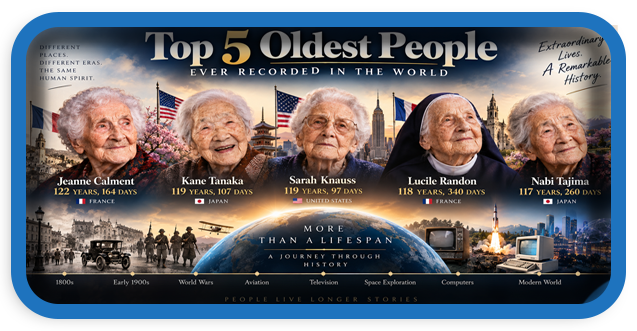
For this ranking, we are focusing on documented and validated longevity records. Current validated data places Jeanne Calment first at 122 years and 164 days, followed by Kane Tanaka at 119 years and 107 days, Sarah Knauss at 119 years and 97 days, Lucile Randon at 118 years and 340 days, and Nabi Tajima at 117 years and 260 days.
Their ages are impressive on their own. However, their lives become even more fascinating when viewed against history. These women lived through enormous changes in transportation, medicine, communication, politics, technology, and everyday life.
Some were born before automobiles became common. Several lived through two world wars. They witnessed the arrival of commercial aviation, television, computers, satellites, the internet, smartphones, and modern medicine.
Their stories therefore represent much more than longevity records. Each life forms a remarkable bridge between different periods of human history.
The Current Verified Top Five
| Rank | Person | Country | Lifespan | Verified Age |
|---|---|---|---|---|
| 1 | Jeanne Calment | France | 1875–1997 | 122 years, 164 days |
| 2 | Kane Tanaka | Japan | 1903–2022 | 119 years, 107 days |
| 3 | Sarah Knauss | United States | 1880–1999 | 119 years, 97 days |
| 4 | Lucile Randon | France | 1904–2023 | 118 years, 340 days |
| 5 | Nabi Tajima | Japan | 1900–2018 | 117 years, 260 days |
These rankings concern verified human lifespans rather than unconfirmed historical claims. Jeanne Calment remains the only validated person known to have reached 120 years. Guinness World Records continues to recognize her 122 years and 164 days as the greatest fully authenticated human lifespan.
1. Jeanne Calment – 122 Years and 164 Days
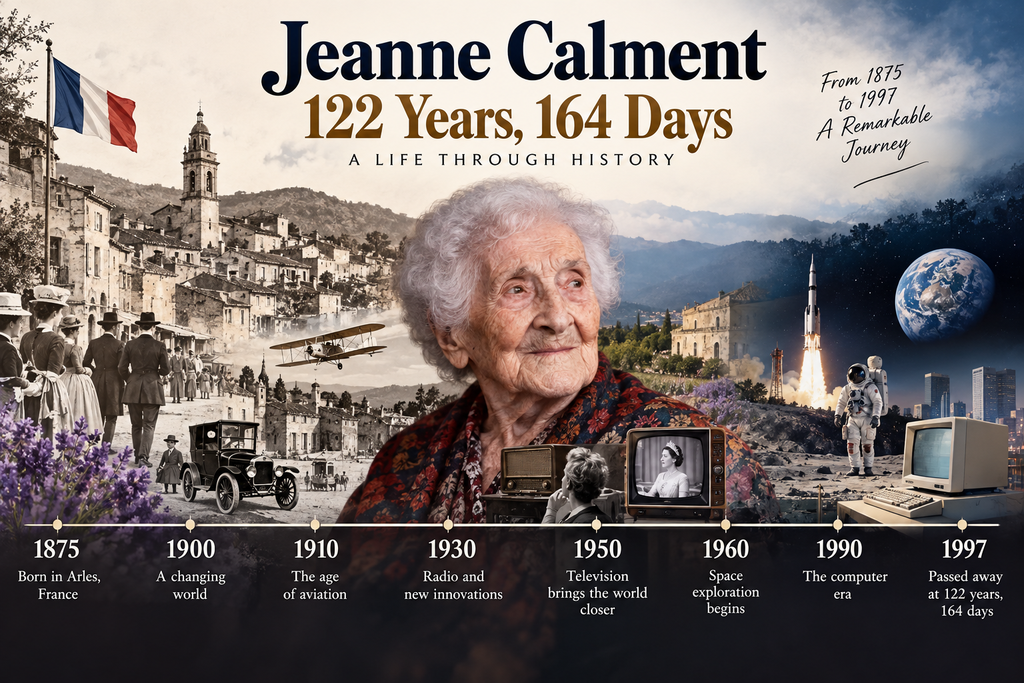
Jeanne Louise Calment remains the extraordinary benchmark against which human longevity records are measured. She was born on February 21, 1875, in Arles, France, and died there on August 4, 1997. Her authenticated lifespan reached an astonishing 122 years and 164 days. Guinness World Records continues to recognize her as the oldest verified person ever.
To understand just how remarkable that lifespan was, consider the world into which she was born. France was still decades away from the widespread adoption of automobiles, airplanes did not exist, and Alexander Graham Bell had not yet received his famous telephone patent. Calment’s life eventually extended into the era of personal computers and the early internet.
She experienced changes that would normally require several generations to witness. Her lifespan covered the late nineteenth century, almost the entire twentieth century, two world wars, enormous medical advances, the development of aviation, television, nuclear technology, space exploration, and the digital revolution.
That historical perspective makes her record particularly fascinating. Calment did not simply reach an extraordinary age. She remained alive across an astonishing period of technological and social transformation.
A Life That Connected Two Completely Different Worlds
Calment married Fernand Nicolas Calment in 1896. Because her husband was financially comfortable, she enjoyed a relatively privileged lifestyle and had considerable freedom to pursue leisure activities.
She reportedly enjoyed cycling, swimming, tennis, roller skating, piano, and opera. Physical activity remained part of her lifestyle for many years. Guinness reports that even after entering a nursing home, she maintained considerable independence and followed a structured daily routine.
Her longevity eventually made her internationally famous. In 1988, at 112, she was recognized as the world’s oldest living person. At 114, she appeared as herself in the movie Vincent et moi, giving her another unusual distinction as the oldest actress.
Calment also claimed that she had encountered Vincent van Gogh as a teenager when the artist visited her uncle’s shop in Arles. That story provides an almost surreal connection between modern history and nineteenth-century European art.
How Jeanne Calment’s Age Was Verified
Exceptional longevity claims require exceptional documentation. That is one reason Calment’s case remains so important.
According to Guinness World Records, her birth certificate was preserved, and researchers found her listed across numerous census records. Her life could therefore be followed through historical documents over many decades. Guinness notes that other individuals have claimed greater ages, but sufficient evidence has not authenticated those claims.
Her record has attracted debate over the years, as might be expected for such an extraordinary lifespan. Nevertheless, Guinness World Records and established longevity databases continue to recognize her age as validated.
She died in Arles in 1997. Nearly three decades later, her 122-year record still stands.
2. Kane Tanaka – 119 Years and 107 Days
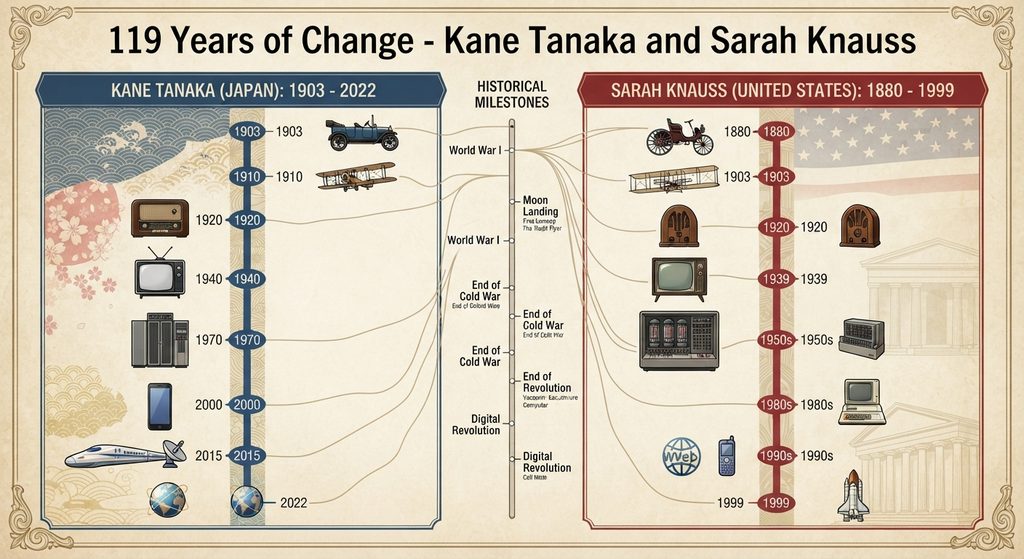
Kane Tanaka holds second place among the oldest validated people ever recorded. Born in Japan on January 2, 1903, she lived until April 19, 2022, reaching 119 years and 107 days. Current validated longevity rankings place her immediately behind Jeanne Calment.
Tanaka entered the world during another remarkable period of technological change. The Wright brothers achieved their famous powered flight later in 1903. By the end of her life, commercial jets crossed continents every day, people carried powerful computers in their pockets, and spacecraft had explored distant parts of the Solar System.
Her life also covered dramatic chapters of Japanese and global history. She lived through two world wars, enormous economic transformations, the development of modern Japan, and the digital revolution.
Tanaka was the seventh of eight children. She married Hideo Tanaka in January 1922. The couple had four biological children and adopted another child. Her husband operated a family business producing and selling foods including rice cakes, udon noodles, and traditional sweets.
Staying Mentally Active at an Extraordinary Age
One interesting aspect of Tanaka’s later life was her continued interest in mental activities. Guinness reported that she enjoyed mathematics and playing Othello, the strategy board game.
She became remarkably good at Othello and reportedly played against staff at her care home. These details give her story a human dimension that statistics alone cannot provide.
Guinness officially confirmed Tanaka as the oldest living person in 2019, when she was 116 years and 66 days old. At the ceremony marking the recognition, she received chocolates and immediately began enjoying them.
Her personality, routines, and interests naturally attracted worldwide attention. However, it would be misleading to treat one person’s habits as a proven formula for extreme longevity.
Human lifespan depends on a complicated combination of genetics, environment, healthcare, socioeconomic circumstances, lifestyle, chance, and many other factors.
Nearly 120 Years of Japanese History
Tanaka’s 119-year lifespan meant she experienced a Japan radically different from the country of her childhood.
She was already an adult before commercial radio became widespread. Television, modern air travel, high-speed trains, computers, mobile phones, and the internet all became ordinary parts of life during her lifetime.
She also survived serious medical challenges. Guinness reported that she underwent surgery for cataracts and colorectal cancer during her long life.
When Tanaka died in April 2022, she had reached 119 years and 107 days. Her validated lifespan remains only ten days longer than Sarah Knauss, the person occupying third place.
That tiny difference becomes particularly striking when comparing lifespans approaching 120 years.
3. Sarah Knauss – 119 Years and 97 Days
Sarah DeRemer Knauss is the third-oldest validated person ever recorded and the oldest authenticated person in United States history. She was born on September 24, 1880, and died on December 30, 1999, at the age of 119 years and 97 days. Guinness identifies her lifespan as the second-oldest authenticated age known at the time of her death, behind Jeanne Calment.
Knauss was born in Hollywood, Pennsylvania. Interestingly, this Pennsylvania community carried the name Hollywood before the California district became internationally famous through the film industry.
Her birth year places her firmly in the nineteenth century. When she was born, the modern automobile industry did not exist. Electric power was only beginning its transformation of cities. Motion pictures, radio broadcasting, airplanes, television, and computers were still in the future.
Yet Knauss survived until just one day before the final day of 1999.
She effectively lived from America’s industrial age into the dawn of the twenty-first-century digital world.
Becoming the World’s Oldest Living Person
After the death of Canadian supercentenarian Marie-Louise Meilleur on April 16, 1998, Knauss became the world’s oldest recognized living person.
She was already 117 years and 204 days old when she inherited that distinction. Guinness notes that this made her the oldest person to become the holder of the “oldest living person” title.
She retained that status until her death more than a year later.
Knauss’s extreme longevity also highlights how uncommon it is to reach 119. Millions of people live into their seventies and eighties, and growing numbers reach 100. However, the number of people with reliably documented lifespans beyond 115 remains tiny by comparison.
Reaching 119 represents an entirely different statistical territory.
A Life Spanning Three Centuries on the Calendar
Knauss lived during parts of the 1800s and 1900s and died immediately before the calendar changed to 2000.
During her lifetime, electricity became widespread, cars replaced horse-drawn transportation, airplanes transformed travel, radio and television changed entertainment, antibiotics transformed medicine, humans walked on the Moon, and personal computers entered ordinary homes.
That historical context helps us appreciate extreme longevity more clearly.
A number such as 119 can feel abstract. Looking at everything that happened during those years transforms the number into something tangible.
Knauss’s record also remains significant because of its strong authentication. Longevity research depends on documentary evidence, and established record organizations distinguish verified cases from claims that cannot be supported adequately.
Her 119 years and 97 days continue to place her among the most extraordinary documented human lifespans.
4. Lucile Randon – 118 Years and 340 Days
Lucile Randon, widely known as Sister André, occupies fourth place among the oldest validated people ever recorded. She was born in France on February 11, 1904, and died in Toulon on January 17, 2023. She reached 118 years and 340 days. Guinness identifies her as the fourth-oldest authenticated person.
Randon’s story is particularly memorable because much of her long life centered on service to other people.
Before entering religious life, she worked as a teacher and governess. Guinness reports that she also cared for children during World War II. Following the war, she spent many years working with orphans and elderly people at a hospital in Vichy.
She adopted the religious name Sister André in 1944.
Her life eventually extended almost eight decades beyond that point.
By the time she became internationally recognized for her longevity, the world she knew in childhood had been transformed beyond recognition.
From the Early 1900s to the Smartphone Era
Randon was born before World War I and lived through both world wars. She witnessed the growth of commercial aviation, television, antibiotics, nuclear power, space exploration, computers, the internet, and smartphones.
Her lifetime also included the 1918 influenza pandemic and, more than a century later, the COVID-19 pandemic.
In 2021, at age 116, Randon tested positive for COVID-19. She subsequently recovered, attracting international attention because of her exceptional age. Guinness later recognized her extraordinary survival story while documenting her longevity records.
After Kane Tanaka died in April 2022, Sister André became the world’s oldest recognized living person.
At that point, she was already 118.
A Remarkable Life of Service
Randon’s long career caring for others distinguishes her story from the simple numbers associated with longevity rankings.
After working as a teacher and governess, she devoted decades to hospital work. Her experiences therefore stretched from early twentieth-century childhood through wartime Europe and into twenty-first-century healthcare.
In later life, she lived in a retirement home in Toulon. Guinness reported that she had become partially deaf and used a wheelchair but continued trying to keep her mind occupied.
She died less than a month before what would have been her 119th birthday.
Her final verified age of 118 years and 340 days placed her behind only Calment, Tanaka, and Knauss in validated human longevity rankings.
The fact that two of the four longest validated lifespans belong to French women is interesting, but such a tiny sample cannot establish a national longevity formula. Individual supercentenarian records should not be confused with population-level life expectancy.
5. Nabi Tajima – 117 Years and 260 Days
Nabi Tajima completes the current top five of validated human lifespans. She was born on August 4, 1900, in Japan and died on April 21, 2018. Her final validated age was 117 years and 260 days.
Her birth date is especially memorable because it came almost at the beginning of the twentieth century.
Tajima lived through nearly all of that century and almost two decades of the next one.
During those 117 years, Japan experienced profound social, economic, technological, and demographic changes. The transformation from the Japan of 1900 to the highly connected society of 2018 was enormous.
She lived long enough to witness inventions and technologies that would have seemed almost impossible during her childhood become ordinary household objects.
Japan’s Extraordinary Longevity History
Tajima is one of several Japanese supercentenarians who have appeared near the top of validated longevity rankings.
Japan is well known for having one of the world’s oldest populations, although individual longevity records should always be separated from broader demographic statistics.
A supercentenarian’s lifespan cannot simply be explained by nationality or one particular food. Genetics, lifestyle, medical care, social circumstances, environmental exposure, and chance can all contribute.
Following the death of Violet Brown in September 2017, Tajima became the world’s oldest recognized living person. She held that distinction until her death in April 2018.
Her final age of 117 years and 260 days currently places her fifth among validated human lifespans.
What Exactly Is a Supercentenarian?
The term “centenarian” describes someone who has reached at least 100 years of age. A supercentenarian goes considerably further, reaching 110 or older.
That ten-year difference might sound modest. Statistically, however, surviving from 100 to 110 is extremely difficult.
Human mortality risk rises sharply at advanced ages. Consequently, only a small fraction of centenarians eventually become supercentenarians.
The people in this ranking went even further. Every person listed here exceeded 117 years.
That distinction matters because extreme longevity records require especially careful verification. When someone claims to be 110 or older, researchers cannot simply accept a reported birth year.
They need evidence linking the elderly individual to records created around the time of birth and throughout life.
Why Documentation Matters So Much
Historical longevity claims can be difficult to investigate because names change, documents disappear, borders move, and recordkeeping systems vary between countries and eras.
Researchers may examine birth certificates, baptism records, marriage documents, census records, immigration documents, family records, government identification, and other evidence.
The goal is not merely to locate an old birth certificate. Researchers must establish that the person named on the early document is the same individual who later reached the claimed age.
Guinness World Records has worked with specialists in gerontology and organizations involved in supercentenarian research. The Gerontology Research Group, for example, has maintained extensive research and authentication efforts involving people aged 110 and above.
This process explains why a dramatic claim such as “someone lived to 150” does not automatically become a world record.
A claim and a validated record are very different things.
Why Unverified Longevity Claims Are Not Included
Stories of people supposedly living 130, 150, or even 160 years regularly appear online. Some originated centuries ago, while others continue circulating through social media.
Such stories can be fascinating, but reliable longevity rankings require documentary evidence.
One famous example is Henry Jenkins of England. Historical accounts claimed that he was born in 1501 and died in 1670, which would have made him approximately 169 years old.
However, Guinness explains that his birth date cannot be documented adequately. Parish registration requirements did not exist at the time of his claimed birth, making reliable authentication impossible.
This distinction is essential.
Calling someone the “oldest person ever” means something very different when the record is supported by documentation spanning a lifetime.
Why Jeanne Calment Still Holds the Record
Many longevity claims have exceeded Calment’s 122 years on paper.
None has produced enough accepted evidence to replace her authenticated record.
Calment’s case benefits from extensive documentation. Guinness reports that her birth certificate survived and that she appeared in numerous census records. Researchers could therefore follow her identity across different stages of her life.
As a result, 122 years and 164 days remains the recognized benchmark for verified human longevity.
That number is remarkable for another reason.
No other validated person has yet reached 120.
Kane Tanaka came closest at 119 years and 107 days, while Sarah Knauss reached 119 years and 97 days. The difference between Calment and every other validated case therefore remains substantial.
What Can These Extraordinary Lives Teach Us About Longevity?
It is tempting to search for a single secret shared by exceptionally old people.
Perhaps it is a particular diet, daily exercise, chocolate, coffee, family life, optimism, religion, or a specific routine.
Reality is far more complicated.
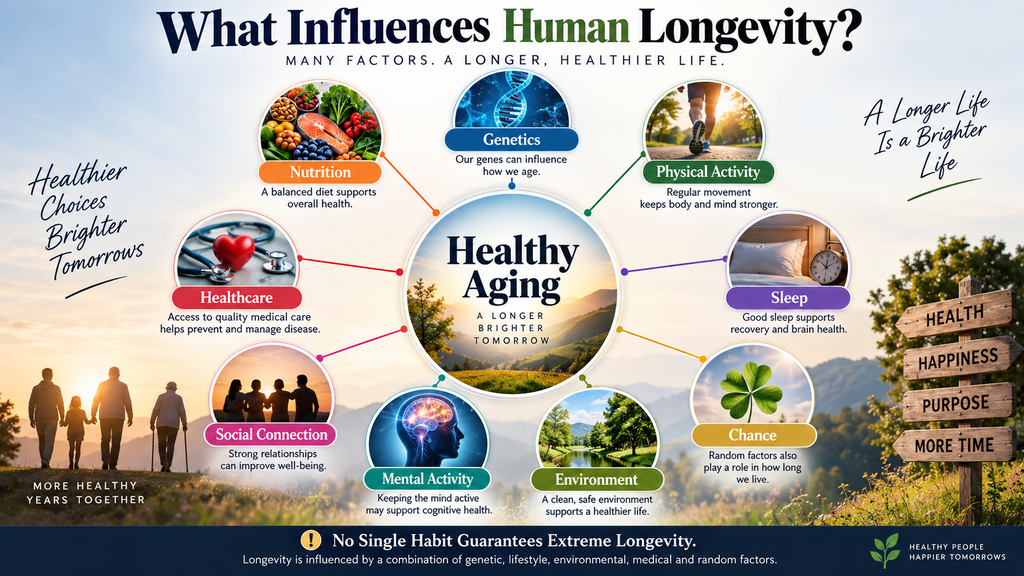
A person’s lifespan develops from many interacting influences. Genetics can matter, but genes do not operate independently of environment. Nutrition, healthcare, physical activity, infections, smoking, alcohol consumption, occupational exposure, income, social relationships, education, stress, and random events can all affect health and longevity.
Supercentenarians are also statistical outliers. Their experiences cannot automatically tell an average person what will produce a similar lifespan.
Someone who lived to 118 while enjoying a particular food did not necessarily live that long because of that food.
Healthy Aging Matters More Than Copying a Record Holder
A more useful lesson comes from established healthy-aging principles rather than unusual anecdotes.
Regular physical activity, appropriate nutrition, preventive healthcare, adequate sleep, social engagement, avoiding tobacco, managing chronic conditions, and maintaining mental activity can support health as people age.
Even then, no lifestyle can guarantee a lifespan of 100, 110, or 120 years.
Genetics and circumstances outside personal control remain important.
Guinness gerontology consultant Robert Young has emphasized the value of maintaining a structured routine, staying physically and mentally active, controlling food portions, and remaining socially engaged.
Those ideas are useful as general healthy-aging concepts. They should not be interpreted as a guaranteed formula for extreme longevity.
Women Dominate the Extreme Longevity Records
One feature of the top-five ranking is impossible to miss: every person is a woman.
Jeanne Calment, Kane Tanaka, Sarah Knauss, Lucile Randon, and Nabi Tajima were all female.
This pattern extends beyond the first five positions. Women are heavily represented among validated supercentenarians and among the world’s oldest populations more generally.
The longest validated male lifespan remains considerably lower than Calment’s overall record.
Japanese supercentenarian Jiroemon Kimura is recognized by Guinness as the oldest verified man. He was born on April 19, 1897, and died on June 12, 2013, reaching 116 years and 54 days.
That represents more than six years of difference between the male and overall verified records.
Why Do Women Generally Live Longer?
Scientists have investigated the female longevity advantage for decades.
There probably is no single explanation.
Biological differences may contribute, including hormonal, genetic, cardiovascular, and immune-system factors. Behavioral patterns can also influence population-level outcomes.
Historically, men in many populations have experienced higher exposure to occupational hazards, warfare, smoking, alcohol-related harm, dangerous driving, and other risks.
However, these patterns differ by country and generation.
Researchers therefore study longevity using large populations rather than drawing conclusions from individual supercentenarians.
The dominance of women among the oldest validated humans remains one of the most interesting patterns in longevity research.
How Much Longer Can Humans Live?
Jeanne Calment’s record naturally raises one enormous question: can a human live significantly beyond 122 years?
Science does not yet provide a simple answer.
Human life expectancy has increased dramatically in many countries because of sanitation, vaccination, antibiotics, safer childbirth, improved nutrition, cardiovascular treatment, cancer therapies, and better management of chronic disease.
However, increasing average life expectancy is different from increasing the maximum human lifespan.
Helping more people survive into their eighties and nineties does not automatically mean someone will reach 130.
Reaching 120 Remains Exceptionally Rare
Calment remains the only validated person known to have reached 120 years.
That fact provides important perspective.
Kane Tanaka lived more than 119 years but still remained almost three years short of Calment’s record.
Sarah Knauss also passed 119 but did not reach 120.
The gap illustrates how rapidly survival becomes difficult at extreme ages.
Future advances in medicine may improve healthy aging. Researchers continue investigating cellular senescence, genetics, metabolism, regenerative medicine, age-related diseases, and other biological mechanisms.
Whether these advances will eventually allow verified human lifespans far beyond today’s record remains unknown.
For now, 122 years and 164 days remains the documented standard that nobody else has surpassed.
A Century of Change Seen Through Five Lives
Perhaps the most fascinating way to understand these records is not through biology but through history.
Jeanne Calment was born in 1875.
Sarah Knauss followed in 1880.
Nabi Tajima arrived in 1900, Kane Tanaka in 1903, and Lucile Randon in 1904.
Together, their lives connect the nineteenth century with the modern digital age.
Imagine being born when horses remained a major form of transportation and living long enough to see humans travel into space.
Imagine growing up before radio broadcasting and surviving into an era when billions of people communicate instantly through the internet.
These women witnessed transformations that reshaped almost every part of human existence.
Technology Changed Around Them
Transportation changed from horses and steam trains to automobiles, commercial jets, and high-speed rail.
Communication evolved from letters and telegraphs to telephones, radio, television, email, video calls, and smartphones.
Medicine changed equally dramatically.
Modern antibiotics did not exist during the childhood of several people on this list. Neither did many vaccines, advanced surgical techniques, CT scanners, MRI machines, organ transplantation, or modern intensive care.
Daily life transformed as electricity, refrigeration, household appliances, automobiles, television, computers, and the internet became increasingly common.
Looking at longevity through this historical lens gives these records an emotional dimension that numbers cannot capture.
A lifespan of 118 or 122 years means watching the world repeatedly reinvent itself.
Frequently Asked Questions
Who is the oldest verified person ever?
Jeanne Louise Calment of France remains the oldest verified person ever recorded. She lived for 122 years and 164 days, from February 21, 1875, until August 4, 1997. Guinness World Records continues to recognize her authenticated record.
Has anyone officially lived to 130 years old?
No validated longevity record has established a human lifespan of 130 years. There have been historical claims exceeding 130, but claims without sufficient documentation are not equivalent to authenticated longevity records.
Who is the second-oldest verified person ever?
Kane Tanaka of Japan ranks second among validated cases. She lived from January 2, 1903, until April 19, 2022, reaching 119 years and 107 days.
Who is the oldest American ever recorded?
Sarah Knauss is the oldest authenticated American. She lived for 119 years and 97 days and remains third in the validated worldwide ranking.
Who is the oldest verified man ever?
Jiroemon Kimura of Japan holds the verified male longevity record. He lived for 116 years and 54 days, from April 19, 1897, until June 12, 2013.
What is a supercentenarian?
A supercentenarian is a person who reaches at least 110 years of age. Because survival beyond 110 is exceptionally rare, these cases receive considerable attention from longevity researchers.
Did Jeanne Calment really live for 122 years?
Her record remains recognized by Guinness World Records and established longevity databases. Guinness notes that her life was supported by extensive documentation, including her preserved birth certificate and numerous census records.
Why are unverified 130-year-old or 150-year-old people excluded?
Extreme longevity rankings require reliable evidence connecting an individual to an authenticated birth date. Historical claims often lack sufficient documentation, so researchers distinguish reported ages from validated records.
Is there a proven secret to living past 110?
No. Extreme longevity probably results from a complex interaction of genetics, environment, healthcare, lifestyle, social circumstances, and chance. No food, supplement, exercise routine, or other single habit has been proven to guarantee becoming a supercentenarian.
Could someone eventually live longer than Jeanne Calment?
It is possible that Calment’s record will eventually be surpassed, but predicting when would be speculative. Her authenticated record of 122 years and 164 days remains unmatched.
Five Lives That Redefined the Meaning of Old Age
The world’s five longest validated human lifespans are difficult to comprehend using numbers alone. Jeanne Calment reached 122 years and 164 days. Kane Tanaka reached 119 years and 107 days. Sarah Knauss followed at 119 years and 97 days, Lucile Randon at 118 years and 340 days, and Nabi Tajima at 117 years and 260 days.
Their stories span France, Japan, and the United States, but they share something extraordinarily rare: each lived well beyond the age reached by almost every human being in recorded history.
Still, their lives should not be reduced to a search for a magical longevity secret.
The more meaningful story lies in the extraordinary amount of history contained inside each lifetime. These women watched transportation, medicine, communication, and technology transform the world around them.
Jeanne Calment remains the ultimate example. Born in nineteenth-century France, she survived into the age of computers and the internet. Until another thoroughly documented person exceeds 122 years and 164 days, her remarkable lifespan remains the benchmark for verified human longevity.
⚠️ Disclaimer and Source Hygiene
This article is intended for educational and informational purposes. Longevity statistics refer to documented and validated cases rather than every historical claim of extreme age. Rankings can change when new evidence is validated or existing records are reassessed.
Health and longevity information should not replace professional medical advice. Individual lifespan depends on many factors, and the habits of individual supercentenarians should never be treated as medical recommendations or guaranteed methods for extending life.
The historical ages and rankings in this article were cross-checked against authoritative longevity sources, including Guinness World Records and validated records published by LongeviQuest.
🔔 For more tutorials like this, consider subscribing to our blog.
📩 Do you have questions or suggestions? Leave a comment or contact us!
🏷️ Tags: oldest person ever, oldest people in the world, Jeanne Calment, Kane Tanaka, Sarah Knauss, Lucile Randon, Nabi Tajima, supercentenarians, human longevity, longevity records
📢 Hashtags: #OldestPerson, #Longevity, #JeanneCalment, #KaneTanaka, #Supercentenarian, #HumanLongevity, #WorldRecords, #History, #HealthyAging, #AmazingPeople
📚 Sources and References
Guinness World Records – Jeanne Calment: Guinness recognizes Jeanne Calment of France as the oldest authenticated person ever, with a lifespan of 122 years and 164 days. Her extensive historical documentation remains central to validation of the record.
Guinness World Records – Sarah Knauss: Guinness documents Sarah Knauss as reaching 119 years and 97 days and recognizes her as the oldest authenticated American.
Guinness World Records – Kane Tanaka: Guinness documented Tanaka’s recognition as the world’s oldest living person and details her family life, interests, and later years.
Guinness World Records – Lucile Randon: Guinness records Sister André’s final age as 118 years and 340 days and identifies her as the fourth-oldest authenticated person.
LongeviQuest Atlas: The validated longevity database currently ranks Jeanne Calment first, Kane Tanaka second, Sarah Knauss third, Lucile Randon fourth, and Nabi Tajima fifth.
🕊️ Secondary Sources and Testimonials
Personal comments, reported routines, favorite foods, and lifestyle anecdotes associated with supercentenarians can make their stories more interesting. However, such accounts should be treated as biographical details rather than scientific evidence explaining why an individual lived so long.
Historical longevity claims should receive similar caution. Extraordinary ages sometimes appear in family histories, newspapers, community traditions, or older records. Unless sufficient evidence establishes identity and birth date, those claims should not be presented alongside authenticated supercentenarian records as equivalent facts.
For this reason, this article prioritizes validated longevity databases and established record-verification organizations when stating ages and rankings.
