
⏲️ Estimated reading time: 30 min
Table of Contents
Gemini Ultra, Pro, Flash, and Nano represent different approaches inside Google’s AI ecosystem. Learn how each tier differs in reasoning ability, speed, scalability, coding performance, cloud processing, and on-device AI, and discover which type of Gemini model makes the most sense for different tasks.
What Are Gemini Ultra, Pro, Flash, and Nano?
Google Gemini is not simply one artificial intelligence model.
It is a broader family of AI models designed for different levels of performance, workloads, devices, and use cases.
When Google originally introduced Gemini, the company presented three main model categories: Ultra, Pro, and Nano.
The basic idea was straightforward.
Some AI tasks require enormous computing power and advanced reasoning.
Others need a strong balance between capability and efficiency.
Meanwhile, certain tasks should ideally run directly on a mobile phone or another local device.
Later, Google expanded the Gemini family with the Flash category.
Flash introduced another important priority: speed.
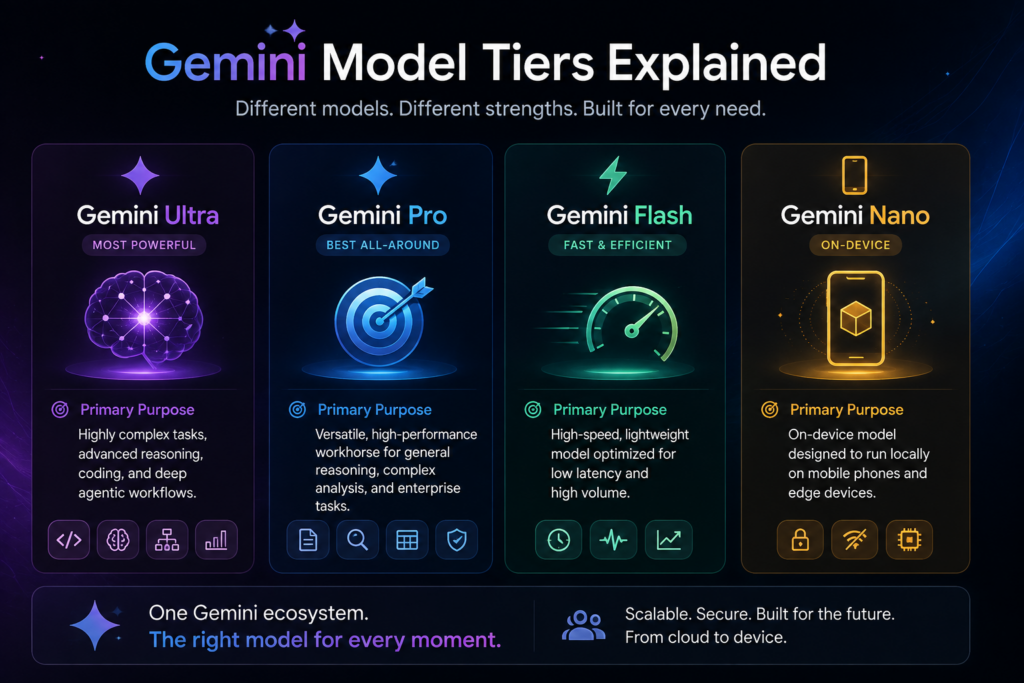
As a result, the four names can be understood in a simplified way:
| Model Tier | Primary Purpose |
|---|---|
| Gemini Ultra | Highly complex tasks, maximum capability, advanced reasoning, coding, and demanding AI workflows |
| Gemini Pro | Powerful general-purpose reasoning, complex analysis, coding, and professional workloads |
| Gemini Flash | Fast, efficient AI optimized for low latency, large-scale processing, and high-volume applications |
| Gemini Nano | Compact AI designed to run directly on phones and other edge devices |
However, there is an important detail.
These names should not always be interpreted as four permanent models arranged in a simple ranking.
The Gemini ecosystem continues to evolve.
New generations use names such as Pro, Flash, Flash-Lite, and other specialized variants.
The word Ultra has also been used in Google’s commercial AI offerings and subscription tiers, which can create confusion.
Therefore, it is better to understand Ultra, Pro, Flash, and Nano as different AI philosophies and performance categories rather than a permanent list of four models.
How Google Originally Structured the Gemini Family
When Google introduced Gemini 1.0, it described three primary sizes.
These were Ultra, Pro, and Nano.
Each model was designed around a different computing environment.
Ultra represented the highest-performance category.
Pro offered strong performance across a wide range of tasks.
Nano focused on running AI directly on devices with limited resources.
This approach made sense because AI workloads vary dramatically.
A smartphone does not have the same processing power as a data center.
A simple text classification task does not require the same intelligence as analyzing thousands of lines of code.
Similarly, a customer service chatbot serving millions of requests must prioritize efficiency differently from an AI research assistant handling a few extremely difficult questions.
Google’s model segmentation attempted to address these differences.
Why Google Needs Several Gemini Model Types
Artificial intelligence consumes real computing resources.
Modern models use specialized hardware, memory, electricity, networking infrastructure, and enormous data centers.
Using the most powerful model for every request would therefore be inefficient.
Consider a simple request such as:
“What is the capital of Belgium?”
An extremely large reasoning model would be unnecessary.
A faster and more efficient model could easily answer the question.
Now consider a different task:
“Analyze these 80 source files, identify the security vulnerability, explain how the exploit works, rewrite the affected code, and create a testing plan.”
That task requires far more reasoning.
The ideal model depends on the problem.
This is why the Gemini family includes models optimized for different goals.
Gemini Ultra: Maximum Capability in the Original Gemini Family
Gemini Ultra was introduced as the most capable model in the original Gemini 1.0 family.
Its purpose was to handle extremely complex tasks.
Rather than focusing primarily on speed or efficiency, Ultra represented the high-performance end of the Gemini architecture.
This type of model is intended for situations where the quality of reasoning matters more than minimizing computational resources.
What Gemini Ultra Was Designed to Handle
Complex AI problems usually contain several layers.
A model may need to understand instructions, evaluate data, identify relationships, and produce a logically structured result.
Examples include:
- advanced mathematical reasoning;
- complex programming;
- large-scale document analysis;
- scientific research;
- multimodal reasoning;
- code debugging;
- technical planning;
- multi-step problem solving;
- advanced automation;
agentic AI workflows.
These tasks often require the AI system to maintain several pieces of information simultaneously.
That increases the difficulty significantly.
Understanding Advanced Reasoning
Many people think an AI model simply predicts the next word.
Technically, language models generate sequences based on learned patterns.
However, modern AI systems can perform tasks that appear increasingly similar to structured reasoning.
For example, imagine providing an AI system with:
- a technical manual;
- a database export;
- three charts;
- several screenshots;
- a list of requirements;
and ten related questions.
The model must understand the relationships between these pieces of information.
It cannot simply respond to each item independently.
It must build a broader understanding of the problem.
This is where advanced models become particularly valuable.
Gemini Ultra and Complex Coding
Programming is a good example of a task where model capability matters.
Simple coding questions might include:
“Write a PHP function that calculates a percentage.”
Almost any modern coding model can handle this.
However, professional software problems are usually more complicated.
A developer might ask:
“Analyze this WordPress plugin, identify potential SQL injection vulnerabilities, check nonce validation, review user capabilities, optimize database queries, and rewrite the code following WordPress coding standards.”
The AI now needs knowledge of:
- PHP;
- WordPress;
- SQL;
- security;
- authentication;
- authorization;
- database optimization;
- coding standards;
software architecture.
A high-capability model is better suited for this kind of task.
Gemini Ultra and Multimodal Reasoning
One of Gemini’s major strengths has always been multimodality.
Multimodal AI can process several kinds of information.
Depending on the model and implementation, those inputs may include:
- text;
- images;
- video;
- audio;
- code;
documents.
A complex model can potentially analyze these different formats together.
For example, imagine uploading a screenshot of a server error along with the configuration file responsible for the problem.
An advanced AI system could examine both.
It might identify the error message from the screenshot and connect it with a mistake inside the configuration file.
That represents a more sophisticated form of analysis than simple text generation.
Gemini Ultra and Agentic AI
The AI industry increasingly focuses on agents.
An AI agent does more than answer a single question.
It may perform a sequence of actions.
A simplified workflow might look like this:
The AI receives an objective.
It analyzes the objective.
It determines what information is missing.
It selects an appropriate tool.
It performs an action.
It examines the result.
It adjusts its strategy.
It continues until the task is completed.
This process is often called an agentic workflow.
Highly capable models are particularly useful for these workflows because they must reason across multiple steps.
Is Gemini Ultra Still a Separate Model?
This question requires some context.
Gemini Ultra was originally the name of the highest-end Gemini 1.0 model category.
However, Google’s naming strategy has evolved.
Modern Gemini products increasingly use generational names and categories such as Pro and Flash.
At the same time, the word Ultra can also appear in commercial Google AI subscription plans.
Therefore, seeing the word “Ultra” does not automatically mean that the user is interacting with a model literally called Gemini Ultra.
It is important to distinguish between:
Gemini Ultra as an original model category
and
Ultra as a commercial product or subscription level.
These are not necessarily the same thing.
Gemini Pro: The Powerful General-Purpose Workhorse
Gemini Pro represents one of the most important categories in Google’s AI strategy.
A Pro model aims to provide strong reasoning while remaining practical for a broad range of professional tasks.
Instead of being designed only for the most extreme workloads, Pro acts as a versatile high-performance model.
This makes it suitable for developers, businesses, researchers, writers, analysts, and advanced AI applications.
What Makes Gemini Pro Different?
The key idea behind Pro is balance.
A Pro model needs enough intelligence for complicated tasks while remaining usable across many different applications.
Typical use cases can include:
- coding;
- document analysis;
- research;
- professional writing;
- data interpretation;
- technical troubleshooting;
- planning;
- reasoning;
- business analysis;
- automation;
AI agents.
This versatility explains why Pro models are often considered the main high-performance workhorse of an AI platform.
Gemini Pro for Coding
Software development has become one of the most important AI use cases.
Developers increasingly use AI for:
writing functions;
- finding bugs;
- explaining code;
- reviewing pull requests;
- generating tests;
- creating documentation;
- refactoring applications;
analyzing security problems.
A powerful Pro model can work beyond isolated snippets.
For example, instead of asking:
“Why does this PHP function fail?”
a developer may ask:
“Analyze the entire plugin architecture, identify why AJAX requests are generating duplicate database queries, improve the cache strategy, and ensure the changes remain compatible with WordPress multisite.”
That request involves multiple technical layers.
The model has to reason about architecture rather than a single line of code.
Gemini Pro for WordPress
WordPress administrators and developers can benefit from advanced AI models in many ways.
A Pro-class model could help analyze:
- plugin code;
- theme code;
- database queries;
- server logs;
- Core Web Vitals;
- JavaScript;
- CSS;
- PHP errors;
- SEO structures;
security configurations.
For example, a WordPress performance issue may not come from one plugin.
The real cause could involve several components.
A slow site might be affected by:
- poor database queries;
- excessive JavaScript;
- uncached API requests;
- incorrect Cloudflare settings;
- large images;
- render-blocking CSS;
plugin conflicts.
A strong reasoning model can examine these elements together.
Gemini Pro for Businesses
Enterprise AI workloads often require more than simple text generation.
Companies may need AI to analyze:
- reports;
- contracts;
- technical documentation;
- financial information;
- customer support messages;
- internal procedures;
- spreadsheets;
- product data;
software repositories.
These tasks require reliability and context awareness.
A Pro model can therefore act as a general intelligence layer for many business applications.
Gemini Pro for Research
Research frequently requires connecting information from different sources.
An AI model may need to:
- summarize documents;
- compare claims;
- identify contradictions;
- extract important details;
- create structured notes;
- develop hypotheses;
generate questions.
The model must also maintain context across a large amount of information.
This is another area where Pro-level models can be useful.
Gemini Pro and Long Context
Modern AI applications often need to process very large inputs.
Instead of analyzing a paragraph, the AI may receive an entire codebase or long document collection.
Long context can be valuable when working with:
- books;
- technical manuals;
- legal documents;
- code repositories;
- meeting transcripts;
business records.
However, having a large context window alone does not guarantee good reasoning.
The model must also understand the information effectively.
That is why model capability still matters.
Gemini Flash: Speed and Efficiency Come First
Gemini Flash introduced a different priority.
Instead of maximizing raw capability at any cost, Flash focuses strongly on speed and efficiency.
This matters because many AI applications operate at enormous scale.
A platform might process thousands or millions of requests every day.
In those environments, small differences in latency and resource consumption become extremely important.
What Does Flash Mean?
The name describes the objective very well.
Flash models aim to deliver:
- fast responses;
- low latency;
- efficient processing;
- large-scale deployment;
- high request volume;
cost-effective AI workloads.
This makes them attractive for production systems where responsiveness matters.
Why Low Latency Matters
Latency refers to the time between sending a request and receiving a response.
Imagine talking to a voice assistant.
If the assistant waits five seconds before every reply, the conversation feels unnatural.
A response arriving almost immediately feels far more human.
The same principle applies to:
- customer service bots;
- AI search engines;
- writing assistants;
- coding assistants;
- voice applications;
real-time translation.
Speed becomes part of the user experience.
Gemini Flash Does Not Mean Weak AI
One common misunderstanding is that Flash must be significantly less capable because it prioritizes speed.
That is not necessarily true.
Modern efficient models have become remarkably powerful.
A new Flash generation can potentially handle tasks that would have required much larger models several years earlier.
AI development improves rapidly.
Architecture, training methods, data quality, inference techniques, and hardware optimization all improve over time.
Therefore, the word Flash should be interpreted primarily as an optimization target.
It does not automatically mean “basic AI.”
When Gemini Flash Makes More Sense Than Pro
Suppose you run a website that receives 100,000 comments every day.
You want AI to classify each comment as:
- question;
- feedback;
- spam;
- technical issue;
- positive review;
negative review.
This task may not require the strongest reasoning model.
However, the system needs to process a large amount of data quickly.
Flash could make more sense.
Other possible Flash workloads include:
- summarization;
- classification;
- content extraction;
- customer support;
- simple coding tasks;
- document processing;
- moderation;
- chatbots;
- metadata generation;
search enhancement.
Gemini Flash for Chatbots
Chatbots benefit greatly from fast models.
Users expect immediate responses.
Even a high-quality answer can feel frustrating if the delay is too long.
Flash models are therefore suitable for conversational applications where most requests are relatively straightforward.
For more difficult questions, the application can route the request to a stronger model.
This hybrid strategy can improve both speed and quality.
Gemini Flash for High-Traffic Websites
Imagine integrating AI into a large WordPress website.
Visitors could use AI to:
- search content;
- find related posts;
- ask questions;
- generate summaries;
- translate pages;
receive recommendations.
If thousands of visitors use these features simultaneously, AI infrastructure can become expensive.
A lightweight, fast model becomes highly valuable.
Flash is designed around exactly this type of problem.
Gemini Flash for APIs
Developers frequently interact with Gemini through APIs.
When building an application, they must consider more than intelligence.
Important factors include:
- response speed;
- price;
- token usage;
- request limits;
- reliability;
- scalability;
output quality.
The strongest model is not always the best engineering choice.
A slightly smaller model that responds faster and costs less can produce a better product.
Gemini Flash-Lite
The existence of models such as Flash-Lite demonstrates how far AI specialization has evolved.
A Flash-Lite model targets even greater efficiency.
These models can be especially useful when processing massive volumes of relatively simple tasks.
Examples might include:
- tag generation;
- classification;
- sentiment analysis;
- short summaries;
- metadata extraction;
basic text transformations.
This creates several performance levels inside the Flash family itself.
Gemini Nano: AI Running Directly on Your Device
Gemini Nano represents another major direction in artificial intelligence.
Instead of relying entirely on cloud servers, Nano is designed for on-device AI.
This means certain AI operations can run locally on a smartphone or another compatible device.
The idea has major implications for speed, privacy, connectivity, and future mobile applications.
How Traditional Cloud AI Works
Most AI services follow a simple architecture.
The user enters a prompt.
The device sends the prompt to a server.
The server runs the AI model.
The result is generated.
The response travels back across the internet.
This architecture has many advantages.
Data centers can provide enormous computing power.
However, it also creates several dependencies.
The device needs connectivity.
The server must remain available.
The user may experience network latency.
Certain information may also need to leave the device.
How On-Device AI Works
On-device AI changes this architecture.
Instead of sending every request to a remote data center, the phone can perform certain operations locally.
The model must therefore fit within the hardware limitations of the device.
A smartphone has limited:
- memory;
- battery capacity;
- processing power;
- thermal capacity;
storage.
This requires highly optimized AI models.
Gemini Nano is built around this concept.
Why Gemini Nano Matters
The importance of Nano goes beyond smartphone convenience.
It represents a broader change in computing.
AI is moving closer to the user.
Instead of every intelligent function depending on a massive remote server, some intelligence can live directly inside everyday hardware.
Potential applications include:
- text processing;
- summaries;
- smart replies;
- offline assistance;
- image understanding;
- notification management;
- local classification;
accessibility tools.
Gemini Nano and Privacy
One potential benefit of local AI is privacy.
If a task runs entirely on the device, the data used for that task may not need to be transmitted to an external server.
This can be valuable when processing sensitive information.
However, users should remain careful.
The fact that an application uses on-device AI does not automatically mean every feature operates locally.
Some functions may still require cloud processing.
Privacy therefore depends on the specific implementation.
Gemini Nano and Offline AI
Another possible benefit is reduced dependence on internet connectivity.
Certain local AI functions can theoretically continue operating even when the network connection is poor.
This can be useful when:
- traveling;
- using weak mobile coverage;
- working offline;
using devices in remote locations.
However, not every Gemini feature available on a phone should be assumed to work offline.
The implementation determines what can run locally.
Limitations of On-Device Models
Local AI has major advantages, but there are compromises.
A phone cannot provide the same computing resources as a massive data center.
Therefore, Nano models must be smaller and highly optimized.
They may perform extremely well on specific tasks.
However, very complicated reasoning may still require cloud models.
This creates an interesting future architecture.
Hybrid AI: Local Models Plus Cloud Models
Many AI systems will likely combine local and cloud intelligence.
The process could work like this:
A local model receives the request.
It determines that the task is simple.
The task is completed directly on the device.
If the request is too difficult, the system sends the necessary information to a stronger cloud model.
The cloud model processes the problem.
The result returns to the device.
This approach combines several advantages.
Local AI provides speed and privacy.
Cloud AI provides greater capability.
Gemini Nano and Edge Computing
Gemini Nano is part of a broader computing trend called edge computing.
Edge computing moves processing closer to where the data is generated.
The edge might be:
- a smartphone;
- a laptop;
- a vehicle;
- a security camera;
- an industrial machine;
an Internet of Things device.
Instead of transmitting every piece of data to a central server, local hardware can process part of the information.
AI makes this architecture even more powerful.
Gemini Ultra vs Gemini Pro
The historical distinction between Ultra and Pro is primarily about capability and practical balance.
Ultra represented the highest-performance category in the original Gemini family.
Pro represented powerful general-purpose intelligence.
Ultra was intended for the most difficult workloads.
Pro aimed to handle advanced tasks while remaining more broadly practical.
A simple analogy can help.
Ultra is similar to a specialized high-performance machine.
Pro is closer to a powerful professional workstation.
Both can be extremely capable.
However, they target slightly different priorities.
Gemini Pro vs Gemini Flash
This is one of the most important comparisons today.
Pro emphasizes advanced capability.
Flash emphasizes speed and efficiency.
For a complicated architecture review, Pro may be preferable.
For processing thousands of short requests, Flash may be more practical.
However, the difference is not absolute.
Modern Flash models can handle increasingly complex tasks.
Therefore, developers should test real workloads rather than choosing based entirely on the name.
Gemini Flash vs Gemini Nano
Flash and Nano both care about efficiency, but they solve different problems.
Flash focuses on fast processing at scale.
Nano focuses on running AI locally.
A useful way to remember the difference is:
Flash = fast and scalable.
Nano = compact and local.
A Flash model may still run on powerful cloud infrastructure.
Nano is designed around device limitations.
Gemini Ultra vs Gemini Nano
Ultra and Nano sit near opposite ends of the original Gemini philosophy.
Ultra prioritized maximum capability.
Nano prioritized efficient local processing.
Ultra assumes access to powerful infrastructure.
Nano assumes resources are constrained.
This illustrates why one universal AI model would not make sense.
Different environments require different designs.
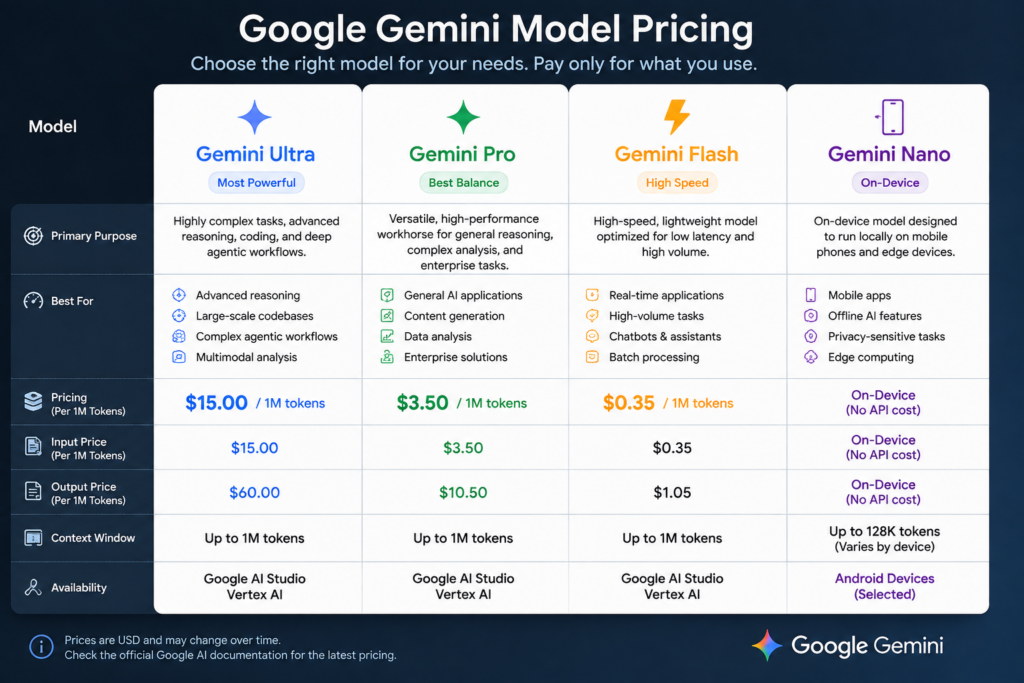
Gemini Ultra, Pro, Flash, and Nano Comparison
| Feature | Gemini Ultra | Gemini Pro | Gemini Flash | Gemini Nano |
|---|---|---|---|---|
| Main Goal | Maximum complexity | Advanced general-purpose AI | Speed and efficiency | On-device AI |
| Complex Reasoning | Very strong | Very strong | Increasingly capable | More limited |
| Coding | Advanced | Advanced | Strong for many tasks | Device-dependent |
| Response Speed | Not primary focus | Balanced | Very fast | Fast locally |
| High Volume | Possible | Possible | Excellent | Not primary purpose |
| Mobile Use | Usually cloud-based | Usually cloud-based | Usually cloud-based | Runs locally |
| Agentic Workflows | Suitable | Highly suitable | Suitable for fast agents | Limited local agents |
| Resource Needs | Very high | High | Optimized | Minimal compared with cloud |
| Offline Potential | No | No | No | Possible for supported tasks |
| Best Example | Difficult reasoning | Professional AI work | Real-time applications | Smartphone intelligence |
Which Gemini Model Is the Most Intelligent?
There is no permanent answer.
A common mistake is to imagine the categories as:
Ultra > Pro > Flash > Nano.
That may roughly describe the original Gemini positioning, but it does not accurately represent every modern generation.
AI models improve very quickly.
A newer Flash model may outperform a much older Pro model in certain benchmarks or tasks.
Therefore, comparisons should consider:
- model generation;
- release version;
- task type;
- context size;
- latency;
- cost;
benchmark performance.
The complete model name matters more than the tier name alone.
Which Gemini Model Is Best for Coding?
For difficult coding problems, a modern Pro model is generally the logical starting point.
Complex software development may require:
- reasoning across many files;
- understanding dependencies;
- security analysis;
- architecture planning;
- debugging;
- test generation;
refactoring.
These tasks benefit from stronger reasoning.
Flash can still be extremely useful.
It may be better for repetitive coding operations or high-volume processing.
A development platform can even combine both.
Pro analyzes difficult problems.
Flash handles routine tasks.
Which Gemini Model Is Best for WordPress?
There is no single answer.
For advanced WordPress debugging, Pro may be ideal.
For example, you might need AI to analyze:
- PHP;
- JavaScript;
- MySQL queries;
- WordPress hooks;
- plugin conflicts;
- server logs;
- Cloudflare configuration.
- That requires broad reasoning.
- Flash may be more appropriate for:
- tag generation;
- short summaries;
- automatic descriptions;
- comment classification;
- content categorization;
basic support responses.
Nano becomes relevant when WordPress-related tools begin processing more information directly on local devices.
Which Gemini Model Is Best for a Chatbot?
Flash is often a strong choice.
A chatbot must usually respond quickly.
Most user questions do not require maximum reasoning.
Using Flash can provide:
- lower latency;
- lower operating costs;
- faster responses;
better scalability.
However, advanced applications may route difficult requests to Pro.
This approach provides the best of both worlds.
Which Gemini Model Is Best for Research?
Pro models are well suited to complex research.
Research tasks can require:
- reading documents;
- comparing sources;
- extracting evidence;
- detecting inconsistencies;
- building arguments;
creating structured summaries.
These tasks rely heavily on reasoning.
Flash can still help with supporting tasks such as summarization and classification.
Which Gemini Model Is Best for Smartphones?
Nano represents the category specifically designed for local device use.
However, using Gemini on a smartphone does not automatically mean the phone uses Nano for everything.
Some features can run locally.
Others may connect to cloud models.
Modern AI systems frequently combine both.
Why Model Generation Matters More Than the Tier Name
One of the most important things to understand about Gemini is that generations evolve rapidly.
Comparing only “Pro” and “Flash” may not provide enough information.
You also need to know the generation.
A newer Flash model may include major improvements in:
- reasoning;
- coding;
- multimodality;
- tool use;
- latency;
context handling.
Therefore, always compare full model names when choosing an API or development platform.
Understanding Gemini Model Routing
Modern AI applications can choose different models automatically.
This technique is often called model routing.
Instead of sending every request to the strongest model, the application evaluates the task.
Simple request?
Use Flash.
Complex reasoning?
Use Pro.
Local processing?
Use an on-device model.
This can dramatically improve efficiency.
Example of Model Routing
Imagine an AI assistant integrated into a WordPress dashboard.
The administrator asks:
“Generate five tags for this article.”
The system sends the task to Flash.
Then the administrator asks:
“Analyze why this website’s LCP increased from 1.8 seconds to 4.2 seconds after the latest theme update.”
The application may route that task to Pro.
The AI examines:
- HTML;
- CSS;
- JavaScript;
- network requests;
- image loading;
theme changes.
This requires deeper reasoning.
The routing system therefore uses resources more intelligently.
Why AI Cost Matters
Every cloud AI request consumes resources.
Those resources have a financial cost.
Large models generally require more computing power.
At small scale, the difference may seem insignificant.
At millions of requests, it becomes extremely important.
A company processing 50 million requests per month cannot ignore model efficiency.
That is why Flash-style models are critical.
They make AI deployment more economically practical.
Why Speed Matters at Scale
Imagine a model saves only half a second per request.
That difference may feel small.
However, if the service handles millions of user interactions, the performance improvement becomes significant.
Fast responses can improve:
- customer satisfaction;
- conversation flow;
- application responsiveness;
- server throughput;
overall scalability.
This is why low latency is such an important AI metric.
Why On-Device AI Matters for the Future
Cloud AI is extremely powerful.
However, sending everything to remote servers is not always ideal.
Local models can provide:
- faster responses;
- reduced network dependency;
- better privacy for certain tasks;
lower cloud infrastructure costs.
As mobile processors become more powerful, on-device models will likely become increasingly capable.
This may change how we think about smartphones.
Instead of simply running apps, phones may become intelligent computing platforms capable of interpreting information directly.
Gemini and the Future of Smartphones
AI is becoming deeply integrated into mobile operating systems.
Eventually, users may stop thinking of AI as a separate application.
Instead, it may become part of normal phone functionality.
Potential capabilities include:
- smart summaries;
- personalized notifications;
- local translation;
- image understanding;
- voice assistance;
- content organization;
- accessibility assistance;
text rewriting.
Nano-style models are central to this transition.
Gemini and the Future of Web Applications
Cloud-based models such as Pro and Flash will also influence the future of websites.
AI-powered websites can provide:
- semantic search;
- personalized recommendations;
- AI customer support;
- automatic content summaries;
- translation;
- data extraction;
- advanced moderation;
content organization.
WordPress plugins may increasingly integrate these features.
Gemini for WordPress Security
AI could become particularly useful for WordPress security.
A Flash model might continuously scan:
- server logs;
- login attempts;
- REST API requests;
- suspicious patterns;
plugin errors.
If it detects something unusual, a stronger Pro model could perform deeper analysis.
For example, the system might identify:
- a suspicious PHP file;
- unauthorized administrator creation;
- malicious AJAX requests;
- strange database modifications;
plugin vulnerability indicators.
Different model tiers could work together rather than compete.
Gemini for WordPress Performance
The same architecture can help performance optimization.
A fast model can monitor:
- LCP;
- CLS;
- INP;
- server response times;
- JavaScript size;
- CSS size;
database queries.
When a serious regression appears, a stronger model can investigate the cause.
For example:
Flash detects that LCP increased.
Pro analyzes the page.
It discovers that a new plugin added render-blocking JavaScript.
The system recommends changes.
This is a good example of model routing in a practical environment.
Gemini for SEO
Artificial intelligence can also support SEO workflows.
Flash can process large numbers of pages.
It might help:
- generate metadata;
- identify missing descriptions;
- classify content;
- suggest internal links;
detect duplicate titles.
Pro can handle deeper analysis.
For example, it could evaluate:
- site architecture;
- search intent;
- content gaps;
- topic clusters;
technical SEO problems.
Again, different models serve different roles.
Gemini and Multimodal AI
Gemini was built around multimodal capabilities.
Multimodal AI can work with different forms of information.
These may include:
- text;
- images;
- audio;
- video;
code.
This creates new types of applications.
For example, a user could upload a screenshot of a WordPress error and ask what happened.
The AI may identify the message visually.
It could then explain the problem.
If the user also provides PHP code, the system can connect both pieces of information.
This is much more powerful than text-only AI.
A Practical Multimodal Example
Imagine taking a photo of a computer screen showing:
“500 Internal Server Error.”
You upload the image.
You also provide the .htaccess file.
The model analyzes both.
It identifies an invalid rewrite rule.
It suggests the corrected configuration.
This workflow combines image understanding, code analysis, and technical reasoning.
Multimodal AI and Mobile Devices
Multimodality becomes even more interesting on smartphones.
Phones already contain:
- cameras;
- microphones;
- GPS sensors;
- motion sensors;
- documents;
messages.
AI can potentially interpret multiple signals together.
However, privacy becomes extremely important.
Some processing may therefore benefit from on-device models such as Nano.
Is Gemini Nano More Private Than Cloud AI?
Potentially.
If processing happens locally, the information may not need to leave the device.
However, users should not assume every Nano-powered feature is completely private or offline.
Applications may still use cloud services.
The correct approach is to review the privacy documentation for each feature.
Can Gemini Nano Replace Pro?
Not completely.
The two models are optimized for different environments.
Nano works within tight hardware constraints.
Pro has access to much greater cloud computing resources.
Therefore, Pro can handle more demanding tasks.
Nano offers advantages in local processing.
They are complementary technologies.
Can Gemini Flash Replace Pro?
For many tasks, yes.
For every task, no.
A modern Flash model may handle:
- summarization;
- coding;
- classification;
- chat;
- document extraction;
standard reasoning.
However, extremely difficult problems may benefit from Pro.
The ideal approach is testing.
Developers should compare:
- accuracy;
- response quality;
- speed;
cost.
Then choose the model that best meets the application requirements.
Can Gemini Pro Replace Flash?
Technically, a stronger model may be able to perform many Flash tasks.
However, it may not be the most efficient choice.
Using a large model for every simple request can increase:
- cost;
- latency;
resource consumption.
Therefore, capability alone does not determine the best model.
Efficiency matters.
Is Gemini Ultra Always Better?
No.
The word “better” requires context.
Ultra historically represented maximum capability.
However, maximum capability is not always the goal.
For a real-time voice assistant, speed may matter more.
For local phone processing, Nano may be more appropriate.
For high-volume APIs, Flash may be better.
The correct model depends on the problem.
Understanding AI Trade-Offs
Every AI model represents trade-offs.
Developers frequently balance:
- intelligence;
- speed;
- cost;
- memory usage;
- privacy;
- hardware requirements;
scalability.
Improving one area can affect another.
A very large model may produce excellent reasoning but require more computing power.
A smaller model may respond instantly but have limitations on difficult problems.
There is no universal perfect configuration.
Why Google Continues Developing Several Gemini Models
The variety of Gemini models reflects the diversity of computing itself.
AI is now used in:
- phones;
- websites;
- business systems;
- developer tools;
- vehicles;
- research platforms;
consumer applications.
Each environment has different requirements.
A phone values efficiency.
A research system values reasoning.
A chatbot values speed.
An enterprise platform values scalability and reliability.
Different models address these needs.
Gemini Ultra, Pro, Flash, and Nano in Simple Terms
The easiest way to remember the four names is:
Gemini Ultra
Think maximum power and complex reasoning in the context of the original Gemini model family.
Gemini Pro
Think high-performance professional AI for demanding general tasks.
Gemini Flash
Think fast, scalable, and efficient AI.
Gemini Nano
Think AI running directly on the device.
These descriptions are simplified, but they capture the core philosophy.
Frequently Asked Questions – FAQs
What Is Google Gemini?
Google Gemini is a family of artificial intelligence models and AI services developed by Google and Google DeepMind. Gemini models are designed for reasoning, coding, multimodal processing, content generation, and many other AI tasks.
What Is the Main Difference Between Gemini Pro and Gemini Flash?
Gemini Pro generally focuses more strongly on advanced reasoning and difficult professional tasks. Gemini Flash emphasizes speed, efficiency, low latency, and large-scale deployment.
Does Gemini Ultra Still Exist?
Gemini Ultra was originally the highest-end category in the first Gemini generation. Google’s naming strategy has evolved, and Ultra can also refer to commercial AI subscription levels. Users should therefore check the specific product or model being discussed.
Can Gemini Nano Work Without Internet?
Gemini Nano is designed for on-device processing. Certain features can potentially operate locally, but whether a specific function works offline depends on how the application has been implemented.
Is Gemini Flash Less Intelligent Than Gemini Pro?
Not necessarily in every situation. Flash prioritizes efficiency, but modern Flash models can still perform advanced reasoning, coding, and multimodal tasks.
Which Gemini Model Is Best for Coding?
A modern Pro model is generally suitable for highly complex software development and architecture tasks. Flash can be an excellent choice for fast or repetitive coding workloads.
Which Gemini Model Is the Fastest?
Flash models are specifically designed with speed and low latency as major priorities.
Which Gemini Model Is Designed for Phones?
Gemini Nano represents Google’s on-device AI approach and is designed for smartphones and other resource-constrained edge devices.
Can One Application Use Multiple Gemini Models?
Yes. Developers can route simple requests to fast models and more difficult requests to stronger models. This can reduce cost and improve performance.
Are Ultra, Pro, Flash, and Nano a Simple Performance Ranking?
No. They represent different goals and architectures. Model generation also matters significantly, so the complete model name should always be considered.
The Key Takeaway About the Gemini Family
Google Gemini demonstrates an important principle of modern artificial intelligence.
There is no single perfect AI model for every task.
Different workloads require different priorities.
Gemini Ultra represented maximum capability in the original Gemini family.
Gemini Pro focuses on powerful and versatile professional workloads.
Gemini Flash prioritizes speed, efficiency, and scalability.
Gemini Nano brings artificial intelligence directly onto local devices.
These categories should not be viewed as a permanent hierarchy.
The Gemini ecosystem continues to evolve.
New generations can significantly improve reasoning, coding, multimodal understanding, tool use, and efficiency.
A modern Flash model may be much more capable than people expect.
Similarly, Pro models continue to push advanced reasoning and agentic workflows forward.
For ordinary users, Google may automatically select the most appropriate model behind the scenes.
For developers, the choice matters much more.
Choosing the correct model can determine:
- application speed;
- operating cost;
- response quality;
- scalability;
- privacy;
user experience.
The simplest way to remember the Gemini philosophy is:
- Ultra for maximum complexity.
- Pro for advanced professional work.
- Flash for speed and scale.
- Nano for local on-device AI.
⚠️ Disclaimer and Source Hygiene
This article is intended for informational and educational purposes.
Google Gemini is evolving quickly. Model names, generations, APIs, pricing, subscription tiers, technical limitations, and availability can change over time.
The information presented here is based primarily on official documentation and announcements published by Google, Google AI for Developers, and Google DeepMind.
Developers planning commercial Gemini integrations should always review the latest official Gemini API documentation before choosing a model.
Businesses should also evaluate privacy, data processing, security, cost, and regulatory requirements before using generative AI for sensitive workloads.
🔔 For more tutorials like this, consider subscribing to our blog.
📩 Do you have questions or suggestions? Leave a comment or contact us!
🏷️ Tags: Google Gemini, Gemini Ultra, Gemini Pro, Gemini Flash, Gemini Nano, Google AI, artificial intelligence, Gemini models, Gemini API, Google DeepMind
📢 Hashtags: #GoogleGemini, #GeminiAI, #GeminiPro, #GeminiFlash, #GeminiNano, #GoogleAI, #ArtificialIntelligence, #GeminiAPI, #GoogleDeepMind, #AI
Sources and References
Google AI for Developers
The official Gemini API documentation provides current information about Gemini models, capabilities, model generations, context limits, supported inputs, API functionality, and model availability.
Google DeepMind
Google DeepMind publishes official information about Gemini research, model development, advanced reasoning, multimodal AI, coding capabilities, and agentic systems.
Google Blog
Google’s official blog contains the original Gemini announcements and explains the historical Ultra, Pro, and Nano classification as well as the later introduction of the Flash family.
Gemini API Documentation
Developers should consult the current Gemini API model documentation before selecting a model because names, versions, limits, pricing, and availability may change.
Secondary Sources and Testimonials
This article intentionally prioritizes first-party Google and Google DeepMind material rather than relying heavily on third-party interpretations.
This source strategy is especially important for Gemini because commercial subscription names and actual model names can sometimes look similar while referring to different parts of Google’s AI ecosystem.
