


⏲️ Estimated reading time: 8 min
Table of Contents
A deadly attack on a security checkpoint in Thailand’s Narathiwat province has renewed concerns about the long-running southern insurgency. Here’s what happened, why it matters, and how the incident could affect security, peace negotiations, and the region’s future.
Thailand’s Deep South Faces Another Deadly Attack
Read also: WPZone Neon Clock – Digital Clock for WordPress
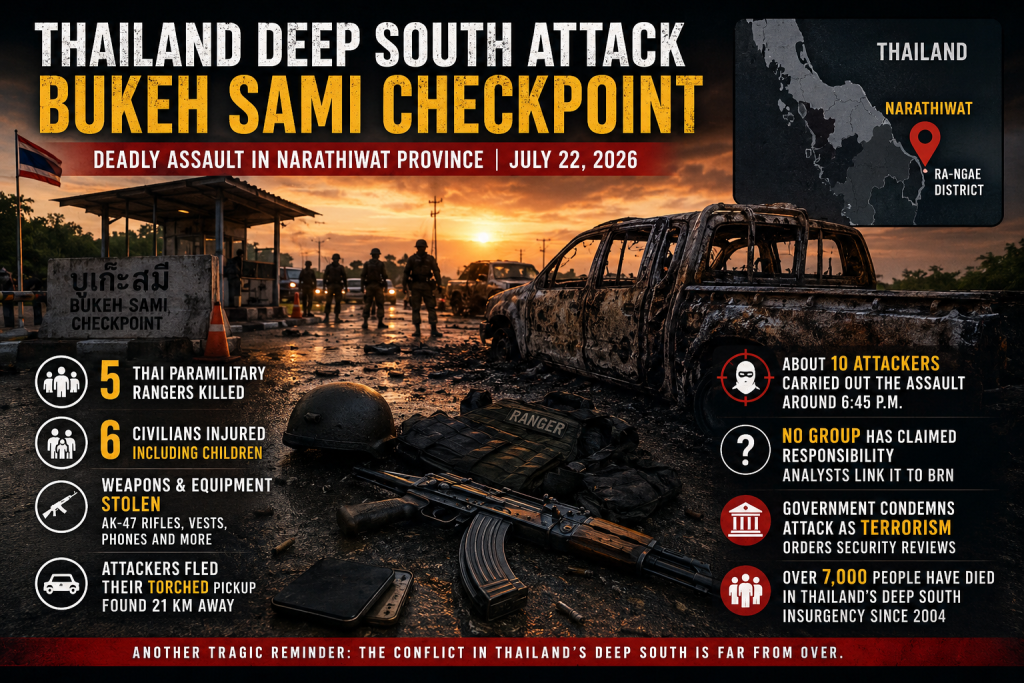
Thailand’s southernmost provinces were shaken on July 22, 2026, after a coordinated assault on the Bukeh Sami security checkpoint in Ra-ngae district, Narathiwat province left five Thai paramilitary rangers dead and several civilians injured.
The attack is one of the deadliest incidents against Thai security forces in recent years. It has reignited debate over security measures, peace negotiations, and the continuing insurgency that has affected southern Thailand for more than two decades.
Although authorities have not officially identified those responsible, investigators believe the operation bears the hallmarks of insurgent groups active in the region. Analysts have pointed to the Barisan Revolusi Nasional (BRN), the largest separatist movement operating in Thailand’s deep south, though no organization has claimed responsibility.
What Happened at the Bukeh Sami Checkpoint?
The attack began at approximately 6:45 p.m. local time on July 22, 2026.
According to Thai authorities, a group of armed attackers arrived at the checkpoint using a pickup truck, while other accomplices reportedly provided support during the assault.
Witnesses and investigators say the attackers:
- Opened fire on the checkpoint with automatic weapons.
- Threw pipe bombs during the attack.
- Targeted members of Thailand’s Ranger force stationed at the checkpoint.
- Stole military equipment after the shooting.
- Escaped before security reinforcements arrived.
The entire assault was reportedly completed in just over one minute, highlighting careful planning and coordination.
Casualties
The attack resulted in:
- Five Thai paramilitary rangers killed
- Six civilians injured
- Injured civilians included young children, including a 10-year-old boy
- Nearby homes and private property were also damaged during the gunfire and explosions.
Emergency responders quickly transported the injured to nearby hospitals while military and police units secured the surrounding area.
Weapons and Equipment Stolen
After killing the security personnel, the attackers reportedly removed military equipment before leaving the scene.
Authorities confirmed they stole items including:
- AK-pattern assault rifles
- Bulletproof vests
- Mobile phones
- Additional military equipment reported during the investigation
The theft of military weapons remains a major concern because such equipment can potentially be used in future attacks.
Escape Route
Following the assault, the attackers fled in a pickup truck. Investigators later discovered the vehicle approximately 21 kilometers (13 miles) from the checkpoint. The truck had been deliberately set on fire, apparently in an attempt to destroy forensic evidence and delay investigators.
Police, military personnel, and forensic teams immediately launched a large-scale manhunt.
Investigation Continues
Thai authorities have not officially announced arrests connected to the attack.
Forensic specialists collected:
- More than 100 spent shell casings
- Pipe bomb evidence
- CCTV footage
- DNA and fingerprint evidence
- Vehicle evidence from the burned pickup truck
Security agencies continue reviewing surveillance footage to identify every participant involved in the operation.
Who Might Be Responsible?
No organization has formally claimed responsibility.
However, many regional security analysts believe the tactics resemble previous operations linked to the Barisan Revolusi Nasional (BRN). The BRN is widely regarded as the largest insurgent organization operating in Thailand’s southern provinces. It has historically sought greater autonomy or independence for parts of Pattani, Yala, and Narathiwat.
Officials have not publicly confirmed BRN involvement, and the investigation remains ongoing.
Understanding Thailand’s Southern Insurgency
The violence cannot be understood without looking at the broader conflict.
Thailand’s southern border provinces differ culturally and historically from much of the country.
The region:
- Has a Muslim-majority population.
- Maintains strong Malay cultural traditions.
- Has experienced political tensions for decades.
The modern insurgency intensified in 2004.
Since then:
- More than 7,000 people have been killed.
- Thousands more have been injured.
- Both civilians and security personnel have been victims.
- Violence has included shootings, bombings, assassinations, and attacks on public infrastructure.
Why Peace Talks Have Struggled
Thailand has attempted multiple rounds of dialogue with insurgent representatives. These discussions have aimed to reduce violence while addressing political and security concerns.
Despite occasional progress:
- Ceasefire efforts have often collapsed.
- Mutual distrust remains high.
- Local violence continues despite negotiations.
- Attacks frequently undermine confidence in the peace process.
The latest incident occurred while efforts toward dialogue remain fragile, making future negotiations even more challenging.
Government Response
Thailand’s government strongly condemned the attack. Prime Minister Anutin Charnvirakul described the incident as a terrorist attack and ordered security agencies to strengthen protective measures across the southern provinces.
Authorities have announced:
- Expanded investigations
- Increased patrols
- Enhanced checkpoint security
- Continued pursuit of the attackers
Security Challenges Ahead
The attack demonstrates several ongoing challenges.
Intelligence Gathering
Authorities must identify organized cells before attacks occur.
Protection of Checkpoints
Security checkpoints remain frequent targets because they represent visible government authority.
Civilian Safety
The presence of nearby homes means civilians often become unintended victims during armed confrontations.
Community Trust
Long-term stability depends not only on military operations but also on maintaining trust between local communities and government institutions.
International Attention
Although the conflict rarely receives widespread international coverage, incidents involving multiple fatalities often attract global media attention.
Security experts continue to monitor developments because prolonged instability can affect:
- Regional security
- Tourism
- Economic development
- Cross-border cooperation with neighboring Malaysia
What Happens Next?
Investigators will likely focus on:
- Identifying every participant seen on CCTV.
- Tracing stolen military weapons.
- Examining communication networks.
- Determining whether additional attacks are being planned.
Authorities are also expected to review checkpoint procedures and reinforce vulnerable security positions throughout Thailand’s southern provinces.
Why This Incident Matters
This attack is significant for several reasons.
It demonstrates that insurgent groups retain the capability to launch highly coordinated assaults. It also highlights the ongoing difficulties facing peace negotiations despite years of dialogue. Most importantly, the incident reminds the world that ordinary civilians including children continue to suffer the consequences of one of Southeast Asia’s longest-running internal conflicts.
Frequently Asked Questions
What happened in Narathiwat on July 22, 2026?
Armed attackers assaulted the Bukeh Sami checkpoint, killing five Thai paramilitary rangers and injuring six civilians.
Where is Bukeh Sami checkpoint?
It is located in Ra-ngae district, Narathiwat province, in Thailand’s southern border region.
How many people were killed?
Five Thai paramilitary rangers lost their lives.
Were civilians injured?
Yes. Six civilians, including children, were injured during the attack.
Did the attackers steal weapons?
Yes. Authorities say they stole military rifles, protective equipment, and mobile phones.
Has anyone claimed responsibility?
No. No group has officially claimed responsibility.
Is BRN confirmed as being behind the attack?
No. Analysts suspect similarities with previous BRN operations, but authorities have not officially confirmed responsibility.
Why is southern Thailand affected by conflict?
The region has experienced a separatist insurgency since 2004, rooted in historical, political, and cultural issues.
How many people have died in the insurgency?
More than 7,000 people have reportedly been killed since 2004.
Is the investigation still ongoing?
Yes. Thai authorities continue searching for the attackers and collecting forensic evidence.
Bukeh Sami Checkpoint
The Bukeh Sami checkpoint attack is another tragic reminder that the conflict in Thailand’s deep south remains unresolved. While security operations continue and investigators work to identify those responsible, lasting peace will likely require more than military action alone. Sustainable solutions will depend on effective security, meaningful dialogue, community trust, and continued efforts to reduce violence while protecting civilians.
⚠️ Disclaimer and Source Hygiene
This article is intended for informational and educational purposes only. It is based on publicly available reports from reputable news organizations and official statements available at the time of publication. As investigations continue, new information may emerge that updates or changes current understanding of the incident.
🔔 For more tutorials like this, consider subscribing to our blog.
📩 Do you have questions or suggestions? Leave a comment or contact us!
🏷️ Tags: #Thailand, Narathiwat, Bukeh Sami checkpoint, Thailand insurgency, BRN, Southern Thailand, terrorism, Thai Rangers, Southeast Asia, breaking news
📢 Hashtags: Thailand #Narathiwat #BreakingNews #SoutheastAsia #Security #Insurgency #BRN #WorldNews #Terrorism #Asia
Sources and References
- Associated Press reporting on the July 22–23, 2026 attack.
- Thai PBS coverage and official updates from Thai authorities.
- The Nation Thailand reporting on the attack and government response.
- Thairath English investigation updates regarding CCTV evidence and forensic findings. Thairath English
Secondary Sources and Testimonies
Additional reporting and regional coverage from The Star (Malaysia) and other international media were used to cross-reference publicly available information while avoiding speculation beyond official investigations. The Star
Do you have questions or thoughts about this developing story? Leave a comment below and join the discussion.
