


⏲️ Estimated reading time: 8 min
Table of Contents
Seventy-one years after his birth, Steve Jobs remains one of the most influential innovators in modern history. This in-depth tribute explores his life, leadership, failures, breakthroughs, and the lasting impact he left on technology, creativity, and global culture.
71 Years Since the Birth of a Visionary. The Man Who Changed the Way We See Technology
When we speak about innovation, design, and bold thinking, one name rises above the rest Steve Jobs.
Seventy-one years since his birth, the world still feels his presence. His ideas continue to shape how we work, communicate, create, and even dream. He did not simply build products. He reshaped industries. He redefined expectations. He challenged mediocrity.
Yet behind the black turtleneck and confident keynotes stood a complex human being. A perfectionist. A risk-taker. A rebel. A visionary.
This is not just a biography. This is the story of a mindset.
Early Life – The Adoption That Shaped a Genius
Steve Jobs was born on February 24, 1955, in San Francisco. His biological parents were not ready to raise him. He was adopted by Paul and Clara Jobs, a working-class couple who lived in Los Altos, California.
His father was a machinist. His mother was an accountant. They were not wealthy, but they were supportive.
Paul Jobs taught young Steve how to take apart electronics and rebuild them. That garage became more than a workshop. It became a laboratory of imagination.
Adoption deeply influenced him. Jobs often spoke about feeling “chosen.” That sense of identity gave him both confidence and emotional complexity.
He was brilliant but restless. Curious but rebellious. Teachers noticed his intelligence early. Discipline, however, was another story.
College Dropout – The Courage to Follow Curiosity
In 1972, Jobs enrolled at Reed College. Tuition was expensive. His parents struggled to pay for it. After six months, he dropped out. To many, this looked like failure. But Jobs later said it was one of the best decisions of his life. He continued attending classes that interested him, including calligraphy. That seemingly random choice later influenced the typography of the Macintosh computer. He slept on friends’ floors. He collected Coke bottles for food money. He followed curiosity instead of convention. Sometimes, innovation starts when you stop following the traditional path.
The Garage That Changed the World
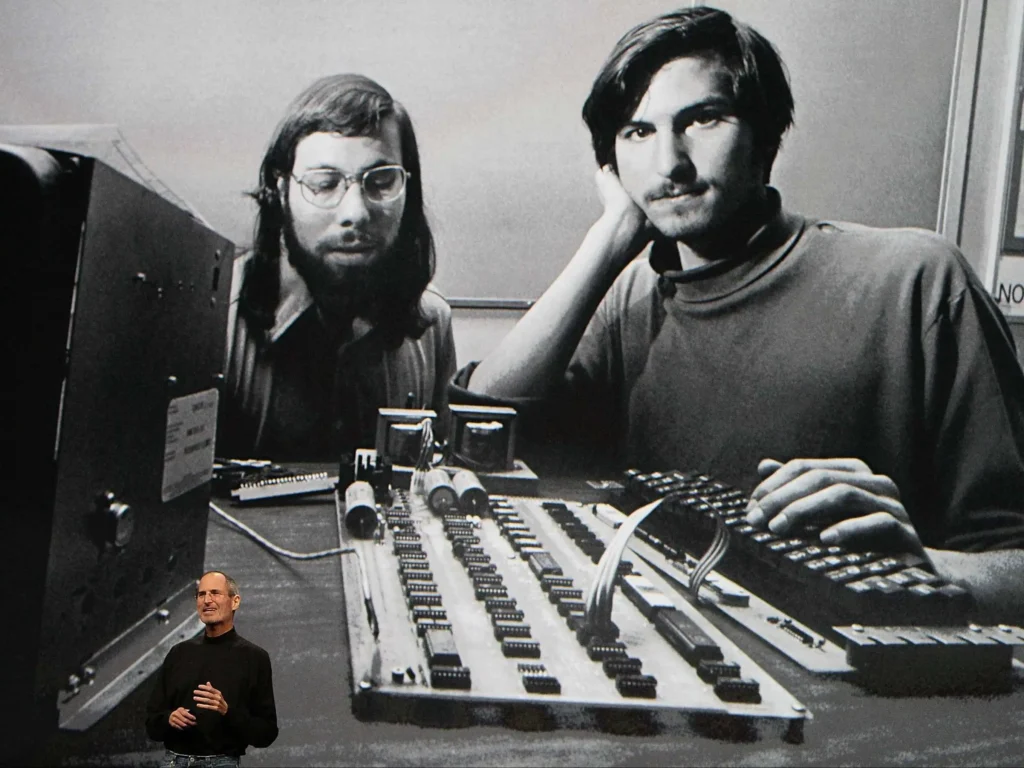
In 1976, Jobs co-founded Apple Inc. alongside Steve Wozniak and Ronald Wayne. The location? A garage in Los Altos. The mission? Make computers personal. At the time, computers were massive machines used by corporations and universities. Jobs believed technology should be accessible. Friendly. Beautiful. The Apple I was born. Soon after, the Apple II became one of the first highly successful mass-produced personal computers. The revolution had begun.
The Birth of the Macintosh – Design Meets Humanity
In 1984, Apple introduced the Macintosh. It was not just a machine. It was a statement. The iconic “1984” Super Bowl commercial positioned Apple as a rebel against conformity. Jobs understood marketing like few others. He knew technology alone was not enough. Story mattered. The Macintosh introduced graphical user interfaces to mainstream users. It made computers intuitive. Design was no longer optional. It became essential.
The Fall – When the Founder Was Fired
Success does not always protect you. In 1985, internal conflict within Apple led to Jobs being removed from the company he created. Imagine building something from nothing, only to be pushed out. It was devastating. But it was also transformative. Jobs later called it one of the best things that happened to him. It freed him from the weight of expectation. Failure did not define him. It refined him.
NeXT and the Seeds of Redemption
After leaving Apple, Jobs founded NeXT. NeXT computers were powerful and beautifully designed. They were not commercially successful, but their operating system later became the foundation for macOS. Innovation does not always win immediately. Sometimes, its value appears later. Jobs was planting seeds without knowing how big the tree would grow.
Pixar – The Unexpected Empire
During this period, Jobs acquired a small graphics division from Lucasfilm. That company became Pixar.
In 1995, Pixar released Toy Story the first fully computer-animated feature film.
It was a massive success.
Suddenly, Jobs was not just a tech entrepreneur. He was a media visionary.
Pixar eventually merged with The Walt Disney Company, making Jobs Disney’s largest individual shareholder.
The man who was fired had built another empire.
The Return to Apple – A Second Act
In 1997, Apple was struggling financially.
The company purchased NeXT. With that deal, Jobs returned.
He simplified product lines. He cut unnecessary projects. He focused on excellence.
In 1998, the iMac launched. Its colorful design stood out in a market filled with beige boxes.
Apple was alive again.
The iPod – 1,000 Songs in Your Pocket
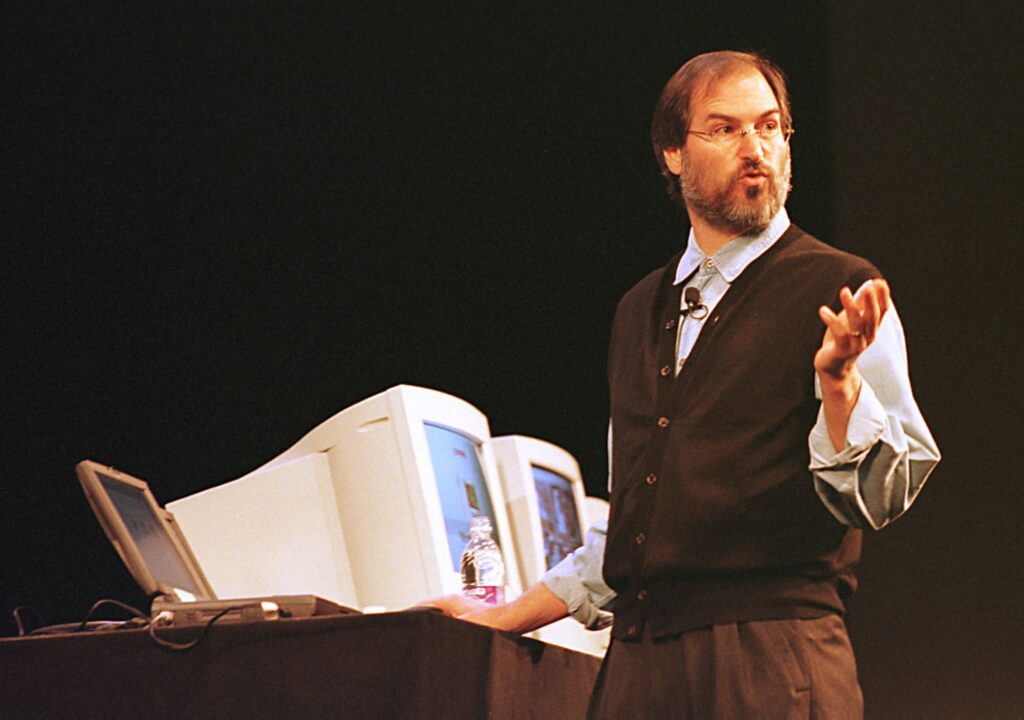
In 2001, Apple introduced the iPod.
It changed how people listened to music.
Paired with iTunes, it disrupted the music industry. It challenged traditional distribution models. It forced companies to adapt.
Jobs understood ecosystems before it became a buzzword.
Hardware and software had to work seamlessly together.
The iPhone – A Cultural Earthquake
In 2007, Jobs unveiled the iPhone. He described it as three devices in one: a phone, an iPod, and an internet communicator. The world laughed at the lack of a physical keyboard. Then the world copied it. The iPhone did not just change phones. It reshaped photography, social media, navigation, gaming, and even journalism. An entire app economy emerged. Today, billions of smartphones trace their DNA back to that moment on stage.
The iPad – Redefining Personal Computing Again
In 2010, Jobs introduced the iPad. Many critics called it unnecessary. Yet tablets became essential tools in education, business, and creativity. Once again, Jobs anticipated a need before consumers realized it themselves.
Leadership Style – Brilliant and Demanding
Jobs was not an easy leader. He demanded perfection. He pushed teams beyond comfort zones. He was known for intense feedback. Some admired him. Others feared him. Yet his insistence on excellence created products that felt magical. He believed good was not enough. Great was the minimum standard.
Philosophy – Connecting the Dots
One of Jobs’ most famous speeches took place at Stanford University in 2005.
He spoke about connecting the dots. About trusting the process. About love and loss.
His message was simple but powerful:
You cannot connect the dots looking forward.
You can only connect them looking backward. It was advice shaped by failure, risk, and resilience.
The Final Chapter – Legacy Beyond Mortality
In 2011, Jobs stepped down as CEO due to health issues.
He passed away on October 5, 2011.
The world reacted with shock and grief.
Tributes poured in from leaders, entrepreneurs, artists, and everyday users.
But legacy is not measured by mourning.
It is measured by influence.
Today, Apple Inc. remains one of the most valuable companies in the world.
His vision continues under leaders like Tim Cook.
The Human Behind the Icon
Jobs was not perfect.
He had complicated relationships. He could be harsh. He struggled with vulnerability.
Yet he evolved.
He matured.
He learned.
Greatness often lives beside imperfection.
Lessons for Entrepreneurs and Dreamers
Seventy-one years after his birth, what can we learn?
Focus Beats Distraction
Jobs simplified relentlessly.
Design Matters
Function without beauty feels incomplete.
Failure Is Not Final
Being fired became fuel.
Passion Drives Excellence
He loved what he built.
Think Different
He turned a slogan into a philosophy.
The Cultural Impact That Will Not Fade
We carry his influence daily.
In our pockets. On our desks. In our creative tools.
Few individuals reshape entire industries. Even fewer reshape human behavior.
Jobs did both.
Frequently Asked Questions
Who was Steve Jobs?
Steve Jobs was the co-founder of Apple Inc. and a pioneer in personal computing, smartphones, and digital media.
When was Steve Jobs born?
He was born on February 24, 1955.
Why was Steve Jobs fired from Apple?
Internal conflicts with Apple’s board and leadership led to his departure in 1985.
What companies did Steve Jobs found?
He co-founded Apple and NeXT, and he played a major role in developing Pixar.
What was Steve Jobs’ biggest invention?
Many consider the iPhone his most transformative product.
What leadership style did he have?
He was demanding, visionary, and intensely focused on perfection.
What is Steve Jobs’ most famous quote?
“Stay hungry. Stay foolish.”
How did Steve Jobs change the world?
He transformed technology into user-friendly, beautifully designed tools that reshaped industries.
The Vision That Still Inspires the World
Seventy-one years since his birth, Steve Jobs remains more than a historical figure.
He is a reminder that bold thinking changes reality.
He teaches us that setbacks refine us.
He shows us that imagination, when paired with execution, can alter the course of history.
Visionaries do not disappear.
They echo.
⚠️ Disclaimer and Source Hygiene
This article is based on publicly available historical records, biographies, interviews, and corporate documentation. For academic or professional research, consult verified sources and official company archives.
🔔 For more tutorials like this, consider subscribing to our blog.
📩 Do you have questions or suggestions? Leave a comment or contact us!
🏷️ Tags: Steve Jobs, Apple history, innovation, entrepreneurship, visionary leaders, technology evolution, iPhone history, Pixar story, business inspiration, Silicon Valley pioneers
📢 Hashtags: #SteveJobs #AppleHistory #Innovation #EntrepreneurLife #Visionary #TechRevolution #ThinkDifferent #Leadership #Pixar #DigitalTransformation
📚 Sources and References
- Official Apple archives
- Authorized biography by Walter Isaacson
- Stanford Commencement Speech (2005)
- Pixar corporate history
🕊️ Secondary Sources and Testimonials
Read also: How to Use an Air Conditioner Correctly: Best Settings for
Public keynote recordings
Interviews with former Apple employees
Industry analysis reports
Media retrospectives on Apple product launches
