


⏲️ Estimated reading time: 6 min
Table of Contents
More than 2,200 years ago, a Greek scholar proved the Earth is round using nothing but sticks, sunlight, and logic. This article explains Eratosthenes’ brilliant experiment step by step and shows how he calculated Earth’s circumference with astonishing accuracy.
Read also: Windows 11 2026 Update: What’s New in 26H2
A Question That Changed How We See the World
Long before satellites, GPS, or space travel, humans wondered about the true shape of the Earth. Some believed it was flat. Others suspected it was curved.
One man did more than speculate. He tested the idea.
That man was Eratosthenes, a scholar living in ancient Egypt during the third century BC. His experiment remains one of the most elegant demonstrations in the history of science.
The World of Ancient Egypt and Greek Science
Eratosthenes lived and worked in Alexandria, one of the greatest centers of knowledge in the ancient world.
Alexandria was home to the famous Library of Alexandria, where scholars gathered texts, maps, and observations from across civilizations. Mathematics, astronomy, and geography flourished here.
Far to the south lay Syene, a city near today’s Aswan. Syene would become the key to Eratosthenes’ insight.
A Curious Observation About Shadows
Eratosthenes learned something intriguing about Syene.
At noon on the summer solstice, vertical objects in Syene cast no shadow at all. The Sun appeared directly overhead. Light reached the bottom of deep wells, something impossible at other times of the year.
In Alexandria, however, things were different.
At that same moment, vertical objects did cast a shadow.
This simple contrast sparked a profound question.
Why Do Shadows Differ at the Same Time?
If the Earth were flat, sunlight would strike all locations at the same angle. Shadows would behave identically everywhere.
Yet they didn’t.
At noon on the solstice:
- In Syene: no shadow.
- In Alexandria: a clear, measurable shadow.
This could only mean one thing.
The Earth’s surface is curved.
The Assumption That Made the Math Possible
Eratosthenes made a crucial and correct assumption.
The Sun is extremely far away.
Because of this immense distance, the Sun’s rays arrive at Earth almost perfectly parallel. That means any difference in shadow length must come from the angle of the ground itself, not the light source.
This assumption is still used in astronomy today.
The Stick Experiment Explained Simply
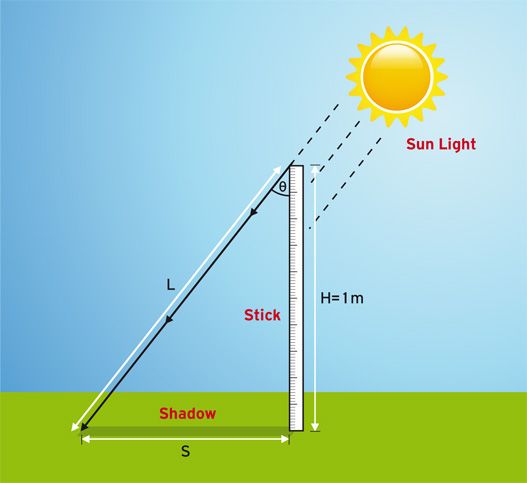
Eratosthenes imagined placing two identical vertical sticks, also called gnomons:
- One in Alexandria
- One in Syene
At the same moment:
- The stick in Syene cast no shadow.
- The stick in Alexandria cast a long shadow.
The angle between the stick and its shadow in Alexandria could be measured.
That angle turned out to be about 7 degrees.
Turning Shadows into Angles
Here is the key insight.
If you extend each stick downward, straight toward the center of the Earth, the angle between those imaginary lines is the same as the angle measured by the shadow.
In other words:
- The angle between Alexandria and Syene, as seen from Earth’s center, is about 7 degrees.
This transforms a shadow measurement into a planetary measurement.
Understanding the 7-Degree Difference
A full circle contains 360 degrees.
If the distance between Alexandria and Syene represents 7 degrees, then that distance is 1/50 of Earth’s total circumference.
This ratio is the heart of Eratosthenes’ calculation.
Measuring the Distance Between Two Cities
Eratosthenes needed one more piece of information.
The distance between Alexandria and Syene.
Historical accounts tell us he had this distance measured directly. A man was reportedly hired to walk the route and record the length.
The result was approximately 800 kilometers.
The Final Calculation
Now the math becomes beautifully simple.
If:
- 7 degrees = 800 km
- 360 degrees = Earth’s full circumference
Then:
800 km × 50 = 40,000 km
That number is astonishingly close to modern measurements.
How Accurate Was Eratosthenes?
Modern science places Earth’s circumference at about 40,075 km at the equator.
Eratosthenes’ result was off by less than one percent.
He achieved this without:
- Telescopes
- Satellites
- Computers
- Modern instruments
He used:
- Sticks
- Shadows
- Eyes
- Feet
- A powerful mind
- Curiosity
Why This Experiment Still Matters
Eratosthenes did more than measure the Earth.
He showed:
- Observation beats assumption
- Simple tools can reveal deep truths
- Nature follows patterns we can understand
His experiment remains a perfect example of scientific thinking.
Debunking the Flat Earth Idea with Ancient Knowledge
Even today, some people question the Earth’s shape.
Eratosthenes answered this debate over two millennia ago.
His method is repeatable.
Anyone can test it.
Anyone can measure shadows.
Science does not rely on belief. It relies on evidence.
The Power of Curiosity and Logic
What makes this story remarkable is not just the number.
It is the mindset.
Eratosthenes asked:
- Why are shadows different?
- What does that difference mean?
- How can I test it?
Those questions are the foundation of all scientific discovery.
A Lesson for the Modern World
In an age of instant information, Eratosthenes reminds us that:
- Careful thinking matters
- Evidence matters
- Simple experiments can reveal universal truths
His work connects ancient curiosity to modern science.
Frequently Asked Questions
Who was Eratosthenes?
Eratosthenes was a Greek mathematician, astronomer, and geographer who lived in the 3rd century BC and worked in Alexandria.
What did Eratosthenes prove?
He proved that the Earth is round and calculated its circumference with impressive accuracy.
Why were Alexandria and Syene important?
They lay nearly north–south of each other, making shadow comparison possible at the same time.
Why was the summer solstice used?
Because the Sun was directly overhead in Syene on that day, producing no shadow.
How did Eratosthenes measure distance?
Historical records suggest he used trained distance measurers or travelers to estimate the route length.
Was the Sun really directly overhead?
Not perfectly, but close enough for the experiment to work with minimal error.
Can this experiment be repeated today?
Yes. Similar experiments are often done in schools worldwide.
How close was his result to modern values?
Within about 75 kilometers of the actual circumference.
Did people already know the Earth was round?
Some scholars suspected it, but Eratosthenes provided measurable proof.
⚠️ Disclaimer and Source Hygiene
This article is for educational purposes only. Historical interpretations are based on academic research, ancient texts, and modern scientific analysis. Readers are encouraged to consult scholarly sources for deeper study.
🔔 For more tutorials like this, consider subscribing to our blog.
📩 Do you have questions or suggestions? Leave a comment or contact us!
🏷️ Tags: Eratosthenes, round Earth proof, ancient science, astronomy history, geography, shadows experiment, Earth circumference, Greek scientists, Alexandria, Syene
📢 Hashtags: #Eratosthenes, #RoundEarth, #AncientScience, #Astronomy, #HistoryOfScience, #EarthCircumference, #GreekScholars, #ScienceExplained, #STEM, #Curiosity
📚 Sources
– Ancient Greek historical accounts
– Classical astronomy texts
– Modern physics and geography analyses
– Educational reconstructions of the Eratosthenes experiment
