


⏲️ Estimated reading time: 11 min
Table of Contents
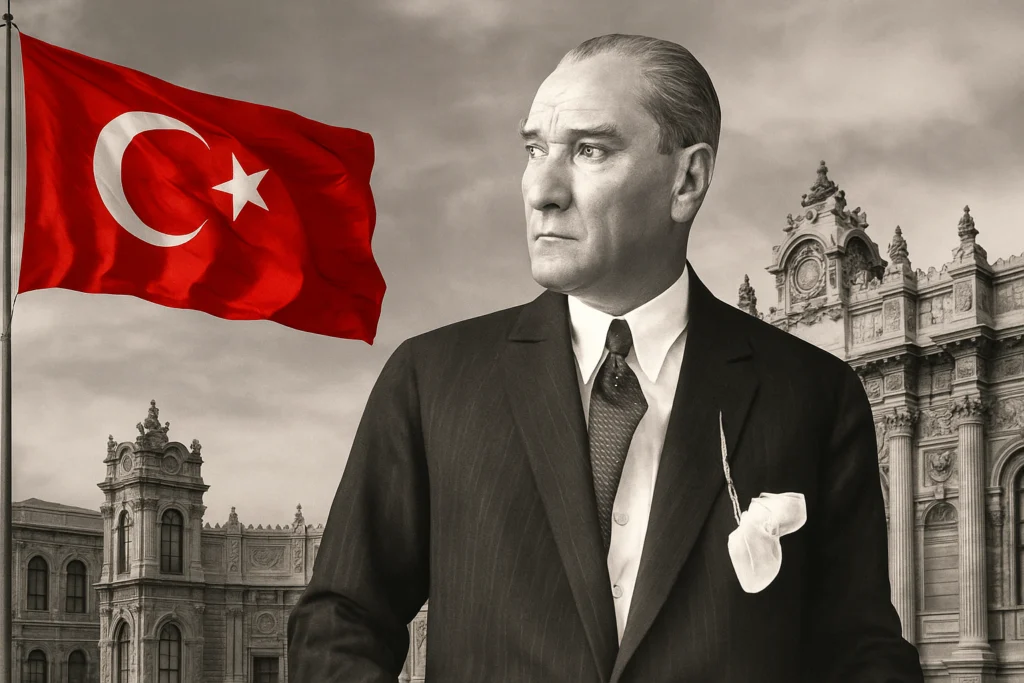
10 November 1938 – Mustafa Kemal Atatürk, Founder and First President of Modern Turkey.
On November 10, 1938, Turkey mourned the death of Mustafa Kemal Atatürk, the visionary leader who transformed a collapsing empire into a modern, secular republic. His reforms shaped education, law, and culture defining Turkey’s national identity for generations.
The Final Morning of Mustafa Kemal Atatürk
On the morning of November 10, 1938, silence fell across Turkey. At 9:05 a.m., the heartbeat of a nation stopped. Mustafa Kemal Atatürk, the soldier, statesman, and reformer who built modern Turkey from the ashes of the Ottoman Empire, passed away in Dolmabahçe Palace in Istanbul.
Every year since, Turks have paused at that exact moment. Sirens wail. Cars stop. People stand in solemn respect. Across cities and villages, the memory of Atatürk’s final breath continues to echo an enduring reminder of how deeply he shaped the Turkish soul.
The Early Life of a Visionary
Mustafa Kemal was born in Salonika (Thessaloniki), then part of the Ottoman Empire, in 1881. His father, Ali Rıza Efendi, was a customs officer, and his mother, Zübeyde Hanım, was a devout and strong woman.
As a child, Mustafa showed an early fascination with learning. His mother wanted him to attend a religious school, but Mustafa’s curiosity and intellect led him to a modern, secular education. This dual influence traditional values and modern knowledge would later define his vision for the Turkish Republic.
His teachers recognized his brilliance. During military school, one of them added the name “Kemal”, meaning perfection, to honor his exceptional intellect. From that moment, he became known as Mustafa Kemal.
The Military Strategist Emerges
In his youth, Mustafa Kemal entered the Ottoman Military Academy in Istanbul. He graduated as a staff officer in 1905, just as the empire was struggling to survive internal decay and foreign threats.
His military career rose rapidly. He proved himself during the Italo-Turkish War (1911–1912) and the Balkan Wars (1912–1913), where he gained firsthand experience of the Ottoman Empire’s decline. But his defining moment came in World War I, particularly during the Battle of Gallipoli in 1915.
The Hero of Gallipoli
The Gallipoli Campaign was one of the bloodiest fronts of World War I. Allied forces sought to seize control of the Dardanelles and knock the Ottoman Empire out of the war.
Mustafa Kemal, then a young commander, delivered the famous order to his troops:
“I am not ordering you to attack, I am ordering you to die.”
His leadership and courage turned the tide of the battle. The Allies were repelled, and the defense of Gallipoli became a symbol of national pride. It was here that Mustafa Kemal became a hero of the Turkish people.
The Collapse of the Ottoman Empire
Despite the victory at Gallipoli, the Ottoman Empire could not survive the war. In 1918, it signed the Armistice of Mudros, leading to Allied occupation and the dismemberment of its territories.
The empire that had lasted for more than six centuries was crumbling. Istanbul was under foreign control, and Anatolia faced invasion from Greece and others.
Many accepted defeat but Mustafa Kemal did not.
The Birth of the Turkish National Movement
In May 1919, Mustafa Kemal landed in Samsun, a moment now recognized as the beginning of the Turkish War of Independence.
He organized resistance groups and established a new national assembly in Ankara, rejecting the authority of the sultan. Over the next four years, under his leadership, Turkish forces fought foreign occupiers and collaborators to reclaim their land.
The war culminated in 1922 with the defeat of the Greek army and the abolition of the Ottoman sultanate. A new nation was about to rise.
The Republic of Turkey Is Born
On October 29, 1923, the Republic of Turkey was officially proclaimed. Mustafa Kemal became its first president.
In his vision, Turkey was to be modern, secular, and sovereign a complete break from the Ottoman past. The capital was moved from Istanbul to Ankara, symbolizing a fresh start.
But founding the republic was only the beginning. The real challenge lay in transforming a deeply traditional society into a progressive, educated, and industrialized nation.
Atatürk’s Revolutionary Reforms
Atatürk believed that independence was meaningless without modernization. His vision touched every aspect of Turkish life.
1. Political Reform
He abolished the caliphate in 1924, separating religion from politics and ending centuries of theocratic rule. A new constitution established a secular state governed by the rule of law.
2. Social Reform
Atatürk promoted women’s rights, granting them the right to vote and run for office decades before many Western countries. He banned polygamy and encouraged gender equality in education and employment.
3. Educational Reform
Education was secularized and made compulsory. New schools replaced religious institutions. Atatürk believed that “the true guide in life is science.”
4. Language and Cultural Reform
In 1928, he replaced the Arabic script with a Latin-based Turkish alphabet, making literacy more accessible. He also established the Turkish Language Association and the Turkish Historical Society to strengthen national identity.
5. Legal Reform
The Ottoman legal system, rooted in Islamic law, was replaced with a Swiss-inspired civil code and European-style criminal and commercial laws.
6. Economic Reform
Atatürk launched industrial projects, built railways, and established state banks. His goal was economic independence an idea he expressed in his motto:
“Political sovereignty must be supported by economic independence.”
7. Dress and Lifestyle Reform
He encouraged Western-style clothing, discouraging the fez and veil as symbols of the old order. It wasn’t about imitation it was about identity. He wanted the world to see Turks as modern equals.
Atatürk’s Vision for the Future
Atatürk’s dream extended beyond borders and generations. He envisioned a nation rooted in reason, equality, and pride. His speeches still resonate today:
“Peace at home, peace in the world.”
“Sovereignty unconditionally belongs to the nation.”
These guiding principles became Turkey’s moral compass. He urged citizens to think freely, to work hard, and to remain loyal to the republic.
The Man Behind the Reforms
Despite his public image as a disciplined leader, Atatürk was known for his charisma and humor. He loved literature, music, and conversation.
He was also deeply human he smoked heavily, suffered from stress, and in later years, battled cirrhosis of the liver, likely caused by excessive alcohol consumption.
But even as his health declined, he continued to work tirelessly for his country.
His Final Days at Dolmabahçe Palace
By 1937, Atatürk’s health began to deteriorate. Doctors diagnosed him with liver disease, but he refused to slow down. He continued to attend meetings, review reforms, and receive foreign guests.
In his final months, he stayed at Dolmabahçe Palace overlooking the Bosporus. The nation waited anxiously for news of his condition.
See also: International Coffee Day History, Rituals, Ways to Celebrate
On the morning of November 10, 1938, surrounded by his doctors and attendants, Mustafa Kemal Atatürk passed away peacefully. He was 57 years old.
A Nation in Mourning
The news of his death devastated Turkey. Millions poured into the streets to pay their respects. His body was transported from Istanbul to Ankara in an emotional state funeral attended by representatives from around the world.
He was temporarily laid to rest at the Ethnography Museum, and in 1953, his remains were moved to Anıtkabir, a grand mausoleum in Ankara that now stands as a symbol of national pride and gratitude.
Atatürk’s Legacy and Eternal Presence
More than eight decades later, Atatürk’s legacy remains alive in every corner of Turkey. His portrait hangs in classrooms, government offices, and homes. His signature is proudly worn as jewelry or tattooed by admirers.
He is not merely remembered as a political leader but revered as the father of the nation a figure who unified, modernized, and dignified a people emerging from centuries of empire and war.
His ideology, Kemalism, continues to shape Turkish political thought, emphasizing nationalism, secularism, republicanism, reformism, statism, and populism.
Global Recognition of Atatürk
Leaders and historians around the world have praised Atatürk’s vision and courage.
British Prime Minister Winston Churchill once described him as
“a genius who has few equals in history.”
Time magazine included him among the most important figures of the 20th century.
Atatürk inspired independence movements in Asia and the Middle East by proving that a nation could modernize on its own terms, without surrendering its identity.
Atatürk’s Words That Still Inspire
Atatürk was not only a soldier and statesman but also a thinker and writer. His speeches and writings continue to guide Turkey’s youth. Some of his most memorable quotes include:
- “The supreme guide in life is science.”
- “A nation without art has lost one of its vital lifelines.”
- “Victory belongs to those who can say ‘Victory is mine.’”
- “Teachers are the one and only people who save nations.”
- “Youth! You are the future.”
These statements are more than words they are the foundation of modern Turkish education, politics, and identity.
Atatürk and the Modern Turkish Identity
Atatürk’s secular and progressive vision created a cultural shift that still defines Turkish society. His reforms empowered women, encouraged innovation, and embraced education as the key to freedom.
Even in the 21st century, the Atatürk model serves as a blueprint for nations seeking modernization without losing their cultural heritage.
From architecture to art, from education to technology, Turkey’s modernization continues to reflect the seeds he planted a century ago.
Controversies and Criticism
While Atatürk is widely revered, his policies were not without criticism. Some argue that his secular reforms marginalized conservative and religious communities. Others claim that his drive for Westernization led to cultural disconnection for certain groups.
Yet, even his critics acknowledge his monumental role in securing Turkish sovereignty and identity. His leadership remains an example of visionary state-building rarely seen in modern history.
November 10 – A Day of Silence and Respect
Every year on November 10, Turkey stands still at 9:05 a.m. the exact time Atatürk passed away.
In schools, offices, and streets, people stop whatever they’re doing. Sirens blare across cities. Heads bow in silence. Television channels show black-and-white footage of Atatürk’s life, accompanied by solemn music.
It’s not just mourning it’s a reaffirmation of values: unity, progress, and gratitude.
Atatürk’s Enduring Message to Humanity
Mustafa Kemal Atatürk’s story is one of resilience and transformation. He proved that leadership is not about power but purpose. He demonstrated that a nation can rise from defeat through vision, education, and courage.
His life reminds us that modernity and tradition can coexist, and that the greatest revolutions are built not with weapons, but with ideas.
As Atatürk once said:
“To see me does not necessarily mean to see my face. To understand my thoughts is to have seen me.”
The Eternal Flame of the Republic
Atatürk’s mausoleum, Anıtkabir, remains one of the most visited sites in Turkey. Each year, millions walk its marble path to pay respect to the man who redefined their future.
Visitors write messages of love, gratitude, and admiration in the guestbook, ensuring that his ideals continue to live on. For Turks, Atatürk is not gone he simply became eternal.
The Man Who Made Turkey Believe Again
Mustafa Kemal Atatürk’s greatest achievement was not just founding a nation, but restoring hope. He made the Turkish people believe in themselves, in science, in freedom, and in their ability to stand equal among nations.
He turned despair into determination and transformed a wounded empire into a proud republic. His legacy is the heartbeat of Turkey steady, strong, and eternal.
🏁 The Light That Never Fades
More than 85 years after his death, Mustafa Kemal Atatürk remains a beacon of progress and national pride. His journey from a soldier in a collapsing empire to the architect of a modern republic shows the power of vision, education, and courage.
Atatürk’s timeless message “Peace at home, peace in the world” continues to inspire not just Turkey, but humanity.
🔔 For more historical posts like this, subscribe to our blog.
📩 Have questions or reflections? Leave a comment or contact us!
🏷️ Tags: Mustafa Kemal Atatürk, Turkish history, modern Turkey, Republic of Turkey, secularism, Gallipoli, Kemalism, national heroes, Turkish reform, Atatürk Day
📢 Hashtags: #MustafaKemalAtaturk, #TurkeyHistory, #ModernTurkey, #AtaturkLegacy, #RepublicOfTurkey, #TurkishReforms, #Kemalism, #Anitkabir, #GallipoliHero, #TurkishPride
FAQ
Who was Mustafa Kemal Atatürk?
He was the founder and first president of the Republic of Turkey, leading major reforms in education, law, and society to modernize the country.
When did Atatürk die?
He passed away on November 10, 1938, at 9:05 a.m. in Dolmabahçe Palace, Istanbul.
What were Atatürk’s most important reforms?
He secularized education, introduced a new alphabet, promoted women’s rights, abolished the caliphate, and established a modern legal system.
Where is Atatürk buried?
His final resting place is Anıtkabir, the grand mausoleum in Ankara.
Why is Atatürk so important to Turkey?
He saved the country from occupation, unified its people, and built the foundation of a modern, independent nation.
