


⏲️ Estimated reading time: 5 min
Table of Contents
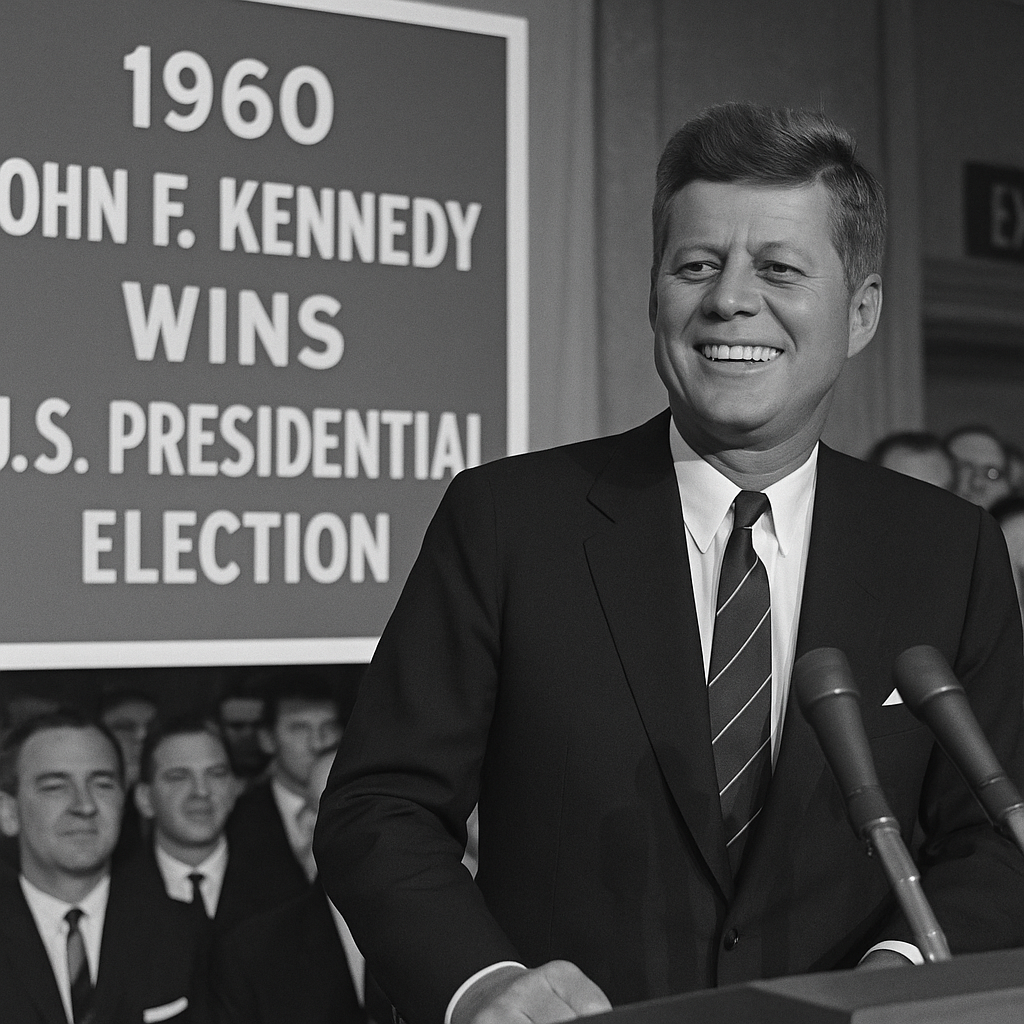
John F. Kennedy Wins the 1960 U.S. Presidential Election. In 1960, John F. Kennedy won the U.S. presidential election, becoming the youngest elected president in American history. His victory symbolized a new era of hope, progress, and optimism that reshaped the nation’s political and cultural landscape.
John F. Kennedy Wins the 1960 U.S. Presidential Election – A New Era for America
On November 8, 1960, John Fitzgerald Kennedy, the Democratic senator from Massachusetts, won the U.S. presidential election, defeating Republican Vice President Richard Nixon. The outcome marked the beginning of a new political era defined by youth, idealism, and forward-thinking vision.
The 1960 campaign was one of the most fiercely contested in U.S. history and one of the most innovative. For the first time, televised debates played a decisive role in shaping public opinion. Kennedy, calm and charismatic, appeared confident and composed, while Nixon, tired and pale, struggled to connect with the audience.
The race was extremely close Kennedy won the popular vote by just 0.17%, but his strong showing in key states gave him a decisive Electoral College victory.
The Campaign That Changed Politics Forever
The 1960 presidential election marked a turning point in American politics. Television became a dominant force, changing how candidates connected with voters. Kennedy understood the power of the new medium and used it masterfully. His poise, eloquence, and youthful energy captivated millions.
His campaign slogan, “A New Frontier,” promised innovation, progress, and a brighter future. Amid the tension of the Cold War, Kennedy’s vision inspired younger generations who saw him as the leader capable of steering America toward peace and prosperity.
Nixon, though experienced and respected, failed to harness the visual power of television. His campaign was more traditional, focusing on policy over personality a strategy that proved less effective in the new media age.
A Historic and Symbolic Victory
At just 43 years old, Kennedy became the youngest person ever elected President of the United States. He was also the first Catholic president, breaking a significant religious barrier in a nation marked by diversity and freedom of faith.
Kennedy’s victory was not only political but cultural. It symbolized a generational shift a movement toward progress, scientific discovery, and social change. His leadership inspired Americans to believe in collective action and civic responsibility.
His famous inaugural words still echo through history:
“Ask not what your country can do for you ask what you can do for your country.”
Global Impact and Foreign Policy
Kennedy’s presidency redefined America’s global image. His administration focused on cooperation, diplomacy, and the defense of freedom. The early 1960s were turbulent years that tested his leadership through critical events such as:
- The Bay of Pigs Invasion (1961) – a failed attempt to overthrow Fidel Castro’s regime in Cuba.
- The Cuban Missile Crisis (1962) – the world’s closest brush with nuclear war, which Kennedy resolved through diplomacy and restraint.
- The Apollo Space Program – Kennedy’s call to reach the Moon inspired generations and symbolized America’s spirit of innovation.
Despite his tragic assassination in 1963, Kennedy’s global vision and leadership left a lasting legacy that continues to influence world politics.
The Legacy of John F. Kennedy
Kennedy’s legacy extends beyond politics it embodies hope, courage, and renewal. He championed:
- Civil rights progress in a time of social division;
- Scientific and technological innovation, including the space race;
- Global cooperation through alliances like NATO;
- Public service, launching initiatives such as the Peace Corps.
Even decades after his death, Kennedy remains one of the most admired leaders in U.S. history a symbol of youthful optimism and visionary leadership.
FAQ – Frequently Asked Questions
Who was John F. Kennedy’s opponent in the 1960 election?
His opponent was Richard Nixon, who was serving as Vice President under President Dwight D. Eisenhower.
What made the 1960 election special?
It was the first presidential election heavily influenced by television, especially through the historic first televised debate.
How close was the 1960 election?
Extremely close Kennedy won the popular vote by only 0.17%, but secured 303 Electoral College votes to Nixon’s 219.
Why was Kennedy’s victory important?
Because it marked a generational and cultural shift in American politics toward innovation, global engagement, and civic idealism.
When was John F. Kennedy inaugurated?
He took the oath of office on January 20, 1961, in Washington D.C., delivering one of the most iconic inaugural addresses in history.
A Victory That Changed the World
John F. Kennedy’s 1960 presidential victory was more than a political win it was a transformation of American identity. It marked the rise of a new generation driven by optimism, courage, and a belief in progress.
His leadership reshaped how the world viewed the United States: as a beacon of freedom, innovation, and hope. Kennedy’s legacy lives on, reminding us that vision, charisma, and communication can redefine history.
🔔 For more tutorials like this, consider subscribing to our blog.
📩 Do you have questions or suggestions? Leave a comment or contact us!
🏷️ Tags: John F. Kennedy, 1960 election, U.S. history, Richard Nixon, American politics, presidential debate, democracy, television influence, Cold War, leadership
📢 Hashtags: #JohnFKennedy, #USElection1960, #History, #Politics, #Leadership, #ColdWar, #Democracy, #AmericanHistory, #PresidentialDebate, #NewFrontier
Read also: The Final Embrace: The Story of Mike Perdue and His Daughter
