


⏲️ Estimated reading time: 9 min
Table of Contents
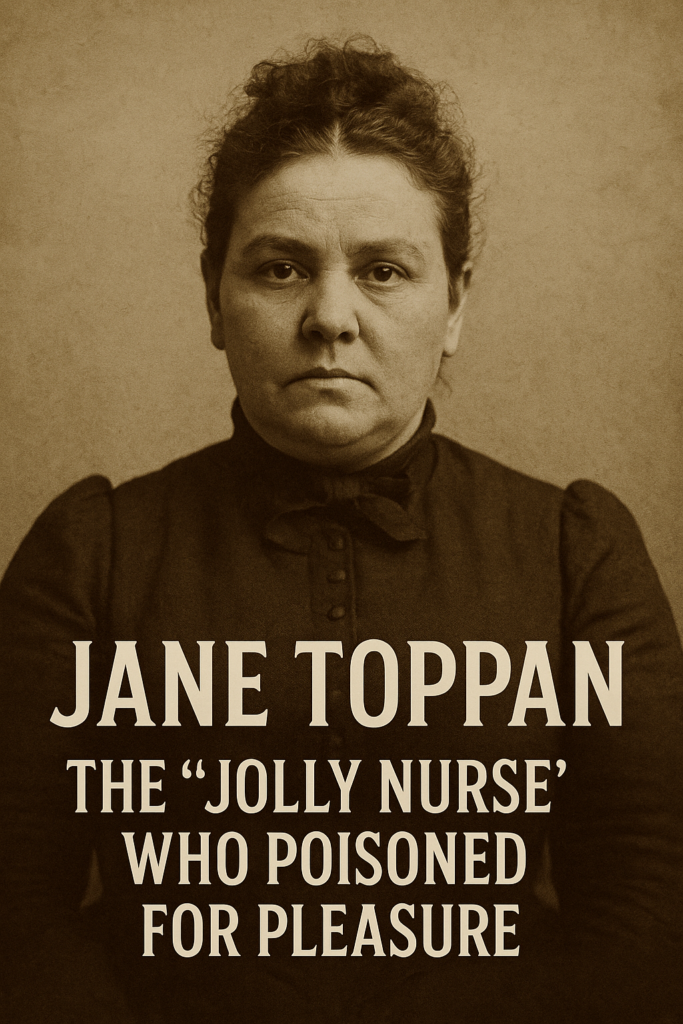
🩸 Jane Toppan – The “Jolly Nurse” Who Poisoned for Pleasure. Jane Toppan, born Honora Kelley, was a nurse turned serial killer in 19th-century America. Known as “Jolly Jane,” she used poison to kill her patients, confessing to 31 murders a chilling story of deceit, obsession, and psychological darkness.
The Early Life of Jane Toppan: From Orphan to “Jolly Jane”
Jane Toppan’s real name was Honora Kelley. She was born in Boston, Massachusetts, around March 31, 1854 (some records suggest 1857). Her life began in hardship. Her parents were Irish immigrants struggling in a poor, unstable home. Her mother died of tuberculosis while Jane was still a toddler. Her father, Peter Kelley, was reportedly mentally unstable and abusive.
When her father could no longer care for his children, he surrendered Honora and her sister to the Boston Female Asylum an orphanage for destitute girls. That decision changed the course of Jane’s life forever.
At about six years old, Honora was indentured to the Toppan family of Lowell, Massachusetts. Though never adopted, she took their surname and became Jane Toppan. Early reports described her as bright but deceitful, with an unusual fascination for control and manipulation. Teachers noted her intelligence, yet her classmates whispered that she enjoyed making others uncomfortable.
Childhood trauma, abandonment, and the rigid world of 19th-century orphanages likely shaped her complex and disturbed personality. These early experiences planted the seeds of the woman who would one day become known as “Jolly Jane.”
The Nurse Who Smiled While She Killed
In the 1880s, Jane began her nursing training at Cambridge Hospital and later worked at Massachusetts General Hospital (MGH). She quickly gained popularity among patients and colleagues for her cheerful, kind demeanor. Her nickname, “Jolly Jane,” reflected her outward charm.
But behind that smile lurked something sinister.
Fellow nurses noticed she often experimented with medications, administering morphine and atropine in suspicious ways. Patients under her care frequently suffered unexplained symptoms and some died unexpectedly. Her manipulation of drug dosages and unauthorized use of opiates raised alarms.
She was eventually dismissed from both hospitals, though her reasons for dismissal were downplayed at the time. Hospitals in the late 1800s often preferred quiet departures over public scandal.
Jane turned to private-duty nursing, caring for patients in their homes. Without the supervision of hospital staff, she had the freedom to act unchecked. Her victims were often elderly, ill, or wealthy people who trusted her completely.
Her killing method was deliberate and terrifying: she would poison patients slowly, watch them suffer, and sometimes revive them to repeat the process. The thrill of holding life and death in her hands gave her immense pleasure.
The Victims Who Never Saw It Coming
Jane Toppan’s crimes were not a single moment of madness but a pattern that grew bolder with time. Between 1895 and 1901, a wave of mysterious deaths followed her wherever she worked.
She was eventually charged with 12 murders, though she confessed to 31 and may have killed over 100 people.
Among her victims were:
- Israel and Lovely Dunham, elderly patients who died within her care (1895–1897).
- Elizabeth Toppan Brigham, her foster sister, who died in August 1899 after Jane poisoned her out of jealousy.
- Alden Davis, his wife Mattie, and their daughters Genevieve and Mary “Minnie” Gibbs all died within weeks in 1901 under Jane’s “care.”
Jane later admitted she experienced sexual arousal and euphoria while watching her victims die. She was fascinated by their final moments, claiming she enjoyed “being close to them as they died.”
Her most chilling statement remains etched in criminal history:
“It is my ambition to have killed more people more helpless people than any man or woman who ever lived.”
Her lack of remorse was absolute. She told investigators:
“I have thought it all over, and I cannot detect the slightest bit of sorrow over what I have done.”
The Fall of “Jolly Jane”: How She Was Caught
In 1901, the suspicious deaths of the Davis family raised alarm. Relatives ordered autopsies and toxicology tests, revealing poisoning by morphine and atropine. Investigators traced the connection back to Jane.
She was arrested on October 29, 1901, in Amherst, New Hampshire. During questioning, her composure cracked. She began talking freely about her crimes, describing the pleasure she felt when watching life fade from her victims.
Her trial took place in Barnstable County, Massachusetts, in June 1902. The courtroom was packed with reporters and curious citizens, fascinated by the contrast between her smiling face and her monstrous acts.
In the end, the court declared her not guilty by reason of insanity. She was committed to Taunton State Hospital for life a grim institution for the mentally ill.
Jane lived there until her death on August 17 or 18, 1938, at around 84 years old. She never expressed regret. According to hospital staff, she often smiled and joked, claiming she would be released soon to “resume her duties as a nurse.”
The Psychology of Jane Toppan: What Drove Her?
Understanding Jane Toppan requires exploring the complex intersection of trauma, narcissism, and psychopathy.
Psychiatrists of her era used the term “moral insanity”, describing people who understood right and wrong intellectually but lacked conscience or empathy. Jane fit this description perfectly.
Her motives were not purely financial. Although she occasionally benefited from wills or gifts, her real drive was power and control. She viewed death as an intimate act one she wanted to command.
Read also: Belgian Workers Find $10 Million in Hidden Gold
1. Early trauma and abandonment
Growing up without stable love or identity likely left her emotionally hollow. Her abandonment at a young age and years in an orphanage fueled a desperate need for control and affection.
2. The thrill of manipulation
She enjoyed deceiving people even colleagues. Her victims trusted her implicitly, which made the betrayal even more exhilarating. This aligns with traits of narcissistic and sadistic personalities.
3. Sexual gratification and domination
In her confessions, Jane admitted that she felt “a real pleasure” during her victims’ deaths, blurring the line between violence and sexuality a hallmark of psychosexual sadism.
4. God-like power
By deciding who lived or died, she played the ultimate role creator and destroyer. Her crimes satisfied a delusion of omnipotence rarely seen in female offenders.
The Historical Context: Medicine, Trust, and Fear
The late 19th century was a time of medical evolution in the United States. Nursing was transitioning from unregulated caregiving to a professional, ethical field.
However, private-duty nurses often worked alone in patients’ homes, with little oversight. The use of morphine and atropine was common but poorly monitored. Record-keeping was minimal, making it easy to disguise foul play.
Jane’s crimes shocked the public because she represented the ultimate betrayal a caregiver who became a killer. The image of the nurturing nurse was shattered. Newspapers across the country printed headlines calling her “The Smiling Monster” and “The Angel of Death.”
Society’s Reaction and the Legal Aftermath
Jane’s case spurred changes in how medical professionals were supervised. Hospitals began to enforce stricter record-keeping, and private nurses were required to carry references and undergo background checks.
The trial also reignited debate about the insanity defense. Many Americans questioned whether Jane truly lacked moral understanding or simply exploited the system to avoid prison.
Doctors who examined her concluded she was “morally insane” a diagnosis that today would likely be labeled psychopathy or antisocial personality disorder.
Her story became a reference point for future debates on criminal insanity, gender, and moral responsibility.
The Shadow of “Jolly Jane” in Pop Culture
Over the decades, Jane Toppan’s story has inspired books, plays, and documentaries. Her chilling duality the smiling nurse and the cold-blooded killer fascinates true crime enthusiasts to this day.
Notable works include:
- Fatal: The Poisonous Life of a Female Serial Killer by Harold Schechter.
- Mentions in America’s Serial Killers: Portraits in Evil (documentary series).
- References in psychology studies exploring female serial killers.
Her story continues to haunt the imagination because it exposes an uncomfortable truth: evil can wear a friendly face.
Lessons from Jane Toppan’s Crimes
- Unchecked power breeds danger.
Nurses and caregivers hold deep responsibility. Without oversight, even compassion can be corrupted. - Mental health and trauma require attention.
Early intervention in cases of abuse or abandonment could prevent future psychological damage. - Trust is sacred in medicine.
The nurse-patient relationship relies on safety. Jane’s betrayal damaged that trust for years. - Female criminality remains misunderstood.
Society often associates nurturing with femininity, but Jane’s case revealed that women, too, can be driven by dark impulses.
Frequently Asked Questions
Who was Jane Toppan?
Jane Toppan, born Honora Kelley, was a nurse in 19th-century America who murdered her patients with poison. She confessed to 31 murders and was committed to a mental institution for life.
Why did Jane Toppan kill her patients?
Her motives included sexual pleasure, power, control, and experimentation with life and death. She was diagnosed as insane, though she claimed she knew right from wrong.
How was Jane Toppan caught?
After several suspicious deaths in the Davis family, autopsies revealed poisoning. She was arrested in 1901 and later declared insane.
What happened to Jane Toppan after the trial?
She was confined to Taunton State Hospital in Massachusetts, where she lived until her death in 1938.
Is “Vickie Toppan” the same person?
Yes. “Vickie Toppan” is a mistaken name found in online stories. The correct name is Jane Toppan.
The Legacy of Jane Toppan
Jane Toppan’s name still evokes fear and fascination more than a century later. Her crimes forced hospitals to strengthen accountability and created awareness around psychological screening for caregivers.
She shattered the stereotype of women as purely nurturing, revealing that darkness can exist even behind the most comforting smile. Her life remains a tragic and chilling reminder that evil often hides in plain sight.
🔚 “Smiles Can Be Deceptive”
Evil rarely announces itself. Jane Toppan’s story reminds us that kindness, when used as a mask, can conceal monstrous intent. Every act of trust carries risk, and every betrayal leaves scars that history will never erase.
🔔 For more true-crime stories and psychology insights, subscribe to our blog.
📩 Questions or ideas? Leave a comment below or contact us anytime!
Tags: Jane Toppan, female serial killers, true crime, American history, nurses who kill, psychopathology, historical murders, Massachusetts crime, insane asylum, Taunton State Hospital
Hashtags: #JaneToppan, #TrueCrime, #SerialKiller, #History, #CriminalPsychology, #Nursing, #PoisonMurders, #AmericanHistory, #CrimeStories, #Psychopath
