


⏲️ Estimated reading time: 10 min
Table of Contents
The Richest and Poorest Formula 1 Drivers: From Esteban Ocon’s Caravan Life to Lance Stroll’s Billion-Dollar Privilege. From Esteban Ocon’s parents selling their home for his dream, to Lance Stroll’s billionaire father buying him an entire team, Formula 1’s grid shows both sides of wealth and sacrifice where money meets raw talent, and privilege meets grit.
From Nothing to Everything: Esteban Ocon’s Story
Esteban Ocon’s rise to Formula 1 remains one of the sport’s most inspiring stories. Born in Évreux, France, to a modest family, Esteban didn’t come from money, fame, or privilege. His father, Laurent, worked as a mechanic, while his mother ran a small garage. They lived a quiet, humble life until their son’s dream changed everything.
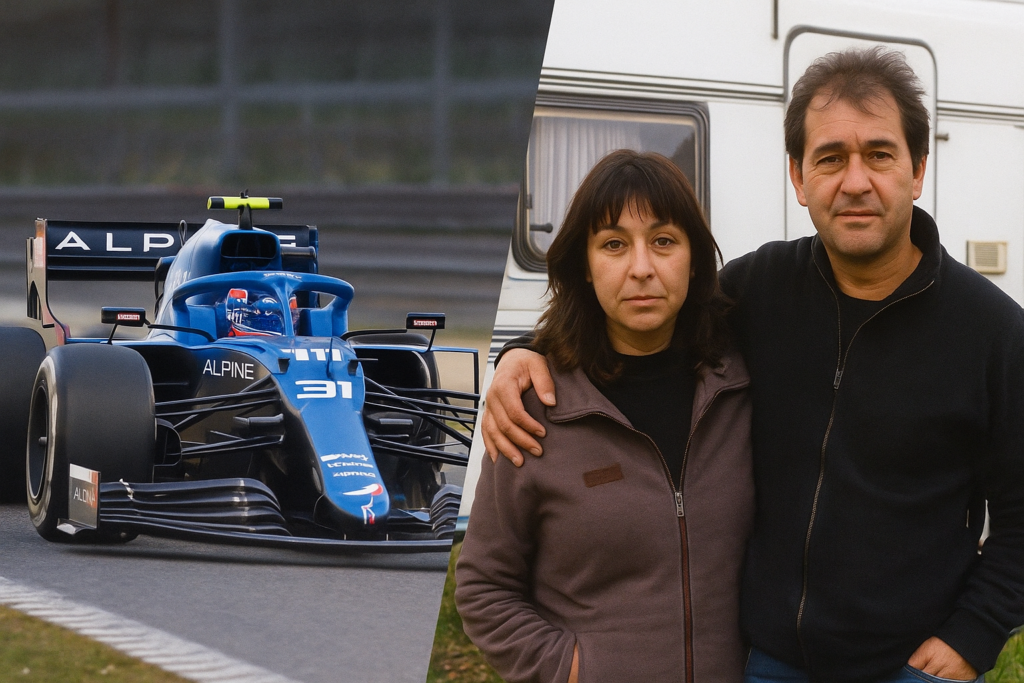
Motorsport is not a game for the poor. The cost of a single kart, travel, mechanics, and tires can drown even the most passionate families. Yet, the Ocons made a choice few would dare: they sold everything the house, the garage, even their stability to keep Esteban racing. The family moved into a caravan, traveling across Europe from race to race, chasing a dream that seemed almost impossible.
While other kids enjoyed the luxury of multiple engines, spare chassis, and full factory support, Ocon was recycling tires discarded by wealthier teams. He ran on used engines, hand-me-down chassis, and whatever his father could repair. But what Esteban lacked in money, he made up for in heart and skill.
His breakthrough came in the 2011 WSK Euro Series, where he finished second behind none other than Max Verstappen. That moment proved his worth talent that could not be bought.
Mercedes: The Turning Point
Everything changed when Mercedes noticed the young Frenchman’s potential. The team saw not just a skilled driver, but a boy fighting against impossible odds. They signed him into the Mercedes Junior Development Program, giving him the lifeline his family needed.
From there, Ocon’s career exploded:
- 2014: Wins the European F3 Championship, even ahead of Verstappen.
- 2016: Makes his F1 debut with Manor Racing.
- 2017: Secures a full-time seat with Force India.
Ocon never forgot where he came from. In interviews, he often recalls his parents’ sacrifices calling them “insane” but inspiring. He admits that in their place, he might not have taken the same risk. But that’s what makes his story special: his family bet everything, and it paid off.
From Privilege to Pitfalls: The Nepo Babies of F1
Now, not every driver’s path is forged through struggle. Formula 1 has long been a playground for the wealthy, where money often buys opportunity. And few names define “rich privilege” like Nikita Mazepin and Lance Stroll.
Let’s start with Mazepin.
Nikita Mazepin – When Money Outweighs Merit
Nikita Mazepin’s story begins not in poverty but in pure luxury. His father, Dmitry Mazepin, is a Russian billionaire and former chairman of Uralchem, one of Russia’s largest fertilizer companies. Worth over $2.2 billion, Dmitry could buy Nikita’s way through nearly any racing team and he did.
Nikita wasn’t untalented. He performed decently in karting, placing second in the 2014 Karting World Championship, just behind Lando Norris. However, his rise through the ranks was fueled by an endless cash flow, not pure performance.
In Formula 2, Mazepin showed flashes of ability but also frequent recklessness. His temper and questionable decisions earned him a bad reputation both on and off the track. When Haas F1 was struggling financially, Dmitry stepped in not with advice or guidance, but with a sponsorship deal that turned Haas cars into walking billboards for Uralchem.
That’s how Nikita got his F1 seat: through his father’s wallet.
His time in Formula 1 was short and controversial. Constant mistakes, public outbursts, and his infamous “Mazaspin” nickname defined his career. After Russia’s invasion of Ukraine, Haas cut ties with him and his father’s company, ending his F1 journey.
Money can buy a car, but not talent. Mazepin is living proof.
Michael Schumacher – The Mechanic’s Son Who Became a Legend
Before the fame, before the seven world titles, Michael Schumacher was just a boy from a working-class German family. His father, Rolf, worked as a bricklayer and managed a local kart track. His mother, Elisabeth, cooked meals for racers to make ends meet.
Michael’s first kart wasn’t a polished machine it was built by his father out of discarded parts. His racing suit? Hand-sewn. His helmet? Borrowed.
When racing became too expensive in Germany, the Schumachers found a creative loophole. They entered Michael under Luxembourg’s flag since qualification fees there were cheaper. This clever workaround allowed him to keep racing despite financial strain.
Even then, his father couldn’t afford the costs forever. Michael worked as a mechanic to support his racing fixing engines by day, racing by night. Eventually, sponsors took notice. Jürgen Dilk and later Willi Weber gave Schumacher the financial backing he needed. The rest is history: seven world titles, eternal fame, and a legacy no money could have purchased.
Lando Norris – Privilege Meets Talent
In contrast, Lando Norris had the perfect formula for success money and skill. His father, Adam Norris, is one of Britain’s wealthiest men, with a fortune of over $250 million. The family’s wealth ensured Lando had access to the best equipment, teams, and opportunities from the start.
Lando dominated karting, becoming World Karting Champion in 2014. With McLaren backing him early, he progressed swiftly through the junior categories and debuted in Formula 1 in 2019.
Unlike Mazepin, Lando justified the privilege. He’s talented, marketable, and likeable proving that while money helps, skill keeps you there.
His father’s wealth also led to cross-brand collaborations like Pure Electric’s partnership with McLaren but unlike others, Lando’s results speak for themselves.
Lewis Hamilton – Sacrifice Turned to Glory
Few stories are as emotionally powerful as Lewis Hamilton’s. Born in Stevenage, England, Hamilton grew up in a modest home. His father, Anthony Hamilton, worked up to four jobs at once to fund his son’s racing dream. Some nights, he slept in the family car just to save money for fuel or entry fees.
Read also: Tom Cruise Stuns Fans With Dramatic New Look in First
Lewis’s father was more than just a provider he was his son’s first engineer, manager, and strategist. He taught Lewis to brake later, push harder, and think differently. The two became an unstoppable team.
At age 13, Lewis was signed to the McLaren Junior Program, after Ron Dennis recognized his extraordinary potential. The partnership gave Lewis the funding and structure he needed to climb the ranks. By 2007, Hamilton was in Formula 1 and the rest is a record-breaking history.
From poverty to billionaire status, Hamilton’s journey defines resilience. He didn’t just race cars he raced life itself.
Lance Stroll – Billionaire Boy in a Racing Suit
And now, the final act Lance Stroll, son of Canadian billionaire Lawrence Stroll, worth nearly $4 billion. Lawrence made his fortune by expanding fashion brands like Tommy Hilfiger and Michael Kors globally. He also owns one of the most impressive car collections in the world, including a $50 million Ferrari 250 GTO.
Unlike Ocon or Hamilton, Lance never had to fight for exposure. He was flown to races in private jets, coached by ex-F1 driver Pedro de la Rosa, and backed by a full team his father built specifically around him.
Lawrence didn’t just support Lance he bought his way into Formula 1. He invested over £60 million into Prema Racing and later purchased Racing Point, which eventually became Aston Martin. Naturally, Lance had a seat waiting.
Despite his privilege, Lance has struggled to win fans. His attitude, lack of humility, and inconsistent performances often overshadow his occasional flashes of skill. Many feel he symbolizes everything wrong with modern F1 where billionaires can buy a team and a legacy.
The Balance Between Money and Talent
Formula 1 has always been a paradox the sport demands both immense funding and raw skill. For every Esteban Ocon or Lewis Hamilton fighting from the bottom, there’s a Lance Stroll or Nikita Mazepin climbing on gold-plated ladders.
But one truth remains: money can get you into Formula 1, but it can’t make you a champion. The greats Schumacher, Hamilton, Vettel prove that sacrifice, intelligence, and determination shape the legends, not the size of their wallets.
Ocon’s parents risked everything. Schumacher’s father built karts out of scraps. Hamilton’s dad worked four jobs. These stories show that true greatness is forged in hardship.
Meanwhile, the wealthy prodigies like Stroll and Mazepin remind us that money might buy speed, but not respect.
In the end, Formula 1 remains a mirror of life unfair, unequal, but full of stories that prove one thing: the human spirit can outrun even the richest engines.
FAQs: Money, Sacrifice, and F1 Careers
1) Did Esteban Ocon’s parents really sell their home to fund his racing?
Yes. They sold their house/garage and lived in a caravan so he could keep racing, traveling from event to event.
2) How did Ocon finally break into Formula 1?
Mercedes added him to their Junior Programme, which opened doors to Euro F3 success, an F1 debut with Manor (2016), and a full season with Force India (2017).
3) Who are other big names that started with little money?
Michael Schumacher, Lewis Hamilton, and Sebastian Vettel all came from modest backgrounds and relied on relentless work, clever support, and timely sponsors.
4) Which current or recent drivers came from wealthy families?
Lance Stroll and Lando Norris had significant financial backing. Nikita Mazepin also benefited from major corporate sponsorship tied to his father.
5) Did Nikita Mazepin “buy” his F1 seat?
His father’s company sponsored Haas during a difficult period, which strongly facilitated Nikita’s seat performance alone likely wouldn’t have secured it.
6) Does money guarantee success in F1?
No. Funding opens doors, but results require talent, discipline, feedback skills, and consistency. Money can buy a seat; it cannot buy a championship.
7) How did Lewis Hamilton’s family manage early racing costs?
His father worked multiple jobs, often sleeping in the car during race weekends, while also coaching Lewis on techniques like later braking.
8) What role did mentors and sponsors play for Schumacher?
Local supporters and manager Willi Weber funded key steps. That backing, plus Michael’s skill, accelerated his path to F1 and seven titles.
9) Is skipping series (like F2) always a red flag?
Not always, but bypassing steps without dominant results usually raises questions. The strongest careers show excellence at each rung.
10) What’s the real takeaway from these stories?
Money helps you start; grit keeps you there. The greatest drivers prove that resilience and craft outrun privilege over time.
When Sacrifice Outraces Wealth
Formula 1 is more than speed it’s about heart. For every billionaire’s son, there’s a fighter like Ocon, proving that pure passion can still defy the odds. In the battle between talent and privilege, one truth stands tall: you can’t buy greatness.
🔔 For more tutorials like this, consider subscribing to our blog.
📩 Do you have questions or suggestions? Leave a comment or contact us!
🏷️ Tags: Esteban Ocon, Formula 1, F1 drivers, Lance Stroll, Lewis Hamilton, Michael Schumacher, Nikita Mazepin, Lando Norris, F1 wealth gap, racing sacrifices
📢 Hashtags: #Formula1, #EstebanOcon, #LanceStroll, #LewisHamilton, #MichaelSchumacher, #NikitaMazepin, #LandoNorris, #Motorsport, #F1History, #RacingLegends
