


⏲️ Estimated reading time: 12 min
Table of Contents
Celebrities Buried in Paris’s Père-Lachaise Cemetery. Paris’s Père-Lachaise Cemetery is the resting place of over 70,000 people, including great artists, writers, and musicians. Discover 20 celebrities and the fascinating stories of their graves in a unique open-air museum.
Père-Lachaise
Read also: The Young Hero Who Sacrificed Everything for Love: The Story
Paris’s Père-Lachaise Cemetery is not only a place of remembrance but also a true open-air museum. Located in the 20th arrondissement, this historic cemetery hosts the graves of some of the most influential figures in history, from composers and writers to actors and political leaders. With shaded alleys, impressive sculptures, and an atmosphere that blends melancholy with beauty, Père-Lachaise attracts over three million visitors annually. Every grave tells a story, and the celebrities buried here have left a cultural legacy that continues to inspire generations. In this article, we explore the lives and legacies of 20 remarkable figures whose tombs make the cemetery an unmissable destination for lovers of art, history, and culture.
The History of Père-Lachaise Cemetery
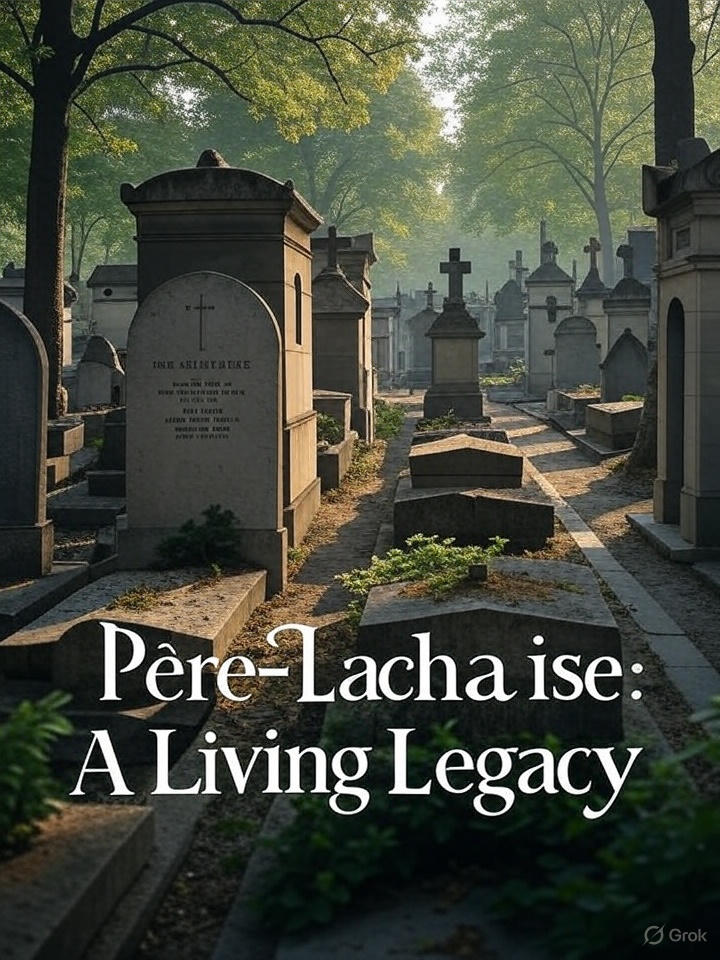
Founded in 1804, Père-Lachaise Cemetery bears the name of François d’Aix de La Chaise, the confessor of King Louis XIV. At first, Parisians were reluctant to use this cemetery, considered too far from the city center. To boost its popularity, authorities moved here the remains of famous figures such as Molière and Jean de La Fontaine, quickly turning Père-Lachaise into a prestigious resting place. Over the centuries, the cemetery has become a symbol of cultural memory, hosting elaborate graves created by renowned artists. Today, Père-Lachaise is not only a place of eternal rest but also a major tourist destination, with guides and maps available to visitors. Its evolution as a tourist attraction reflects the global fascination with history and funerary art, and the cemetery is included in Paris’s cultural routes.
Celebrities Buried in Père-Lachaise
Frédéric Chopin (1810–1849)
Frédéric Chopin, the brilliant Polish composer and pianist, died at just 39 due to fragile health, likely tuberculosis. His grave in Père-Lachaise, located in Division 11, is one of the most visited. Designed by sculptor Auguste Clésinger, the monument features a weeping muse symbolizing the melancholy of his music. Chopin revolutionized piano music with compositions such as waltzes, mazurkas, and nocturnes, which blend Polish sensibility with French refinement. Although his heart was taken to Poland, per his wish, his body rests in Paris. Visitors often leave flowers and sheet music on his grave, a tribute to his eternal legacy. His love story with the writer George Sand adds a romantic note to his legend, and his music continues to inspire pianists worldwide.
Édith Piaf (1915–1963)
Édith Piaf, known as “The Little Sparrow of Paris,” conquered the world with her unmistakable voice and songs such as “La Vie en Rose.” Her grave in Division 97 is simple but always covered with flowers brought by fans. Born into a poor family, Piaf knew fame but also tragedy, losing her daughter and struggling with addiction. Her death at 47 shocked France, and her funeral drew tens of thousands of people. Grave, adorned with a plaque reading “Édith Piaf – Éternel Amour,” reflects the public’s love for her. Her songs remain symbols of the Parisian spirit, and cemetery visitors honor her courage and passion.
Jim Morrison (1943–1971)
Jim Morrison, lead singer of The Doors, died at 27, becoming a member of the infamous “27 Club.” His grave in Division 6 is a magnet for fans, though it has been controversial due to vandalism. The current simple monument with a bronze plaque replaces the original bust, stolen in the 1980s. Morrison lived a tumultuous life marked by excess, but his music with hits like “Light My Fire” defined psychedelic rock. His death in Paris, officially caused by an overdose, remains shrouded in mystery. Fans leave notes, flowers, and bottles of whiskey at the grave, celebrating his rebellious spirit. Thanks to Morrison, Père-Lachaise has become a pilgrimage site for rock lovers.
Oscar Wilde (1854–1900)
Oscar Wilde, the Irish writer known for The Picture of Dorian Gray, has a spectacular grave in Division 89, created by sculptor Jacob Epstein. The monument, a flying sphinx, is covered with lipstick marks a gesture from fans who kiss the stone. Wilde died in exile in Paris after being imprisoned in England for homosexuality. His literary genius, marked by humor and irony, continues to fascinate. Grave was protected with glass to prevent damage, but admirers still leave messages of love. His life, full of triumph and tragedy, makes his grave a symbol of resilience and creativity.
Marcel Proust (1871–1922)
Marcel Proust, author of the masterpiece In Search of Lost Time, rests in Division 85. His simple grave contrasts with the complexity of his work. Suffering from asthma, Proust lived in seclusion, writing at night in his cork-lined room. His monumental novel explores memory and French society, influencing modern literature. The grave a black plaque bearing his name draws readers from around the world. Though discreet, it is a place of reflection for those who admire his literary depth. Proust died at 51, but his work remains alive, studied and celebrated to this day.
Sarah Bernhardt (1844–1923)
Sarah Bernhardt, the “divine” actress of French theater, is buried in Division 44. Nicknamed the “queen of tragedy,” she dominated the 19th-century stage with roles in plays by Victor Hugo and Alexandre Dumas. Her grave, adorned with a simple cross, reflects her modesty in death, in contrast to her extravagant life. Bernhardt was the first actress to tour internationally, winning over audiences in Europe and America. She died at 78 after a legendary career. Theater fans visit her grave to honor a woman who redefined the dramatic arts.
Eugène Delacroix (1798–1863)
Eugène Delacroix, master of French Romanticism, is buried in Division 49. Painter of the masterpiece Liberty Leading the People, Delacroix influenced art through vibrant colors and intense emotion. His grave, a sober plaque, contrasts with the drama of his paintings. He died at 65, leaving a legacy that inspired generations of artists. Cemetery visitors admire his grave for his contribution to modern art, and Père-Lachaise reflects his status as a central cultural figure of France.
Georges Seurat (1859–1891)
Georges Seurat, founder of Pointillism, rests in Division 66. His painting A Sunday Afternoon on the Island of La Grande Jatte revolutionized art through his innovative technique. He died at only 31, probably from diphtheria, leaving behind a small but influential body of work. His simple grave attracts art lovers who appreciate his precision and vision. Seurat was a pioneer of modernism, and his presence in Père-Lachaise underscores the cemetery’s importance as a place of great creators.
Jean de La Fontaine (1621–1695)
Jean de La Fontaine, the famous fabulist, is buried in Division 25. His fables, such as “The Crow and the Fox,” have educated and delighted generations. Remains were moved to Père-Lachaise in 1817 to enhance the cemetery’s prestige. His modest grave reflects the simplicity of his stories, but his cultural impact is immense. Visitors sometimes leave books or flowers, honoring a writer whose morals are still relevant. La Fontaine remains a beloved figure in French literature.
Molière (1622–1673)
Molière, the master of French comedy, rests in Division 25 next to La Fontaine. His plays, such as Tartuffe and The Misanthrope, criticized society with humor and intelligence. He died at 51 after collapsing on stage. His remains were moved to Père-Lachaise in the 19th century. His grave, a simple plaque, draws theater lovers. Molière remains a symbol of satire, and his presence in the cemetery underscores its link to French culture.
Honoré de Balzac (1799–1850)
Honoré de Balzac, giant of realist literature, is buried in Division 48. Author of La Comédie Humaine, Balzac depicted French society with astonishing precision. He died at 51, exhausted by work and debts. His grave, adorned with a bust, reflects his literary status. Visitors admire his legacy, which influenced writers such as Zola and Proust. Balzac transformed literature, and his grave is a pilgrimage site for readers.
Guillaume Apollinaire (1880–1918)
Guillaume Apollinaire, the avant-garde poet, rests in Division 86. His poems, such as Alcools, redefined modern poetry. He died at 38, weakened by wounds from World War I and the Spanish flu. His grave, decorated with a menhir, symbolizes his innovative spirit. Apollinaire was a pioneer of Surrealism, influencing artists such as Picasso. Cemetery visitors appreciate his contribution to 20th-century poetry.
Colette (1873–1954)
Colette, the French writer known for Gigi and Chéri, is buried in Division 4. Her sensual style and sharp observations of human nature made her a beloved literary figure. She died at 81 after a prolific career. Her simple grave draws readers who admire her courage and independence. Colette was the first woman in France to receive a state funeral, a tribute to her cultural impact.
Isadora Duncan (1877–1927)
Isadora Duncan, pioneer of modern dance, rests in Division 87. She died tragically at 50, strangled by her own scarf caught in a car wheel. Her grave, a simple urn, reflects her artistic grace. Duncan revolutionized dance, promoting freedom of expression. Admirers visit Père-Lachaise to honor an artist who changed the performing arts.
Maria Callas (1923–1977)
Maria Callas, the legendary soprano, had her ashes temporarily placed in Père-Lachaise, in Division 87, before being scattered in the Aegean Sea. Her unique voice and dramatic interpretations in operas such as Tosca made her immortal. She died at 53, probably of a heart attack. Her symbolic grave remains a draw for opera lovers who celebrate her extraordinary passion and talent.
Georges Bizet (1838–1875)
Georges Bizet, composer of the opera Carmen, is buried in Division 68. He died at 36, shortly after the opera’s premiere, which was initially a failure. His grave, decorated with a lyre, honors his musical genius. Today, Carmen is one of the most beloved operas, and his grave draws classical music fans who acknowledge his contribution to opera.
Félix Faure (1841–1899)
Félix Faure, former President of France, is buried in Division 4. He died suddenly at 58 during an amorous encounter, which sparked a national scandal. His sober grave contrasts with his controversial life. Visitors are intrigued by his story, which adds a touch of historical scandal to Père-Lachaise.
Abelard and Héloïse (12th century)
Abelard and Héloïse, the famous medieval couple, are buried together in Division 7. Their tragic love story, marked by separation and passionate letters, became legendary. Their Gothic tomb, a symbol of eternal love, attracts romantics from around the world. Moving their remains to Père-Lachaise in the 19th century cemented the cemetery’s status as a place of great stories.
Gertrude Stein (1874–1946)
Gertrude Stein, the American writer and mentor of the avant-garde, rests in Division 94. Known for her Parisian salon, where she supported artists such as Picasso and Hemingway, Stein died at 72. Her simple grave reflects her minimalist style. Visitors appreciate her role in promoting modern art, and her presence in Père-Lachaise underscores the cemetery’s cultural diversity.
Edith Cavell (1865–1915)
Edith Cavell, a British nurse and World War I heroine, is commemorated in Division 87. Executed by the Germans for helping Allied soldiers, she died at 49. Her symbolic grave honors her courage. Cemetery visitors admire her sacrifice, which inspired humanitarian movements around the world.
Funerary Monuments and Art
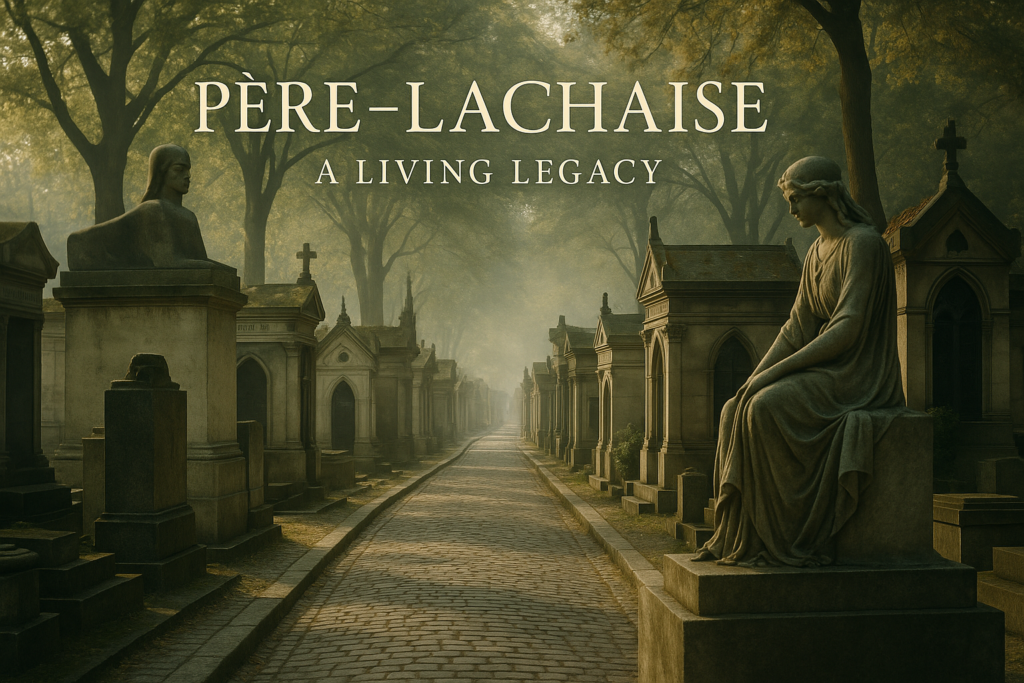
Père-Lachaise is not just a cemetery but also a gallery of funerary art. The graves are decorated with sculptures by famous artists such as Jacob Epstein (for Oscar Wilde) and Auguste Clésinger (for Chopin). Styles range from Neoclassical to Gothic and Modernist, each monument telling a story about the era and personality of the deceased. For example, the tomb of Abelard and Héloïse impresses with its medieval architecture, while Jim Morrison’s draws attention through its rebellious simplicity. The cemetery also hosts elaborate mausoleums, such as that of the Rothschild family, and monuments dedicated to war victims. The funerary art of Père-Lachaise reflects Paris’s cultural and artistic diversity, turning every visit into a lesson in history and aesthetics.
Visitor Guide
Père-Lachaise Cemetery is open daily from 8:00 a.m. to 6:00 p.m. (Monday–Friday), 8:30 a.m. to 6:00 p.m. (Saturday), and 9:00 a.m. to 6:00 p.m. (Sunday). Entry is free, but a map available at the main entrance or online is recommended. The cemetery is vast (44 hectares), and routes can take several hours. To find celebrities’ graves, use interactive maps or apps such as “Père-Lachaise Cemetery Guide.” Popular routes include the graves of Chopin, Piaf, and Morrison, all located in central areas. Wear comfortable shoes, as the paths are paved and sometimes steep. Respect cemetery rules: do not litter and avoid touching fragile monuments. Visitors can opt for guided tours, available in several languages, to discover the cemetery’s hidden stories.
Conclusion
Père-Lachaise Cemetery is a place where memory, art, and history meet. The celebrities buried here, from Chopin to Morrison, remind us that cultural heritage does not die with people. Every grave is a story, every alley a journey through time. Visiting this cemetery is an experience that blends respect for the past with admiration for creativity.
🔔 For more tutorials and articles like this, subscribe to our blog.
📩 Do you have questions or suggestions? Leave a comment or contact us!
🏷️ Tags: Père-Lachaise, Paris travel, celebrities buried, Chopin, Jim Morrison, Oscar Wilde, Édith Piaf, Balzac, Seurat, funerary art, tourism France
📢 Hashtags: #Perelachaise, #Paris, #Celebrities, #TravelFrance, #Chopin, #JimMorrison, #OscarWilde, #EdithPiaf, #ParisHistory, #FrenchCulture
