


⏲️ Estimated reading time: 7 min
Table of Contents
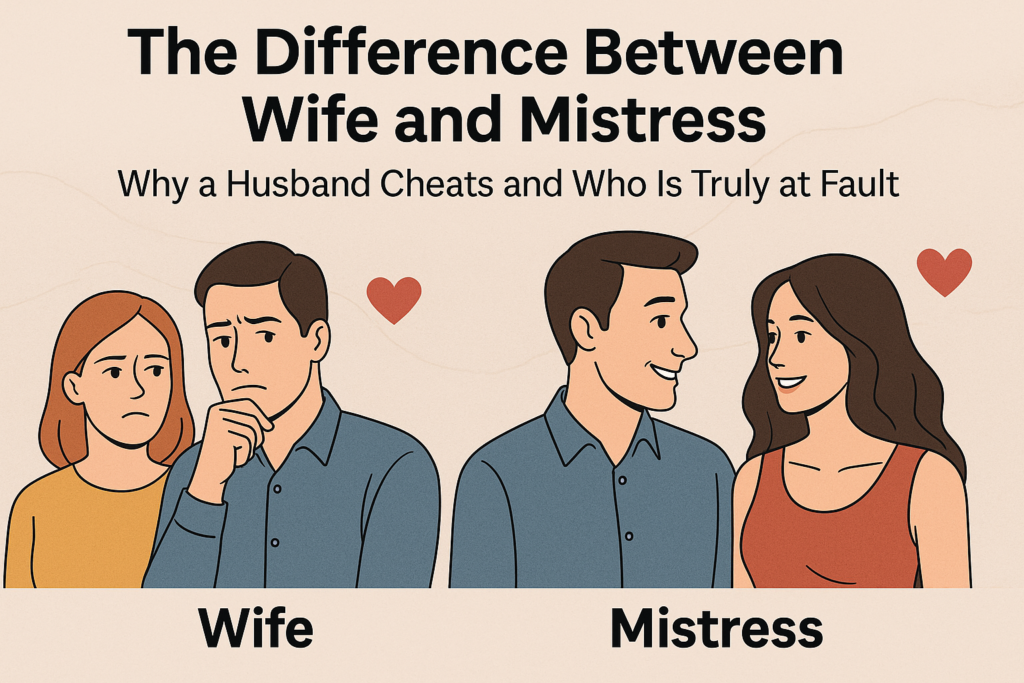
The Difference Between Wife and Mistress: Why a Husband Cheats and Who Is Truly at Fault. Why does a husband cheat even in a seemingly happy marriage? This article explores the difference between wife and mistress, the real causes of infidelity, moral implications, and situations when the husband, the wife, or both are at fault.
Wife and Mistress
Infidelity remains one of the most sensitive and controversial subjects in relationships. It can appear even where love, stability, and family life seem unshakable. Many men with a beautiful wife, children, and what looks like a happy home end up leading a double life with a mistress.
This raises complex questions:
- What is the real difference between wife and mistress?
- Why does a “happy” husband look elsewhere?
- What is the moral explanation behind such behavior?
- Who is at fault: the husband, the wife, or both?
In this article, we will carefully examine these aspects to better understand the psychological, emotional, and moral dimensions behind infidelity.
The Role of the Wife in Marriage
A wife is not simply “the official partner.” She embodies:
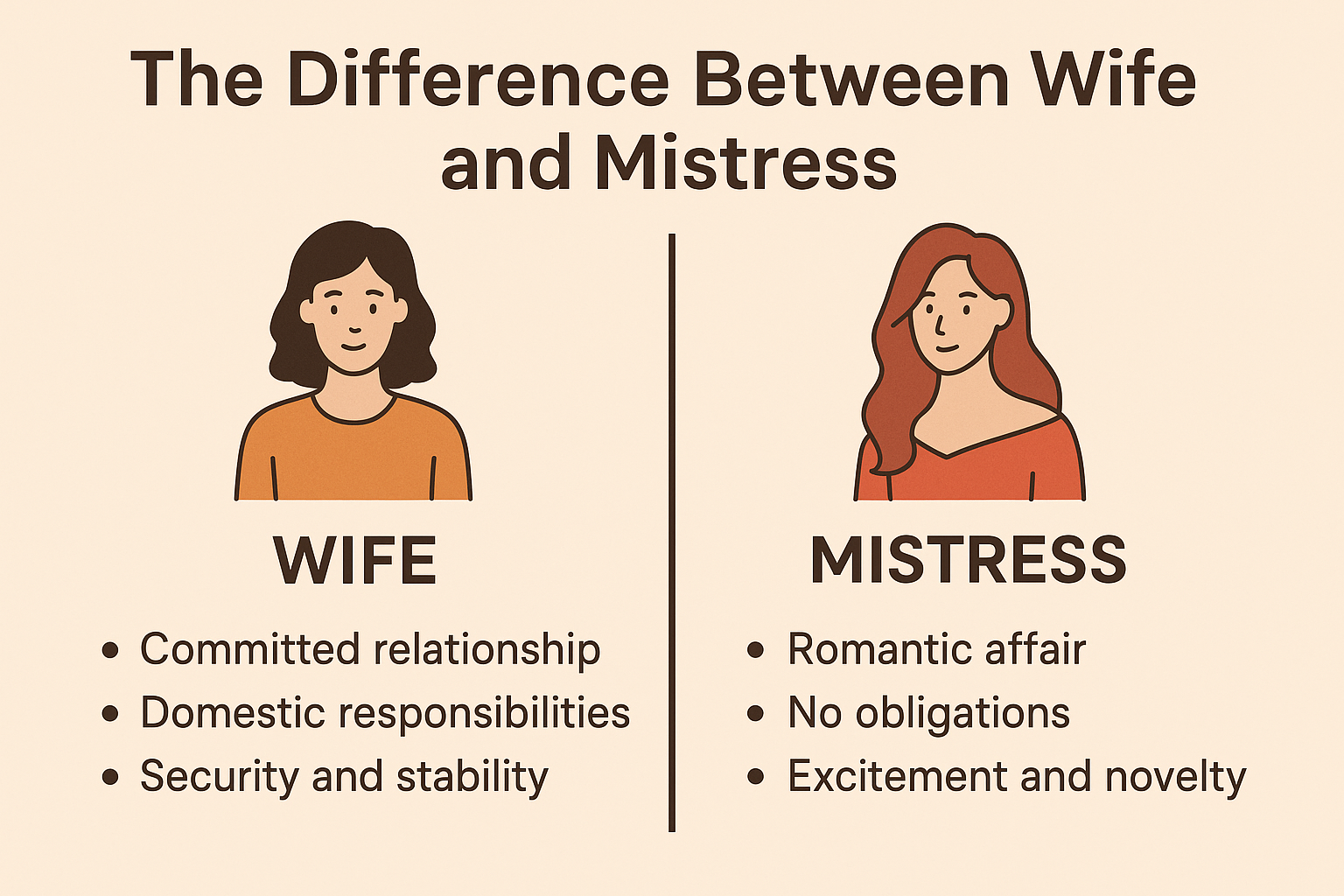
- Stability – sharing responsibilities, managing the household, long-term planning.
- Support – standing by her husband in difficult times.
- Motherhood – the center of family life, caring for the children.
- Social recognition – marriage makes the relationship legitimate and respected.
When the Wife’s Role Weakens
- Daily routines overshadow intimacy.
- Fatigue and stress drain emotional availability.
- Communication breaks down, replaced by sarcasm or silence.
- Romance fades as responsibilities grow.
While at the beginning of a marriage passion and discovery are strong, with time the relationship may become more about logistics than about love.
The Mistress and the Temptation of Novelty
The mistress is not merely “the other woman.” For the husband, she symbolizes:
- Novelty – a fresh sense of discovery.
- Escape – freedom from obligations and responsibilities.
- Validation – attention and admiration that boost his ego.
- Passion – an intensity often absent in routine marriage life.
Unlike the wife, the mistress doesn’t carry the weight of bills, children, or daily struggles. She becomes a symbol of freedom and excitement.
The Core Difference Between Wife and Mistress
The difference does not lie in their intrinsic value as women, but in the roles the man projects onto them:
- Wife = security, responsibility, long-term partnership.
- Mistress = passion, freedom, idealization.
The mistress is not inherently “better” than the wife, but the man perceives her as a refreshing alternative in contrast to routine.
Why a Husband Cheats
1. Routine and Boredom
Monotony makes him crave novelty and adventure.
2. Unmet Emotional Needs
When the wife no longer offers affection, admiration, or attention, he seeks them elsewhere.
3. Physical Desire and Ego
External validation reassures him that he is still attractive.
4. Midlife Crisis
Men in their 40s or 50s may try to relive their youth.
5. Poor Communication
Unresolved issues and emotional distance create fertile ground for infidelity.
When Infidelity Turns Into Emotional Attachment
Some affairs are not just physical. Emotional affairs often include:
- Sharing secrets and dreams.
- Becoming each other’s confidants.
- Building a “second life” together.
This type of extramarital relationship is far more dangerous because the man divides not only his body but also his heart between two women.
The Moral Explanation
From a moral standpoint, infidelity is a betrayal of vows and principles of respect. However, accountability must be examined on multiple levels:
The Husband’s Responsibility
- He chooses to break his promises.
- He avoids dialogue and opts for secrecy.
The Wife’s Responsibility
- In some cases, she may neglect emotional and physical intimacy.
- However, this does not justify his cheating it only explains the background.
Shared Responsibility
- Both partners fail when communication, intimacy, and respect fade.
- A marriage requires effort from both sides, not just one.
Wife Is at Fault
- Rejecting emotional and physical closeness for long periods.
- Treating the husband solely as a financial provider.
- Ignoring obvious signs of his dissatisfaction.
Husband Is at Fault
- Choosing deception instead of dialogue.
- Putting short-term pleasure above family responsibility.
- Justifying betrayal as a “solution” to marital issues.
When Both Are at Fault
- Letting passion die without fighting for it.
- Living as roommates instead of partners.
- Forgetting that love must be nurtured, not assumed.
Preventing Infidelity
- Constant Communication – talk openly about needs and frustrations.
- Romance Renewal – surprises, vacations, date nights.
- Couples Therapy – seek help before things break.
- Respect and Appreciation – the foundation of long-lasting love.
- Taking Responsibility – both must admit mistakes and work on them.
Infidelity as a Symptom, Not a Solution
Cheating does not solve marital problems; it only exposes them. It highlights unspoken frustrations and unmet needs, but it makes rebuilding trust harder.
Lessons for Couples
- Husbands must learn that cheating is not an escape but an avoidance of real solutions.
- Wives must understand that men need affection, admiration, and attention just as much as stability.
- Both must choose each other every day, not only at the wedding.

FAQ – Frequently Asked Questions
1) Can you love two people at once?
You can feel attraction and attachment to two people, but true mature love requires coherence, responsibility, and honesty.
2) Do children notice infidelity?
Yes. Even if unspoken, they feel the tension. Silence often hurts more than the truth.
3) Can an affair save a marriage?
Rarely. It usually worsens the problems. At best, it reveals issues that must be addressed inside the marriage.
4) Is couples therapy necessary after infidelity?
Not mandatory, but highly recommended. It provides a safe space and professional guidance.
5) How long does it take to rebuild trust?
Anywhere between 6 months and 2 years, depending on transparency and consistency.
6) What if the husband refuses to end the affair?
The wife has every right to set firm boundaries, protect her dignity, and make independent decisions.
7) Is it always one person’s fault?
The decision to cheat is the cheater’s alone. Relationship dynamics may explain, but never justify, infidelity.
8) How do I know the relationship has healed?
Trust feels real again, intimacy returns, and future plans are shared without tension.
9) Should intimacy pause after betrayal?
For many couples, yes. Intimacy is rebuilt gradually, once emotional safety is restored.
10) How can I handle the craving for excitement without cheating?
Channel it into shared adventures: travel, projects, sports, or personal growth.
Conclusion
Infidelity is not an accident it is a choice. The difference between wife and mistress is not about who is better, but about how a man projects his unmet needs. The wife represents reality and stability, while the mistress represents fantasy and freedom.
A healthy marriage requires daily investment: communication, respect, passion, and shared growth. When these are missing, temptation arises. But choosing cheating is never the answer it is only an escape that deepens wounds.
If betrayal happens, healing is possible, but only with truth, effort, and visible repairs. Mature love is not about always feeling passion; it is about choosing each other again and again, every day.
🔔 For more tutorials like this, consider subscribing to our blog.
📩 Do you have questions or suggestions? Leave a comment or contact us!
🏷️ Tags: difference between wife and mistress, reasons for infidelity, morality in relationships, marriage and betrayal, extramarital affairs, why husbands cheat, psychology of cheating, communication in couples, rebuilding trust, couples therapy
📢 Hashtags: #infidelity, #wife, #mistress, #marriage, #relationships, #psychology, #morality, #love, #trust, #couplestherapy
Read also: Jada Pinkett Smith Infidelity, Ego, and Public Confession
