

⏲️ Estimated reading time: 10 min
Table of Contents
7 Most Important Rules for Money You Should Never Ignore. Mastering your finances starts with understanding a few timeless principles. The journey to financial freedom is not built on luck or a high salary it’s built on habits, discipline, and smart decisions practiced consistently over years.
See also: Top 10 Best Perfumes for Women
Most people move through life without ever being taught how money works. Schools rarely teach budgeting, investing, or debt management. Families often avoid financial conversations. Society pushes consumerism everywhere you look. And as a result, millions of people end up stressed, overwhelmed, and confused about how to manage their income effectively.
But the truth is simple:
Anyone absolutely anyone can build financial stability and wealth if they follow the right rules.
This long-form guide breaks down the 7 most important money rules that successful people live by. When applied consistently, these rules can completely transform your financial future, whether you are a student, an employee, an entrepreneur, or someone trying to start over.
Let’s dive deep into each rule and explore how you can apply it in your daily life.
💰 1. Spend Less Than You Earn The Golden Financial Law
If you ignore every other rule in this list, but follow only this one, you will still move toward financial success.
Spending less than you earn is the foundation of wealth-building.
It sounds simple, but most people struggle with it because:
- Costs rise as income rises
- Advertisements fuel impulsive buying
- Social pressure encourages lifestyle upgrades
- Many expenses are emotional, not rational
Why This Rule Matters More Than Anything Else
You cannot save, invest, or build wealth if you constantly outspend your income.
You can make €2,000 or €20,000 per month it makes no difference if you’re always spending more than you bring in.
People often say: “I’ll save when I earn more.”
But when their income grows, their spending grows even faster.
This is known as lifestyle inflation.
The more you earn, the more you upgrade your lifestyle… but not your financial safety.
How to Apply This Rule in Real Life
✔ Track your income and expenses monthly
Use apps like Revolut, Mint, or YNAB, or simply create a Google Sheet.
✔ Set a realistic budget
Not a restrictive one, but a realistic budget that matches your life.
✔ Identify money leaks
Most people waste money unconsciously on:
- Food delivery
- Subscription services
- In-app purchases
- Daily coffees
- Impulse shopping
Small leaks sink big ships.
✔ Choose long-term comfort over short-term flashes
You don’t need the newest phone, the newest clothes, or the trendiest restaurants.
You need stability, safety, and control.
Why This Rule Works
When you consistently spend less than you earn, you create a gap a surplus.
That surplus becomes:
- Savings
- Investments
- Opportunities
- Freedom
And freedom, not luxury, is the real definition of wealth.
🏦 2. Always Pay Yourself First Your Future Comes Before Your Bills
This rule completely changes your financial behavior, because it flips the traditional mindset.
Most people do this:
- Receive salary
- Pay bills
- Buy things
- Save “whatever is left”
But that almost always means:
Nothing gets saved.
The Wealthy Do the Opposite
They pay themselves first.
They treat savings like a bill a mandatory monthly payment.
Before you pay rent, utilities, or entertainment… you deposit money into your future.
How Much Should You Save?
Aim for 10% to 20% of your income, but even 5% is better than 0%.
If you earn €2,000 per month:
- 10% = €200 saved
- 20% = €400 saved
Over 10 years, that becomes:
- €24,000 to €48,000 saved
- Without counting interest or investments
- Without extra effort
Small amounts become big amounts because of consistency.
Ways to Apply “Pay Yourself First”
✔ Automate savings transfers every payday
Set your bank to transfer money automatically to your savings account.
✔ Build an emergency fund (3–6 months of expenses)
Life will always bring unexpected events:
- Car repairs
- Medical bills
- Job loss
- Broken appliances
An emergency fund protects you from falling into debt.
✔ Use high-yield savings or investment accounts
Don’t let your savings sit idle earning nothing.
Why This Rule Is a Game Changer
When you “pay yourself first,” you force your lifestyle to adjust to what remains.
You save effortlessly because the money is gone before you can spend it.
Your future becomes a priority, not an afterthought.
📈 3. Make Your Money Work for You The Power of Investing
You can’t work forever.
Your body has limits.
Your time has limits.
But your money does not.
Rich people understand one thing clearly:
Money that works → makes more money.
Money that sleeps → loses value.
Savings alone will not make you wealthy. Inflation slowly eats your money if it stays in a standard bank account.
What Does “Money Working” Mean?
It means investing so your money grows while you sleep.
Examples:
- Your €1,000 becomes €1,200
- Your €10,000 becomes €13,000
- Your €100,000 becomes €140,000
Investing multiplies wealth through compound interest the eighth wonder of the world, according to Einstein.
Smart Ways to Invest (Even with Small Amounts)
✔ Index funds and ETFs
Low-risk, diversified investments perfect for beginners.
✔ Dividend-paying stocks
Provide passive income every month or quarter.
✔ Real estate
Renting or buying property for value appreciation.
✔ Retirement accounts
Long-term protection and tax advantages.
Why Most People Fear Investing
- They think they need a lot of money
- They fear losing everything
- They don’t understand how markets work
- They believe investing is “only for rich people”
These are myths.
You can start with €20 or €50 per month.
Why Investing Is Essential
If you save €200 per month for 20 years without investing, you get:
€48,000
But if you invest that money with 7% growth annually, you get:
€104,000
Nearly double without extra work.
This is why rule #3 is life-changing.
💳 4. Avoid Bad Debt Like the Plague It Destroys Wealth Faster Than Anything Else
Debt can be a financial tool, but it can also be a financial nightmare.
There are two types of debt:
Good Debt: Helps You Grow
Examples:
- A mortgage with low interest
- A student loan with reasonable rates
- A business loan that generates more income
- Real estate financing
Good debt creates long-term value.
Bad Debt: Destroys Your Wealth
Examples:
- Credit card debt
- Payday loans
- High-interest consumer loans
- Borrowing for vacations or shopping
- Buying things you cannot afford today
These debts trap you in a cycle of payments, interest, and stress.
Why Bad Debt Is So Dangerous
- Interest grows faster than you can pay
- It limits your opportunities
- It destroys financial stability
- It affects mental health
- It keeps you working harder without making progress
Bad debt steals your future.
How to Manage Debt Wisely
✔ Pay off high-interest debts first
Use the avalanche method (highest interest first) or snowball method (smallest debt first).
✔ Avoid borrowing for wants
If you need to borrow money to buy something, you probably shouldn’t buy it.
✔ Don’t carry balances on credit cards
Treat credit like cash if you can’t pay it immediately, don’t buy it.
✔ Build a debt-free mindset
Ask yourself: “Will this purchase bring me long-term value?”
If the answer is no, don’t get into debt for it.
📚 5. Educate Yourself About Money Knowledge Creates Wealth
Financial literacy is one of the most powerful tools you can develop.
Most financial mistakes happen because people simply don’t know better.
Why Money Education Matters
- It protects you from financial scams
- It helps you make better decisions
- It opens doors to opportunities
- It makes wealth-building easier
- It reduces fear and stress about money
People who understand money also understand freedom.
How to Educate Yourself Easily
✔ Read personal finance books
Some classics include:
- The Richest Man in Babylon
- Your Money or Your Life
- Rich Dad Poor Dad
- The Psychology of Money
✔ Watch educational videos
YouTube channels like Graham Stephan, Andrei Jikh, or Dave Ramsey break down money concepts clearly.
✔ Learn about taxes, investing, and saving
Basic knowledge that every adult needs.
✔ Take online courses
Many platforms offer free or cheap courses on budgeting, investing, and wealth creation.
Why This Rule Helps You Build Wealth
Money rewards the informed and punishes the ignorant.
The more you understand:
- How banks work
- How credit works
- How investments grow
- How taxes affect income
…the more control you gain over your financial life.
🧠 6. Delay Gratification Choose Long-Term Rewards Over Short-Term Temptations
This rule is the secret ingredient behind every wealthy and successful person.
The ability to say “not now” builds:
- Discipline
- Stability
- Control
- Long-term vision
What Is Delayed Gratification?
It means resisting the urge to buy something now so you can achieve something bigger in the future.
Examples:
- Skip the new phone → Save for real estate
- Avoid overeating → Improve health
- Don’t buy luxury items → Build investments
- Skip unnecessary subscriptions → Grow your savings
Every small sacrifice builds long-term comfort.
How to Practice Delayed Gratification
✔ Sleep on major purchases
Use the 24–48-hour rule.
If you don’t want it after two days, you never needed it.
✔ Visualize long-term goals
Picture your financial freedom:
Traveling, no debt, a paid home, money working for you.
✔ Create a rewards system
You can enjoy nice things but only after hitting savings/investment goals.
Why This Rule Works
Short-term satisfaction fades quickly.
Long-term success lasts forever.
Discipline may feel difficult at first, but rewards you for a lifetime.
📊 7. Have a Plan for Every Dollar Money Without Purpose Disappears
Every euro you earn should have a job.
When money has no assignment, it gets wasted.
Why Planning Your Money Matters
- It eliminates confusion
- It prevents overspending
- It gives you clarity and confidence
- It helps you reach your goals faster
People without a financial plan always wonder:
“Where did my money go?”
People with a plan always say:
“I know exactly where my money is working.”
How to Create a Strong Financial Plan
✔ Set clear financial goals
Short-term goals:
- Pay off debt
- Save for emergencies
Long-term goals:
- Retirement
- Real estate
- Travel
- Investments
✔ Use zero-based budgeting
Every euro is assigned a purpose saving, investing, bills, or fun.
✔ Review your finances quarterly
Your income and expenses change over time.
Adjust your plan accordingly.
✔ Use systems like envelope budgeting
Especially effective for avoiding unnecessary purchases.
Why This Rule Protects Your Future
When you plan your money, you take control of your destiny.
Nothing is left to chance or emotion.
Your financial life becomes organized, stable, and predictable.
💡 A New Beginning for Your Financial Life
Mastering money doesn’t require:
- A finance degree
- A high salary
- Luck or perfect timing
It requires discipline, intention, and clarity.
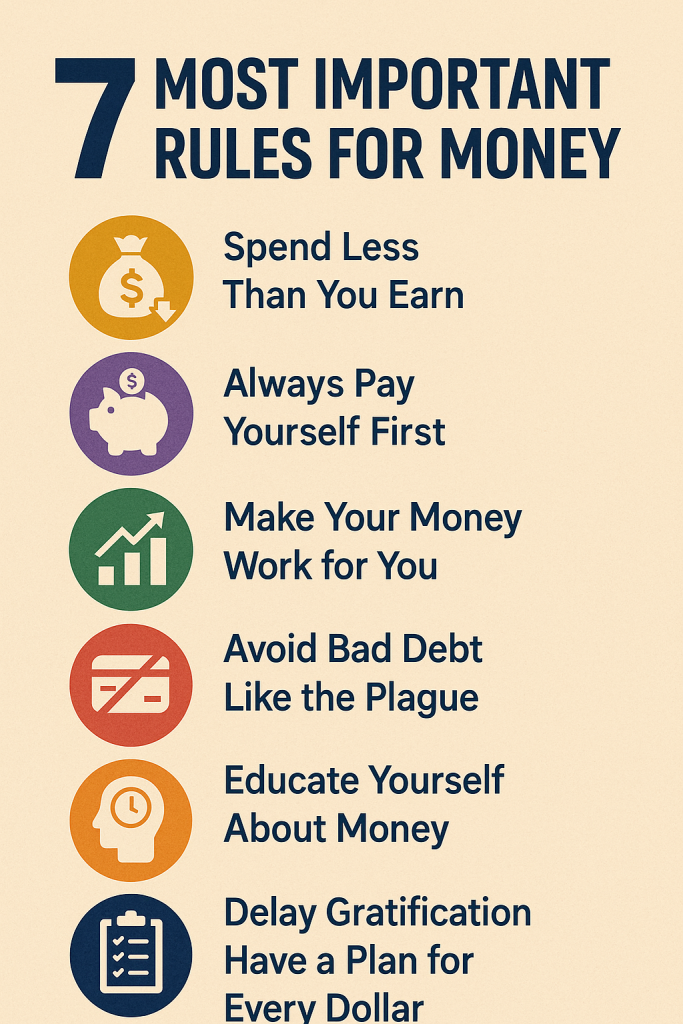
These 7 rules create the foundation for long-term stability and wealth:
- Spend less than you earn
- Pay yourself first
- Make your money work for you
- Avoid bad debt
- Educate yourself
- Delay gratification
- Plan every dollar
Apply them consistently, and your financial life will grow stronger every day.
🟦 Disclaimer
The information provided in this article is for educational and informational purposes only. It does not constitute financial, legal, or investment advice. Every person’s financial situation is unique, and results may vary based on individual choices and circumstances.
Before making any financial decisions, budgeting changes, investments, or debt management strategies, you should consider consulting a licensed financial advisor, accountant, or certified professional who can offer personalized guidance.
The author and publisher are not responsible for any losses, risks, or outcomes resulting from the application of the ideas discussed in this content.
🔔 For more tutorials like this, consider subscribing to our blog.
📩 Do you have questions or suggestions? Leave a comment or contact us!
🏷️ Tags: personal finance, budgeting, saving money, investing, debt management, financial planning, money habits, financial literacy, smart money, passive income
📢 Hashtags: #MoneyRules, #FinancialFreedom, #SaveSmart, #InvestWisely, #MoneyMindset, #BudgetTips, #DebtFreeJourney, #MoneyGoals, #FinancialEducation, #WealthBuilding
