


⏲️ Estimated reading time: 8 min
Table of Contents
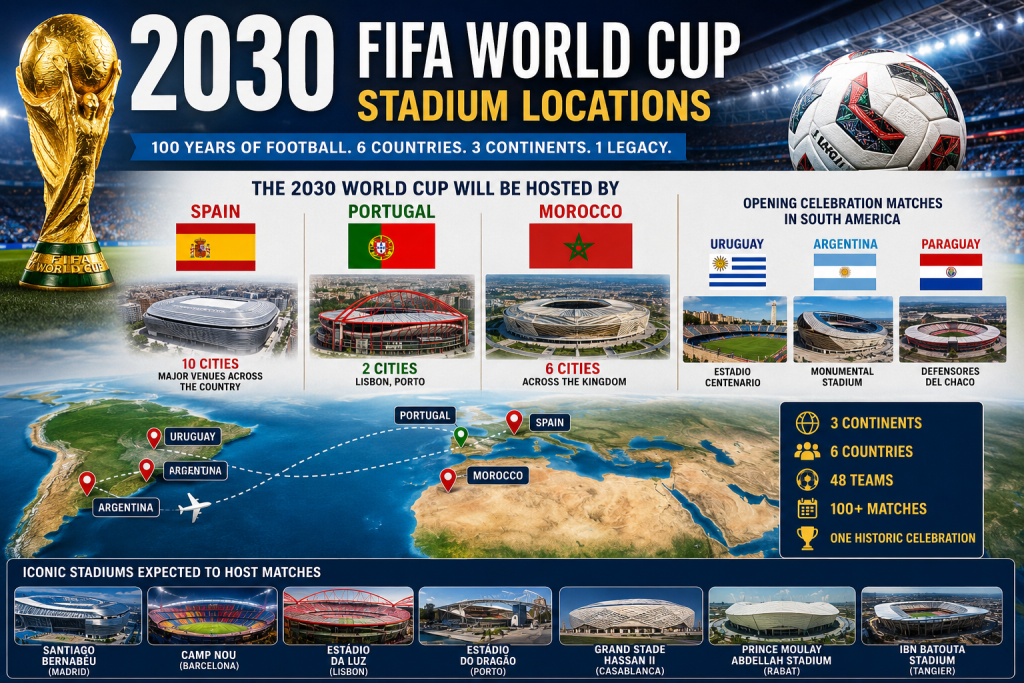
The 2030 FIFA World Cup will make history by spanning three continents and six countries. Discover every confirmed host nation, proposed stadium, tournament format, and everything fans need to know about the historic centenary edition of the FIFA World Cup.
2030 World Cup Stadium Locations: Everything You Need to Know
The 2030 FIFA World Cup will be unlike any previous tournament in football history. Instead of being hosted by a single nation or neighboring countries, the competition will celebrate the 100th anniversary of the FIFA World Cup by taking place across three continents.
Fans from around the world are already searching for information about the 2030 World Cup stadium locations, wondering where matches will be played, which countries will host the tournament, and how FIFA plans to organize such a unique global event.
This guide covers every important detail, including confirmed host countries, proposed stadiums, tournament structure, qualification process, travel tips, and what supporters can expect from one of the biggest sporting events ever organized.
Why the 2030 FIFA World Cup Is Historic
The first FIFA World Cup took place in 1930 in Uruguay. Exactly one hundred years later, FIFA decided to celebrate the tournament’s centenary by returning to its roots while also creating a truly global competition.
The tournament will feature:
- Three continents
- Six participating host nations
- Multiple time zones
- Modern stadiums
- Millions of international visitors
- 48 national teams
No previous World Cup has been organized on this scale.
Where Is the 2030 World Cup Being Held?
The official host nations are:
- Spain
- Portugal
- Morocco
In addition, FIFA approved three opening celebration matches that will take place in:
- Uruguay
- Argentina
- Paraguay
These three South American matches honor the very first World Cup held in Uruguay in 1930.
After those matches, the remainder of the tournament will continue in Europe and Africa.
2030 World Cup Host Countries
Spain
Spain will host the largest number of matches.
The country already has extensive experience organizing major football events, including the 1982 FIFA World Cup. Spanish stadiums are among Europe’s best, featuring modern facilities, excellent transportation, and world-famous clubs.
Expected Spanish host cities include:
- Madrid
- Barcelona
- Seville
- Bilbao
- Zaragoza
- Málaga
- Valencia
- A Coruña
- Las Palmas
- San Sebastián
Spain is expected to stage several knockout matches and possibly the final.
Portugal
Portugal previously co-hosted UEFA Euro 2004 and offers several outstanding football venues.
Expected host cities include:
- Lisbon
- Porto
Portugal’s compact geography makes travel easy for supporters.
Morocco
Morocco becomes one of the first African countries to host World Cup matches on such a large scale. The nation has invested billions in infrastructure, stadium development, airports, rail transportation, and tourism.
Potential host cities include:
- Casablanca
- Rabat
- Tangier
- Marrakech
- Agadir
- Fez
Morocco is expected to showcase African football on the global stage.
Uruguay
- Uruguay will host one celebratory opening match.
- As the home of the first FIFA World Cup in 1930, Uruguay holds special historical importance.
- The iconic Estadio Centenario will once again welcome World Cup football.
Argentina
Argentina will also stage one opening celebration match. The country remains one of football’s greatest nations, producing legendary players and passionate supporters.
Paraguay
Paraguay completes the South American centenary celebration with one opening fixture.
This allows FIFA to recognize all founding regions connected to the first World Cup.
Confirmed and Proposed 2030 World Cup Stadium Locations
Spain Stadiums
The following stadiums are expected to host matches.
| Stadium | City | Capacity |
|---|---|---|
| Santiago Bernabéu | Madrid | 80,000+ |
| Camp Nou | Barcelona | 100,000+ (after renovation) |
| Metropolitano | Madrid | 70,000+ |
| San Mamés | Bilbao | 53,000 |
| La Cartuja | Seville | 70,000+ |
| RCDE Stadium | Barcelona | 40,000+ |
| La Rosaleda | Málaga | Planned expansion |
| Riazor | A Coruña | Upgraded |
| Romareda | Zaragoza | New redevelopment |
| Gran Canaria Stadium | Las Palmas | Modernization planned |
Portugal Stadiums
Portugal is expected to use:
| Stadium | City |
|---|---|
| Estádio da Luz | Lisbon |
| Estádio José Alvalade | Lisbon |
| Estádio do Dragão | Porto |
Morocco Stadiums
Proposed stadiums include:
| Stadium | City |
|---|---|
| Grand Stade Hassan II | Casablanca |
| Prince Moulay Abdellah Stadium | Rabat |
| Ibn Batouta Stadium | Tangier |
| Marrakech Stadium | Marrakech |
| Agadir Stadium | Agadir |
| Fez Stadium | Fez |
Several venues are receiving significant renovations ahead of the tournament.
South America Celebration Stadiums
Expected venues include:
| Country | Stadium |
|---|---|
| Uruguay | Estadio Centenario |
| Argentina | Monumental Stadium |
| Paraguay | Defensores del Chaco |
Which Stadium Could Host the Final?
Although FIFA has not officially confirmed the final venue, leading candidates include:
- Santiago Bernabéu (Madrid)
- Camp Nou (Barcelona)
- Grand Stade Hassan II (Casablanca, if completed as planned)
The final decision will be announced closer to the tournament.
Tournament Format
The 2030 FIFA World Cup will continue using the expanded format introduced in 2026.
This means:
- 48 national teams
- 12 groups
- More knockout matches
- More participating nations
- More total games
The tournament is expected to include over 100 matches.
Why FIFA Chose Multiple Continents
Several reasons influenced FIFA’s decision.
Celebrating 100 Years
The tournament commemorates the centenary of the first World Cup.
Growing Global Football
Hosting across continents expands football’s popularity.
Tourism
Millions of visitors are expected to travel between Europe and Africa.
Economic Development
Host nations will benefit from:
- Infrastructure investment
- Hotel growth
- Airport improvements
- New transportation projects
- Increased tourism revenue
Travel Between Host Countries
Travel will be easier than many people expect. Spain, Portugal, and Morocco are geographically close.
Supporters can use:
- High-speed trains
- Ferries
- Short international flights
Travel between Spain and Morocco takes only a short time across the Strait of Gibraltar.
Stadium Technology
Many stadiums will feature:
- Retractable roofs
- Advanced cooling systems
- Hybrid grass pitches
- Smart ticketing
- Facial recognition entry
- Cashless payments
- High-speed Wi-Fi
- Sustainable energy systems
Sustainability Goals
FIFA aims to reduce the tournament’s environmental impact through:
- Renewable energy
- Public transportation
- Stadium modernization instead of new construction
- Reduced emissions
- Green infrastructure
Economic Impact
Experts expect the tournament to generate billions in economic activity through:
- Tourism
- Hospitality
- Retail
- Broadcasting
- Sponsorships
- Employment
Hotels, restaurants, airlines, and local businesses are likely to benefit significantly.
Fan Experience
Supporters can expect:
- Fan festivals
- Cultural events
- Music performances
- Interactive football exhibitions
- Museum displays celebrating 100 years of World Cup history
Qualification
National teams from every FIFA confederation will compete for qualification.
Expanded qualification means more countries than ever will have the opportunity to participate.
Previous World Cup Hosts
Recent tournaments include:
| Year | Host |
|---|---|
| 2018 | Russia |
| 2022 | Qatar |
| 2026 | United States, Canada, Mexico |
| 2030 | Spain, Portugal, Morocco, with opening matches in Uruguay, Argentina, and Paraguay |
Looking Beyond 2030
After the centenary edition, FIFA is expected to return to more traditional hosting formats.
Future tournaments will continue evolving as football grows worldwide.
Frequently Asked Questions
Where is the 2030 World Cup?
The main tournament will be hosted by Spain, Portugal, and Morocco, with opening celebration matches in Uruguay, Argentina, and Paraguay.
Which countries are hosting the 2030 FIFA World Cup?
Spain, Portugal, Morocco, Uruguay, Argentina, and Paraguay.
Why are six countries hosting?
The tournament celebrates the 100th anniversary of the FIFA World Cup.
How many teams will compete?
Forty-eight national teams.
Will Morocco host World Cup matches?
Yes. Morocco is one of the three primary host nations.
Where will the World Cup final be played?
FIFA has not yet officially announced the final stadium.
What is the largest proposed stadium?
The renovated Camp Nou and the planned Grand Stade Hassan II are among the largest proposed venues.
How often is the FIFA World Cup held?
Every four years.
When is the Women’s World Cup?
The next FIFA Women’s World Cup will be held in 2027 in Brazil.
Is this the first World Cup on three continents?
Yes. The 2030 edition will be the first FIFA World Cup held across three continents.
2030 FIFA World Cup
The 2030 FIFA World Cup promises to become one of the most memorable sporting events in history. With matches spread across Europe, Africa, and South America, fans will witness a celebration that honors football’s past while embracing its global future.

Whether you plan to attend in person or watch from home, the 2030 tournament is set to deliver unforgettable stadiums, passionate supporters, world-class football, and a once-in-a-century celebration of the beautiful game.
⚠️ Disclaimer and Source Hygiene
This article is provided for informational purposes only. Stadium selections, host cities, and scheduling may change as FIFA finalizes preparations. Always refer to official FIFA announcements for the latest confirmed information. This content is based on research from authoritative football and tournament planning sources.
🔔 For more tutorials like this, consider subscribing to our blog.
📩 Do you have questions or suggestions? Leave a comment or contact us!
🏷️ Tags: 2030 World Cup stadium locations, World Cup 2030, 2030 FIFA World Cup, FIFA 2030, Spain World Cup, Portugal World Cup, Morocco World Cup, World Cup host countries, football stadiums, FIFA World Cup travel
📢 Hashtags: WorldCup2030 #FIFA2030 #2030WorldCup #Football #Soccer #Spain #Portugal #Morocco #WorldCupStadiums #FIFA
Sources and References
- FIFA official announcements regarding the 2030 FIFA World Cup hosts and tournament structure.
- Official bid documents from Spain, Portugal, and Morocco.
- National football federation publications.
- Stadium redevelopment plans released by host countries.
- FIFA tournament regulations and competition format documentation.
Secondary Sources and Testimonials
Read also: Thailand Deep South Attack: What Happened at the Bukeh Sami
- Analyses from international sports journalists and football experts.
- Infrastructure reports published by host nation organizing committees.
- Travel and tourism studies related to major international sporting events.
- Historical archives documenting the inaugural 1930 FIFA World Cup in Uruguay.
