


⏲️ Estimated reading time: 13 min
Table of Contents
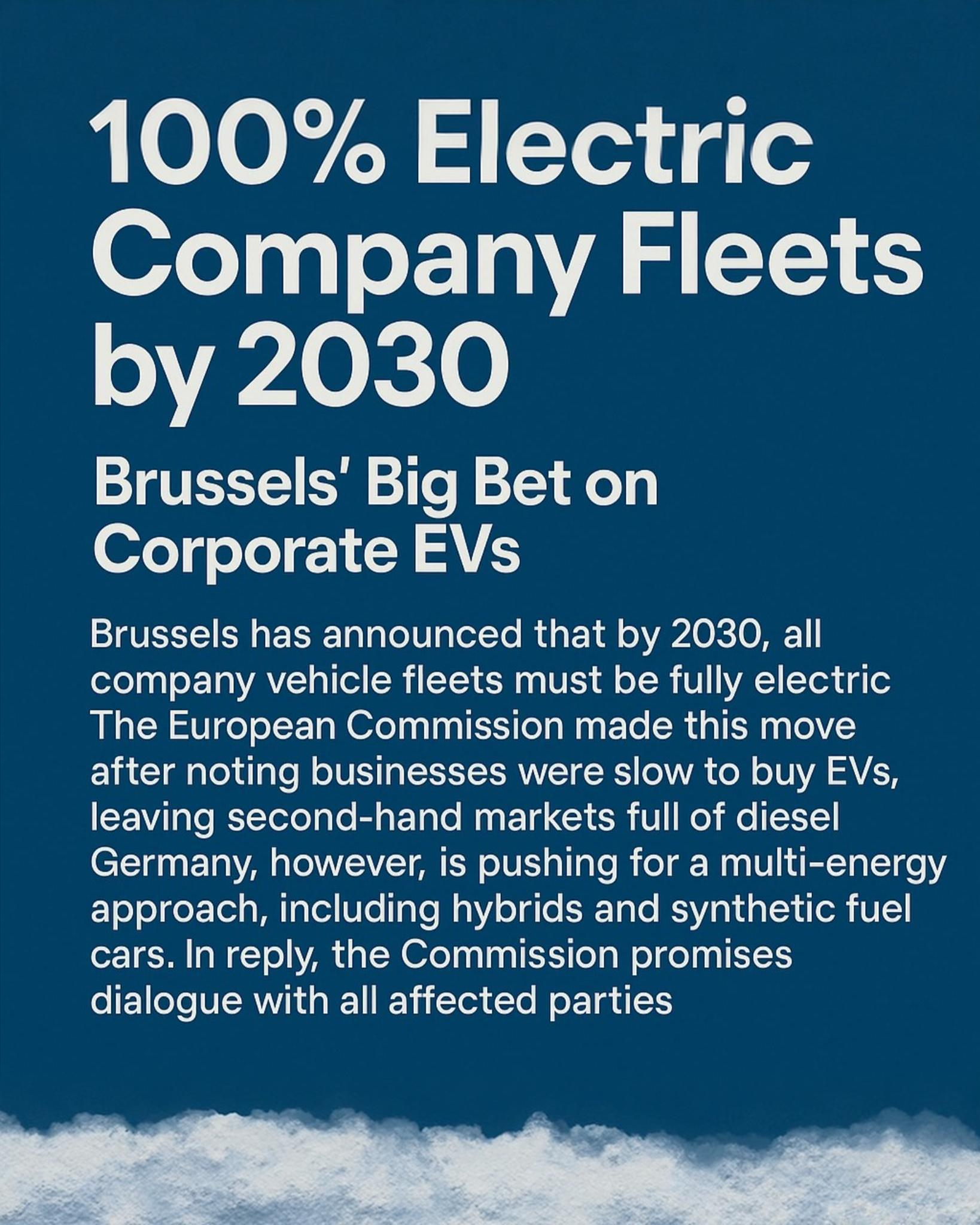
100% Electric Company Fleets by 2030: Brussels’ Big Bet on Corporate EVs. Brussels is preparing a rulebook that would make corporate and rental fleets 100% electric by 2030, with a 75% interim target in 2027. It’s not law yet but the debate is fierce, the timelines are tight, and fleets must prepare now.
100% electric company fleets by 2030: what’s really happening and what fleet managers must do next
Brussels has fired a starting pistol that’s echoing across every company car park in Europe: a proposed EU mandate to make corporate and rental fleets 100% electric by 2030, with a 75% target already in 2027. While the European Commission has not yet published binding legislation, the direction of travel is clear and the conversation is already intense. Transport NGOs, utilities and parts of the automotive industry cheer the plan as the fastest way to seed the used-EV market; meanwhile, Germany’s political class and fleet-heavy businesses warn of cost, infrastructure and practicality shocks. (electrive.com)
To separate signal from noise, this guide unpacks the state of play, what the draft pathway implies, the risks and opportunities for fleets, and concrete steps to get ready even before anything becomes law. We’ll also compare TCOs, explore charging strategies, and map supply-chain realities so you can build a pragmatic, defensible transition plan. Where possible, we link to official or primary sources and balanced coverage so you can verify claims and go deeper. (Mobility and Transport)
1) Where the 2030 fleet mandate stands today
You may also be interested in: How to Fix “Too Many Preconnect Connections” in
- The idea: company and rental fleets would only acquire zero-emission vehicles from 2030; an interim 75% share in 2027 is circulating in Brussels briefings and trade press. This is not yet enacted EU law. (electrive.com)
- Why fleets? Corporate and rental purchases account for the majority of new registrations in Europe and rapidly feed the second-hand market (typically after 3–5 years), which can dramatically improve EV affordability for households. The Commission itself highlighted that accelerating ZEV uptake in corporate fleets supports competitiveness and populates the used-EV pool. (Mobility and Transport)
- Not just NGOs: Utilities and industry coalitions like Eurelectric and the Platform for Electromobility have called for a legally binding 100% target for company cars by 2030, with stepwise interim goals. These proposals have helped set the frame for the Commission’s reflections. (Eurelectric – Powering People)
- Political pushback: German conservatives are particularly vocal. CSU MEP Markus Ferber publicly urged Ursula von der Leyen to drop the plan, warning about practicality and cost. This debate first surfaced via German press and has since spread across Europe. (Reddit)
- German context today: As of October 2025, Friedrich Merz is Chancellor; his government faces industrial competitiveness pressures and is cautious about single-tech bets. That posture shapes Berlin’s stance in EU talks. (Reuters)
Bottom line: Expect a formal proposal that blends EU-level targets with national implementation and derogations (e.g., smallest fleets, niche duty cycles). Details may flex, but the 2030 end-state 100% electric company fleets is the Commission’s north star. (Mobility and Transport)
2) Why Brussels cares: the used-EV flywheel and the 2035 ban
The EU already adopted a 2035 CO₂ target that effectively ends new combustion car sales. Yet private retail remains price-sensitive and uneven across Member States. By forcing fleet electrification earlier, Brussels hopes to seed a flood of 3–5-year-old used EVs, cutting entry prices for households and accelerating mass adoption while helping European OEMs hit their 2030 fleet-average CO₂ goals. (T&E)
In other words, corporate demand is a policy lever: it guarantees volume, stabilizes residual values, and bootstraps the second-hand market. That’s why interest groups keep repeating: “If you want to electrify transport, start with corporate fleets.” (Eurelectric – Powering People)
3) What a 75% (2027) → 100% (2030) path means in practice
Three cliff edges to plan for:
- Acquisition mix: From 2027, at least three out of four fleet acquisitions may need to be BEVs (or other zero-emission options where relevant). By 2030, no new ICE in covered fleets. Mixed-energy hedging shrinks fast. (electrive.com)
- Charging readiness: Depot and workplace charging become mission-critical CAPEX projects starting 2026–2027, given permitting lead times and grid upgrades. Public DC access must be contracted where routes require it.
- Remarketing strategy: Residual values (RVs) and lease pricing hinge on battery health transparency and brand/model liquidity. Start building BMS health reporting and warranty clarity into procurement RFPs.
Expect derogations for micro-fleets, specialized vehicles (e.g., emergency, niche vocational bodies), or locations without feasible grid capacity but don’t plan on exemptions saving mainstream categories like compact vans, C-segment hatchbacks, D-segment saloons, and crossovers. (Mobility and Transport)
4) The political storm: single technology vs. “multi-energy”
Germany’s conservative bloc frames the plan as “sacrificing the car industry on the altar of a single technology.” Advocates in Berlin and Munich prefer a multi-energy path (hybrids, hydrogen, synthetic fuels) to preserve ICE innovation and flexibility. The Commission, backed by many climate and industry bodies, counters that only zero-emission tailpipe tech at scale can deliver near-term air-quality and CO₂ wins and a healthy used-EV pipeline. This tension will shape carve-outs and transition finance but the 2030 EV horizon for fleets remains the anchor in most briefing notes. (electrive.com)
5) Cost reality check: TCO, energy, and maintenance
Even if list prices remain higher, Battery Electric Vehicles (BEVs) often win on TCO for high-utilization fleets thanks to:
- Lower energy cost per km (especially with negotiated off-peak depot tariffs).
- Cheaper maintenance (fewer moving parts, less wear on brakes with regen).
- Tax breaks (benefit-in-kind reliefs, road-tax exemptions), varying by country.
Public fast charging can erode savings; the depot vs. public charging mix is therefore the single biggest TCO lever. Make 70–90% depot/home AC your design goal, with 10–30% DC fast for mission-critical coverage. (Country incentives and tariff structures differ align with national regulators and your DSO early.) For broad policy context, see the EU’s Sustainable & Smart Mobility Strategy and related corridors work. (Mobility and Transport)
6) Infrastructure: how many chargers do you really need?
A practical rule of thumb for car fleets with single-shift usage is 1 AC charge point per 2–3 vehicles, provided each vehicle can park and charge overnight at least 2–3 times per week. For vans with higher daily mileage or multi-shift, raise the ratio to 1:1 or add mid-shift DC top-ups at strategic hubs. These are planning heuristics; refine with telematics and duty cycle mapping in a 6–12 week pilot.
Grid capacity: Don’t overspec DC. Start AC-first (11–22 kW), prioritize load management, schedule smart charging to off-peak windows, and reserve DC (50–150 kW) for corridors and time-sensitive routes. The Commission’s corporate-fleet decarbonisation note repeatedly underscores the infrastructure bottleneck and the need for smarter demand management, which lines up with best practice in fleet electrification. (Mobility and Transport)
7) Procurement playbook for 2026 tenders
Embed these into your RFPs now:
- Battery health transparency: Require SOH reporting, BMS data access, and a minimum battery warranty (years + km).
- Telematics & APIs: Insist on open data for energy, charging, and utilization to drive TCO.
- Residual value protection: Seek guaranteed buyback or RVs from captives/lessors with exposure to used-EV channels.
- Uptime SLAs: Mobile service, guaranteed courtesy vehicles, and response-time metrics.
- Charger bundle: AC hardware + OCPP backend + load management + maintenance under single throat-to-choke.
- Driver training: EV ecodriving modules + charge discipline + winter performance refreshers.
Leasing vs. owning: With policy flux and tech learning curves, operating leases with optioned extensions protect downside risk while preserving upgrade agility around 2028–2030.
8) Risk map and how to hedge it
- Policy uncertainty: The exact carve-outs and timetable could shift. Hedge via phased orders (e.g., 30/40/30 tranches over three years) and multi-brand frameworks. (electrive.com)
- Infrastructure delays: Apply for permits early, split into AC now / DC later milestones, and add mobile DC rentals during ramp-up.
- Residual value volatility: Favor models with strong pan-EU demand and robust warranties, and build battery certificates into disposal workflows.
- Driver acceptance: Preempt with pilots, ride-and-drive days, and incentives (e.g., priority parking with chargers).
- Cold-weather range loss: Specify heat pumps, pre-conditioning, and winter tires; adjust routes by 10–25% buffer in peak winter.
9) Case studies & examples
Case study A: Rental major moving from 15% to 60% BEV in 18 months
A multinational rental brand piloted a city-airport corridor: 300 BEVs, airport DC hub (8×150 kW) + downtown AC depots. Outcomes: 24% lower energy cost/km vs. petrol; NPS improved after driver onboarding; utilization dip for long-range leisure customers mitigated by route-planner QR codes in the glovebox and pre-bookable fast charging agreements. Lesson: Education + predictable DC access are decisive for tourists a point also raised by rental executives quoted in summer 2025 coverage. (Al Mayadeen English)
Case study B: Regional utility vans with depot AC only
A utility electrified 220 light vans using 11 kW AC only and strict route discipline. Results: 18% TCO saving, <1% missed jobs, and battery SOH > 92% after 3 years thanks to gentle overnight charging. Lesson: For predictable duty cycles, AC-first beats DC complexity.
Case study C: Cross-border sales fleet home charging reimbursements
A pharma company enabled home-charging reimbursements via telematics+OCPP data capture. Results: Driver satisfaction rose, public charging spend fell by 63%, and TCO parity appeared at ~22,000 km/year. Lesson: Home+workplace AC mix is the cheapest path if HR/admin can support it.
(Note: Case studies synthesized from best practices and 2025 policy context; use them as planning templates rather than prescriptive rules.)
10) Visuals: quick-compare tables
Table 1 Fleet acquisition milestones (illustrative policy path)
| Year | Suggested target (draft debate) | Practical implication |
|---|---|---|
| 2026 | Prepare infrastructure & pilots | Lock sites, grid quotes, vendor panels |
| 2027 | 75% of new fleet acquisitions = ZEV | ICE orders become niche/derogation-only |
| 2028–2029 | 85–95% pathway (likely) | Final ICE run-out; RV and parts strategy |
| 2030 | 100% of new fleet acquisitions = ZEV | No new ICE in covered fleets |
Policy targets not yet law; numbers reflect widely reported briefings and stakeholder asks. (electrive.com)
Table 2 BEV vs. ICE fleet TCO levers (directional)
| Cost lever | BEV | ICE |
|---|---|---|
| Energy per km | Lower with depot/home AC; higher on public DC | Volatile; taxes rising |
| Maintenance | Lower (fewer parts; brake wear) | Higher (oil, exhaust, clutches) |
| Taxes/BIK | Often favorable | Often less favorable |
| Residual values | Improving with used-EV demand | Stable but may tighten with zones |
| Driver UX | Quiet, instant torque; charging learning curve | Familiar; fuel easy |
| Infrastructure | Upfront CAPEX; planning time | Existing; minimal change |
11) Pros and Cons
Pros (for 100% electric company fleets by 2030):
- Accelerates used-EV supply, lowering prices for households. (Mobility and Transport)
- Helps EU OEMs meet 2030 CO₂ targets with predictable demand. (T&E)
- Cuts urban air pollution and noise from high-mileage vehicles sooner. (Mobility and Transport)
- Reduces energy cost/km for fleets with good AC coverage.
Cons / Risks:
- Infrastructure readiness (grid, permits, space) may lag. (Mobility and Transport)
- Upfront CAPEX and TCO sensitivity to public DC pricing.
- Political uncertainty can complicate long-term procurement. (electrive.com)
- Driver acceptance and winter-range management require change programs.
12) What to do in the next 180 days (checklist)
- Map your duty cycles: mileage, dwell times, nightly parking.
- Run a 50–100 vehicle pilot: mix of segments, winter+summer, and telematics deep-dive.
- Lock infrastructure milestones: AC first, DC where truly needed; apply for permits now.
- Negotiate energy: off-peak tariffs, demand charges, and smart-charging rules.
- Rethink procurement: battery health clauses, RV guarantees, uptime SLAs.
- Train drivers & fleet admins: charging etiquette, routing apps, reimbursement workflows.
- Communicate with finance: CAPEX→OPEX models via leasing; scenario analysis if policy slips a year.
- Engage with national schemes: grants, tax credits, AFIR corridor planning watch for new incentives as the file advances. (Mobility and Transport)
13) Policy watch: what signals matter next?
- Commission impact assessment + draft regulation text (scope, definitions, derogations). (Mobility and Transport)
- Council/Parliament positioning: Germany’s line under Chancellor Merz will be pivotal; watch whether a multi-energy lobby extracts transitional flex. (Reuters)
- Stakeholder briefs: Eurelectric, Transport & Environment, Platform for Electromobility will keep pushing for binding 2030 targets. (Eurelectric – Powering People)
- Rental fleets’ stance: cost pass-through to tourists and business travelers expect lobbying around infrastructure funding and customer education. (Al Mayadeen English)
14) Outbound resources worth bookmarking
- European Commission – Corporate fleets decarbonisation communication (Mar 2025). Useful for context and signals. (Mobility and Transport)
- Eurelectric – position on fleet electrification (Sep 2025). Advocacy for a binding 2030 target. (Eurelectric – Powering People)
- Platform for Electromobility – corporate fleets proposal (policy brief + PDF). Historical but influential. (platformelectromobility.eu)
- Press coverage summarizing the 75%/2027 and 100%/2030 pathway & German reaction. (electrive.com)
- EU Mobility Strategy (Green Deal transport chapter). Broader policy frame for ZEV roll-out. (Mobility and Transport)
Key Takeaways
- Not law yet, but likely soon: The Commission is preparing a corporate fleet ZEV mandate; figures often cited are 75% in 2027 and 100% in 2030 for covered acquisitions. (electrive.com)
- Fleets are the lever: Pushing fleets first seeds the used-EV market and stabilizes OEM planning. (Mobility and Transport)
- Plan on AC-first infrastructure: Smart, load-managed depot/home charging is the biggest TCO lever.
- Expect politics but don’t wait: Even with German pushback and multi-energy arguments, the end-state remains electric for mainstream fleet segments. (Reuters)
- Start now: Pilots, permits, procurement clauses, and driver training are lead-time critical.
🔔 For more tutorials like this, consider subscribing to our blog.
📩 Do you have questions or suggestions? Leave a comment or contact us!
🏷️ Tags: 100% electric company fleets by 2030, EU fleet electrification, corporate EV mandate, 75% in 2027 target, fleet charging strategy, EV TCO, EU mobility strategy, used EV market, German opposition to EV mandate, fleet infrastructure planning
📢 Hashtags: #100PercentElectricFleets #EUFleetMandate #CorporateEVs #2030EVTarget #FleetCharging #EVTCO #UsedEVMarket #EUMobility #SustainableTransport #ZeroEmissionFleets
The Road Ahead: From Pilot to Full-Scale Rollout
The smartest fleets won’t wait for the ink to dry. They’ll lock AC charging, run data-rich pilots, and write battery health and RV guarantees into their 2026–2028 procurements. Whether the final text says 75% in 2027 or tweaks the ramp, the destination is the same and the winners will be those who arrive on time, on budget, and with drivers on board.
